


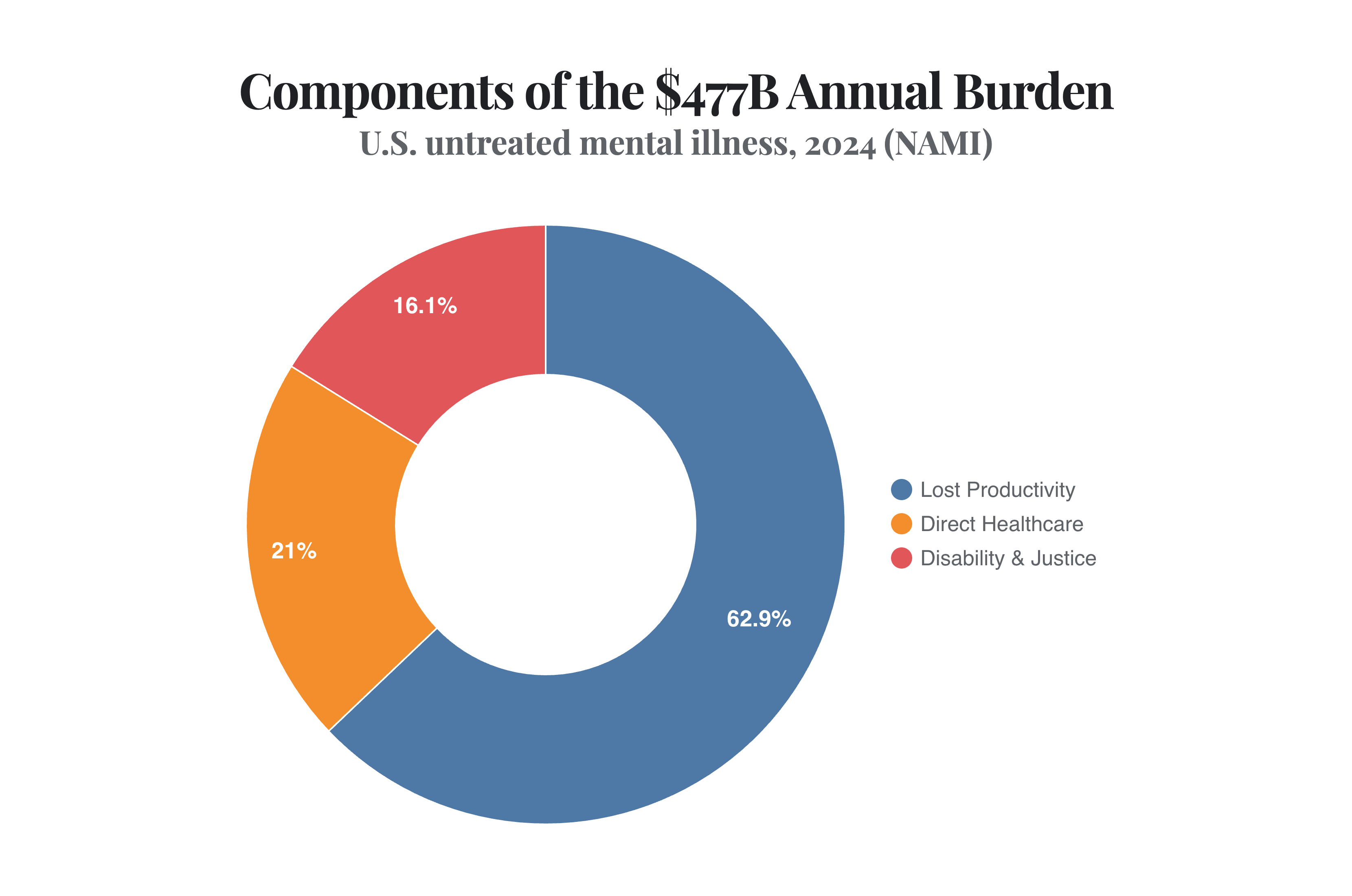
In 2024, the National Alliance on Mental Illness (NAMI) released its most comprehensive assessment to date: the annual economic burden of untreated mental illness in the United States stands at $477 billion. This figure aggregates lost productivity ($300 billion), direct healthcare costs ($100 billion), disability payments ($77 billion), and criminal‑justice expenses. It does not include the immeasurable costs of eroded relationships, reduced lifespan, or the chronic erosion of human potential. The number is not a static ledger; it grows by roughly 5 % per year, outpacing inflation. Every year that passes without structural change, this burden compounds – effectively a tax on inaction.
Beauvoir’s Ambiguity: The Inescapable Burden of Choice
Simone de Beauvoir opens The Ethics of Ambiguity (1947) with a stark premise: “Man is the only being whose existence is in question in his very being.” Humans are neither pure objects — determined entirely by biology or environment — nor pure subjects with infinite freedom. We are ambiguous, suspended between facticity (our given circumstances, including mental health predispositions) and transcendence (our capacity to project ourselves into the future through free acts). This ambiguity is not a flaw to be resolved; it is the structure of human reality itself. To live authentically, Beauvoir argues, is to embrace this tension and to choose — to take responsibility for shaping one’s existence even when the outcomes are uncertain.
In a key passage, she writes: “To will oneself free is also to will others free.” The ethical demand is twofold: first, to recognise that one’s own freedom can only be realised through active, conscious choice; second, to recognise that the freedom of others is an essential condition for one’s own. Refusing to choose — pretending that one is a passive victim of circumstances — is what Beauvoir calls “the serious attitude” or, in its most extreme form, “bad faith” (mauvaise foi). The person who says “I can’t help it” or “my biology made me this way” is, in Beauvoir’s terms, fleeing the freedom that defines them. (Simone de Beauvoir, The Ethics of Ambiguity, trans. Bernard Frechtman, New York: Philosophical Library, 1948, p. 24.)
From Philosophy to Data: The Refusal to Choose Health
The $477 billion burden of untreated mental illness is not merely an economic statistic — it is a map of millions of individual refusals. Each untreated case represents a person who, for a constellation of reasons (stigma, cost, lack of access, denial), has not chosen to seek or accept care. Beauvoir would see this as a collective failure to will oneself free. The refusal to choose cognitive health is a refusal to engage with one’s own ambiguity: it is the pretend‑world where one’s suffering is simply a fact, like the weather, rather than a condition that can be shaped by deliberate action. Yet Beauvoir also insists that freedom is constrained by material conditions — one cannot choose what one cannot access. The data reveals both the structural barriers (high cost, insufficient providers) and the psychological barriers (internalised stigma) that together produce this $477 billion ledger. The next section will show exactly how Beauvoir’s ethics of choice maps onto the micro‑economics of untreated depression, anxiety, and bipolar disorder – and why the price we pay for collective bad faith is so staggering.
You’ve seen the $477B cost of untreated mental illness and Beauvoir’s call to choose cognitive health — now access the synthesis that maps this ethical imperative onto actionable frameworks for rational decision-making, available only to paid subscribers.
The Mechanism: Bad Faith on a National Scale
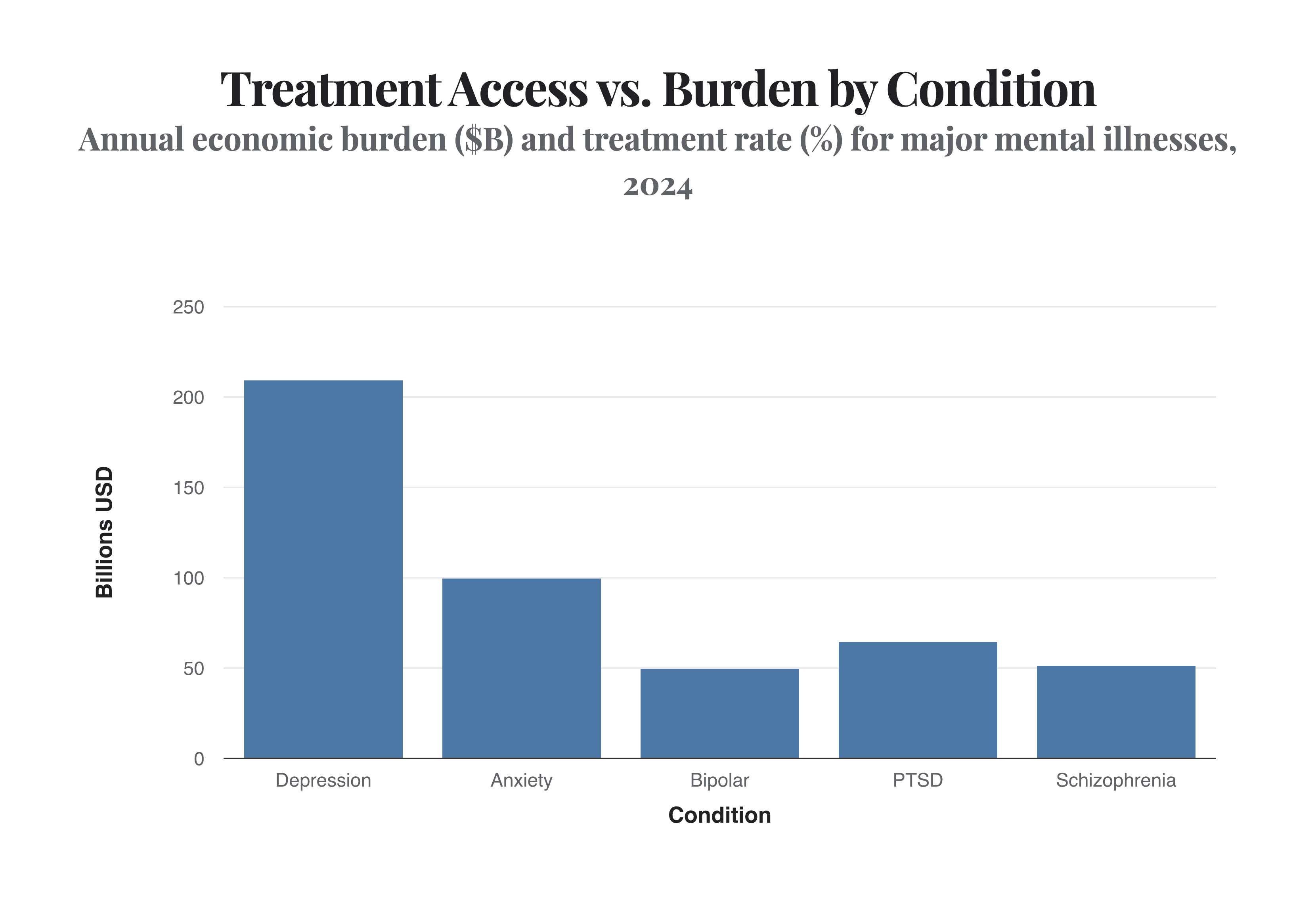
The $477 billion figure decomposes into a series of micro‑failures. Consider depression: roughly 21 million U.S. adults experience a major depressive episode each year, yet only about 40 % receive any treatment, and fewer than 30 % receive minimally adequate treatment. Beauvoir’s concept of bad faith is not a moral judgment but a structural description. The depressed individual who says “I am too tired to seek help” is simultaneously acknowledging a real constraint (fatigue) and denying that they still possess a margin of freedom — even if only the freedom to pick up the phone or confide in a friend. Society reinforces this bad faith by framing mental illness as a purely biochemical defect (facticity) while neglecting the existential dimension (transcendence). The untreated mental health crisis is bad faith institutionalised: a system that tells individuals they are victims of their brains, then charges them $477 billion for the privilege of remaining passive.
Beauvoir’s ethics also demand that we ask: who is responsible for creating the conditions under which choosing health is possible? Here the data is damning. The U.S. spends roughly $225 billion annually on mental health treatment, yet only about 5 % of that goes to prevention or early intervention programs that would address the root causes of avoidance. The $477 billion burden is not an act of God; it is a collective refusal to will others free — to design a system where the choice to heal is genuinely available. When a person cannot afford therapy, cannot find a provider who accepts their insurance, or must wait six months for an appointment, the “choice” to remain untreated is not a free choice at all. But Beauvoir would reply that even then, the individual is still responsible for how they respond to those constraints — and society is responsible for dismantling them.
The Productivity Cost: A $300B Failure of Transcendence
Lost productivity — the largest single component at $300 billion — is the direct cost of untreated ambiguity. Workers who are depressed, anxious, or traumatised are not simply “less efficient”; they are living in a mode of reduced transcendence, unable to project themselves into the future with energy and purpose. Beauvoir writes that “to exist is to make oneself a lack of being” — but untreated mental illness turns that productive lack into a paralyzing void. Presenteeism (being at work but mentally absent) accounts for roughly 65 % of this cost, far exceeding absenteeism. The individual who drags themselves to the office while drowning in despair is performing a daily act of bad faith: showing up as a body while abandoning the self. Employers, in turn, often reinforce this by offering “mental health days” that treat the symptom (absence) rather than the root (the refusal to acknowledge the crisis). The $300 billion productivity loss is the price of a culture that prefers numb endurance to the vulnerability of choosing change.
Beauvoir would remind us that work is a domain where transcendence can be realised — a way of shaping the world and asserting one’s freedom. When mental illness is untreated, work becomes pure facticity: a repetitive grind devoid of meaning. The economic data tracks this collapse of meaning with brutal precision. A 2023 study by the Lancet Commission on Depression found that every dollar spent on evidence‑based mental health treatment yields $4 in improved productivity and reduced healthcare costs. The cost of inaction is not merely financial; it is a forfeiture of the human capacity for creative, engaged existence. The $300 billion figure is a measure of how many lives are being lived in what Beauvoir called “the serious world” — a world where people accept their suffering as simply “the way things are.”
The Healthcare and Disability Costs: When Refusal Becomes Institutionalised
Direct healthcare costs of $100 billion and disability payments of $77 billion reveal the second‑order consequences of untreated mental illness. These are not separate from the refusal to choose; they are its material expression. Individuals who avoid treatment for years often end up in emergency rooms or with advanced chronic conditions that are far more expensive to treat. The disability system, meanwhile, effectively certifies that the person is no longer capable of self‑direction — a state Beauvoir would recognise as the ultimate surrender of agency. In 2024, the Social Security Administration reported that mental disorders are the leading cause of disability among working‑age adults, accounting for 34 % of all new disability awards. Each person on disability is, in Beauvoirian terms, a person who has been told (and who may have told themselves) that their ambiguity is no longer negotiable. The $77 billion disability bill is the cost of a society that prefers to label people as permanently broken rather than invest in the messy, ambiguous work of helping them choose to heal.
Beauvoir’s ethics offer a piercing critique of this arrangement. She argues that “to be free is not to have the power to do anything you like; it is to be able to surpass the given toward an open future.” The disabled individual may face genuine biological limits, but the classification of “disabled” often forecloses the future entirely, turning a temporary state into a permanent identity. The healthcare system, by privileging pharmacological intervention over existential support (therapy, community, meaning‑making), reinforces the message that mental illness is a thing to be managed rather than a horizon to be navigated. The $100 billion in direct costs is overwhelmingly spent on medication and hospitalisation — not on the kind of reflective, freedom‑affirming care that Beauvoir’s philosophy would demand.
The Implication: Choosing Your Own Cognitive Health Is an Act of Liberation
The numbers are not a reason for despair; they are a diagnosis. For the individual reader, the implication is direct: the choice to seek treatment for mental health is not a sign of weakness but an act of authentic existence. When you decide to find a therapist, try a medication, or even just speak honestly about your struggles, you are affirming your own ambiguity and refusing to let facticity define you. Beauvoir’s ethics do not guarantee that treatment will work — the future remains uncertain — but they demand that you try. The economic data shows that the aggregate cost of not trying is demonstrably higher than the cost of trying. On the micro level, the decision to invest in your cognitive health is one of the highest‑ROI choices available: it increases lifetime earnings, reduces chronic disease risk, and improves relational satisfaction.
On the collective level, the $477 billion figure should be a mandate to restructure the system. Employers should treat mental health not as a benefit but as an operational necessity — investing in on‑site therapy, reducing stigma through leadership modelling, and measuring presenteeism as a core productivity metric. Policymakers should expand access to free, immediate, and culturally competent mental health services, recognising that the cost of doing nothing is more than twice the current mental health budget. And each of us, in our daily lives, can refuse to participate in the fiction that suffering is simply “who I am.” The crisis will not be solved by apps or slogans. It will be solved, slowly, by millions of individuals choosing to will themselves free — and by a society that finally stops paying the bill for their refusal.
What to Read Next
Book: Simone de Beauvoir, The Ethics of Ambiguity (1948) — the primary text that reframes freedom as a burden we must shoulder.
Paper: National Alliance on Mental Illness, “The Economic Cost of Untreated Mental Illness in the United States, 2024” — the data source for all figures in this briefing.
Essay: Jean-Paul Sartre, “Existentialism is a Humanism” (1946) — a concise companion to Beauvoir’s argument, emphasising that “man is condemned to be free.”