


The War on Latency
In the high-stakes theater of modern cognitive warfare, the most dangerous variable is not misinformation, nor is it AI-generated noise. It is smoothness. We are currently living through the apex of the “Frictionless Era,” a period where the global economy has optimized every consumer interface to remove the nanoseconds of hesitation between desire and action. This is not accidental design; it is weapons-grade behavioral engineering.
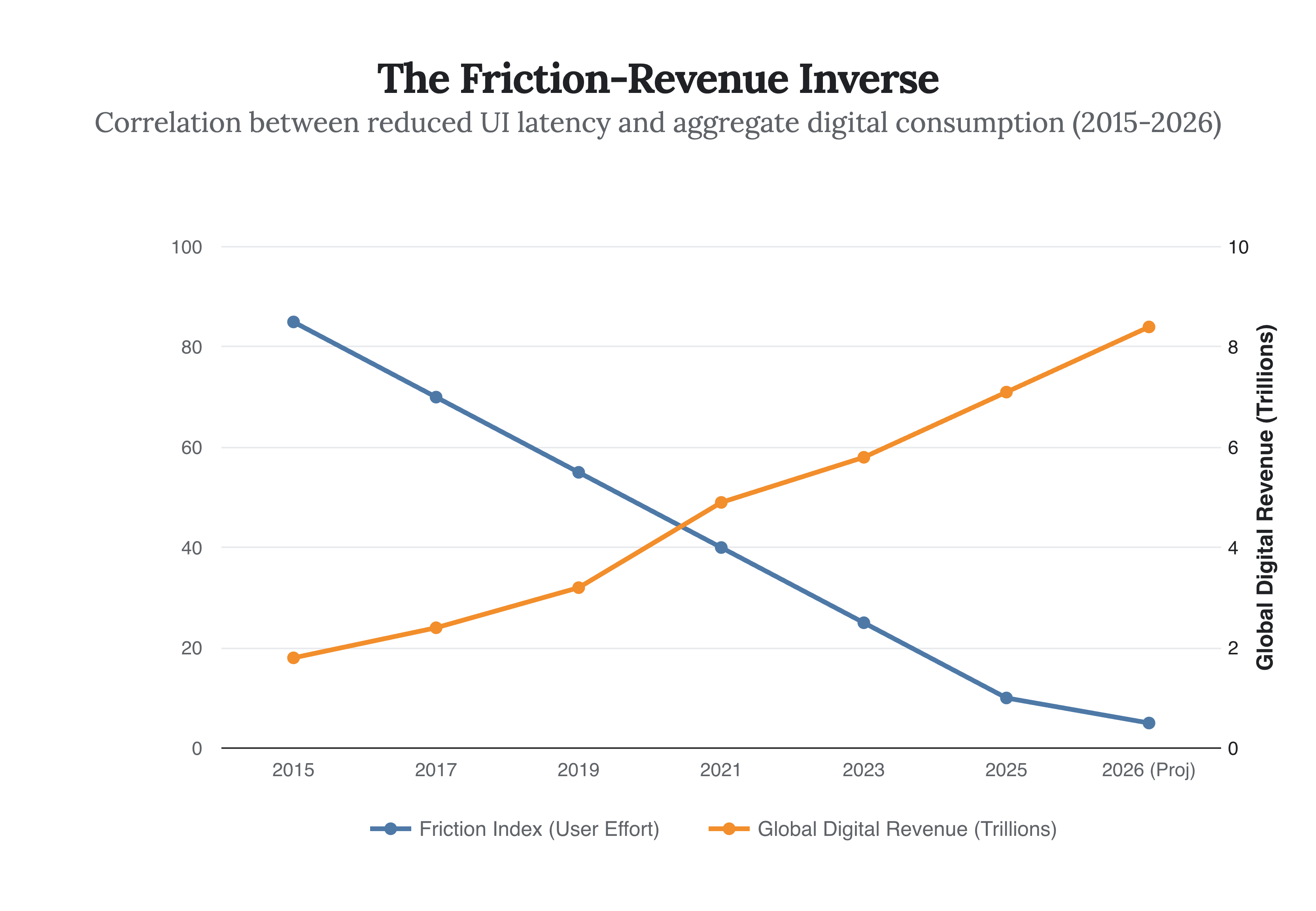
As of March 2026, the data is unequivocal: The entities winning the capital allocation wars—whether they are harvesting your attention, your fiat currency, or your metabolic health—are those that have successfully reduced the coefficient of friction to zero. Conversely, the individuals maintaining sovereignty are those who have learned to artificially re-introduce friction into their own ecosystems.
We are witnessing a bifurcation of the human species into two distinct classes: the Frictionless Consumers, whose every impulse is immediately gratified by a logistical machine roughly the size of a deity, and the Friction Architects, who deliberately engineer latency into their lives to preserve their executive function.
Friction is the only variable remaining in a world of infinite abundance that distinguishes a strategic decision from a reflex.
This dossier analyzes the mechanics of this war. We will dissect how friction was systematically removed from the global operating system, the devastating second-order effects on human capability as of Q1 2026, and how to deploy Protocol 002 to reverse-engineer these systems for your own advantage.
Vector 1: The Neuro-Digital Interface
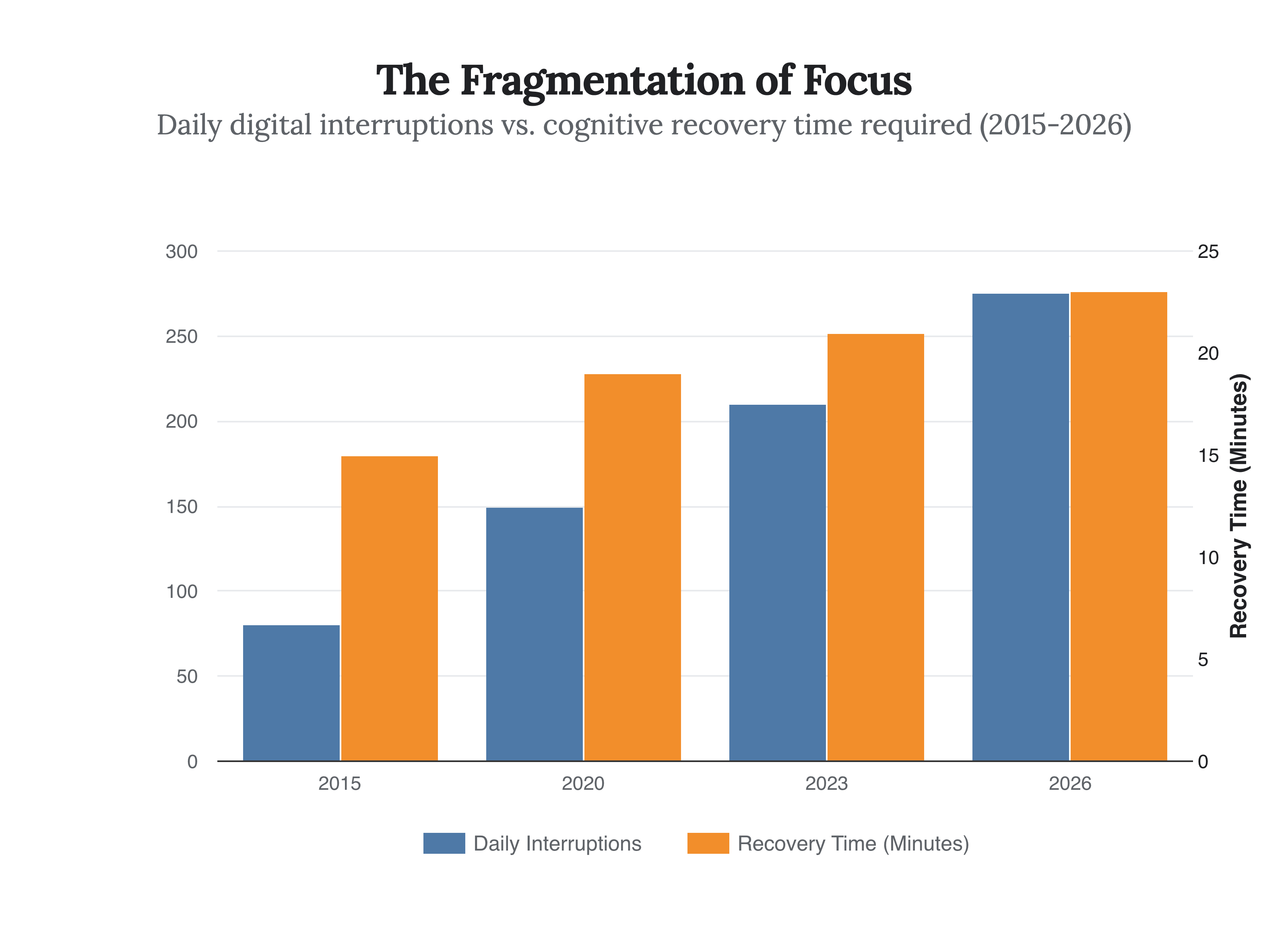
The first front is attention. The metrics from Q1 2026 paint a stark picture of cognitive fragmentation. The average knowledge worker is now interrupted every 120 seconds. This figure, derived from Microsoft’s 2025 Work Trend Index and corroborated by real-time metadata analysis in early 2026, suggests that deep work has become a statistical anomaly.
The mechanism is “Context Switching.” When a user toggles between applications—Slack to Email to Browser—the brain does not switch instantly. There is a “cognitive switching penalty.” Research from 2025 indicates it takes approximately 23 minutes and 15 seconds to fully regain deep focus after a distraction. When interruptions occur every two minutes, the math reveals an impossible equation: There are literally not enough minutes in the workday to recover from the interruptions that the workday contains.
This is not a discipline failure; it is a friction failure. The “Alt-Tab” motion has zero friction. The notification banner has zero friction. The swipe-down-to-refresh has zero friction. The digital environment is designed like a greased slide.
In 2026, the average digital worker toggles between apps 1,200 times per day. The economic cost of this context switching is estimated at $450 billion annually in the United States alone. But the personal cost is higher: a functional IQ drop of roughly 10 points during the switching period—equivalent to losing a night’s sleep.
The platforms have weaponized “Variable Reward Schedules” (the slot machine mechanic) but removed the “pull” lever friction. The content now auto-plays. The “Stop” cue has been removed. In 2025, TikTok and Reels effectively eliminated the decision to continue watching; the decision is now required to stop watching. By changing the default state from “Pause” to “Play,” they shifted the friction burden from the platform to the user’s willpower. Willpower, biologically, is a finite resource; the server’s ability to stream video is infinite. You will always lose.
Vector 2: The Financial Substrate (The 1-Click Trap)
If Vector 1 captures your time, Vector 2 captures your capital. The Fintech revolution of the 2020s was marketed as “democratizing finance.” In reality, it was an industrial effort to remove the “Pain of Paying.”
Psychologically, handing over cash triggers a pain center in the brain (the insula). Swiping a card triggers less. Double-clicking a side button (Apple Pay) triggers almost none. Background payments (Uber/Amazon Go) trigger zero. We have severed the neural link between consumption and resource depletion.
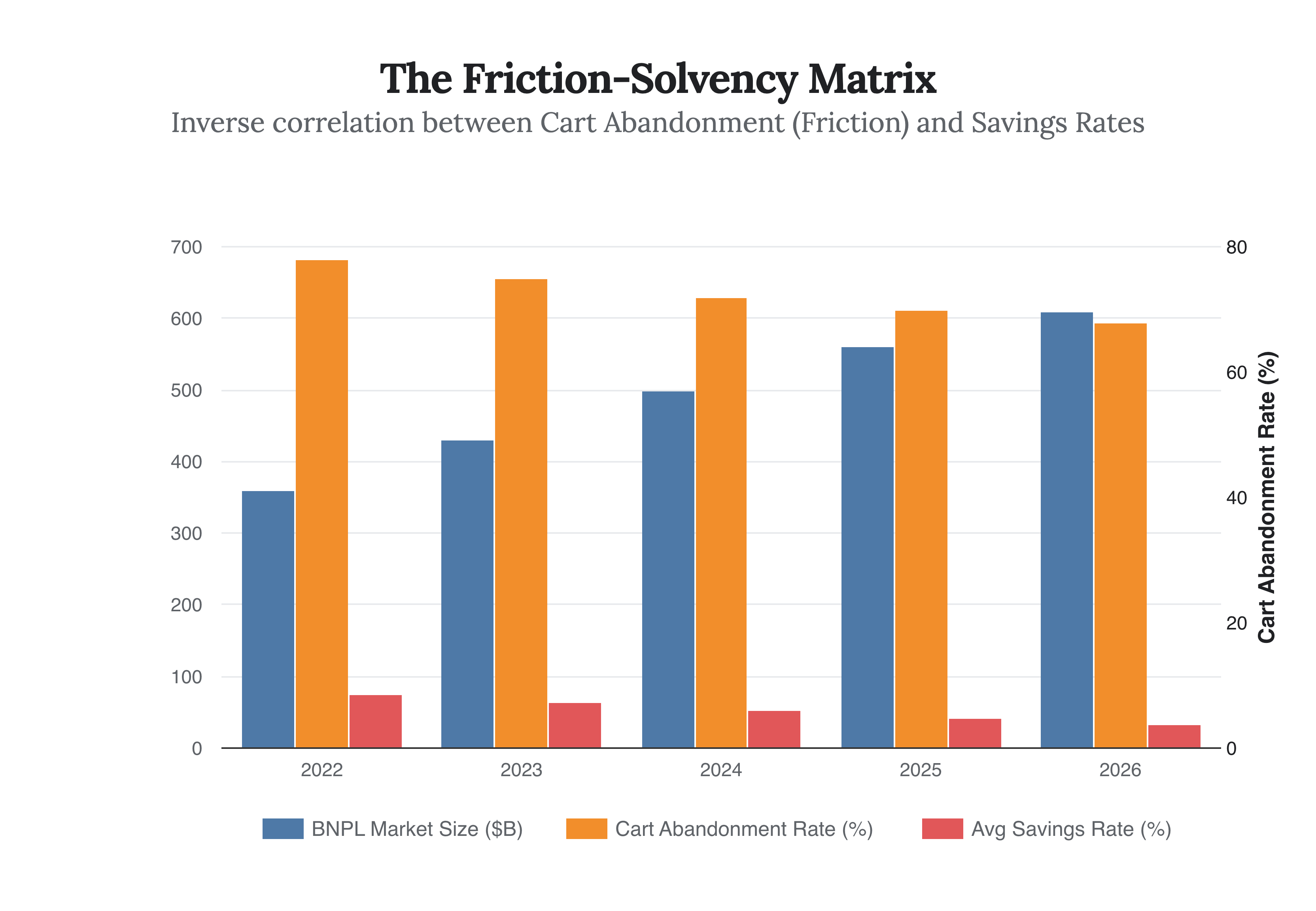
Enter the “Buy Now, Pay Later” (BNPL) infrastructure. By Q1 2026, the global BNPL market has swelled to roughly $576 billion. The data shows a terrifying correlation: BNPL adoption increases Average Order Value (AOV) by 20-40%. It induces consumers to spend money they do not have, on things they do not need, simply because the friction of the “total price” has been fractured into four digestible, frictionless micro-payments.
The default rate tells the true story. In late 2025, delinquency rates for BNPL users hovered between 34% and 41%, with Gen Z users seeing rates as high as 51%. This is not a credit crisis; it is a friction crisis. The application process for a BNPL loan takes seconds. There is no paperwork, no cooling-off period, no friction to allow the prefrontal cortex to override the limbic system’s desire for the new item.
Consider the “Cart Abandonment Rate.” In 2025, the global average was ~70%. Merchants view this as lost revenue; we view it as the last line of defense for consumer solvency. Every UI improvement that reduces cart abandonment—1-click checkout, saved shipping info, auto-filled credit cards—is a direct assault on your savings rate. The “Friction Engineer” at Amazon gets a bonus for every percentage point drop in abandonment. Your net worth is the collateral damage.
The 2026 data indicates a divergence: Households that retain “payment friction” (cash usage, manual entry of credit card numbers, 24-hour waiting periods) have savings rates 3x higher than those fully integrated into the 1-click ecosystem.
Unlock deeper strategic alpha with a 10% discount on the annual plan.
Support the data-driven foresight required to navigate an era of radical uncertainty and join a community of institutional-grade analysts committed to the truth.
