


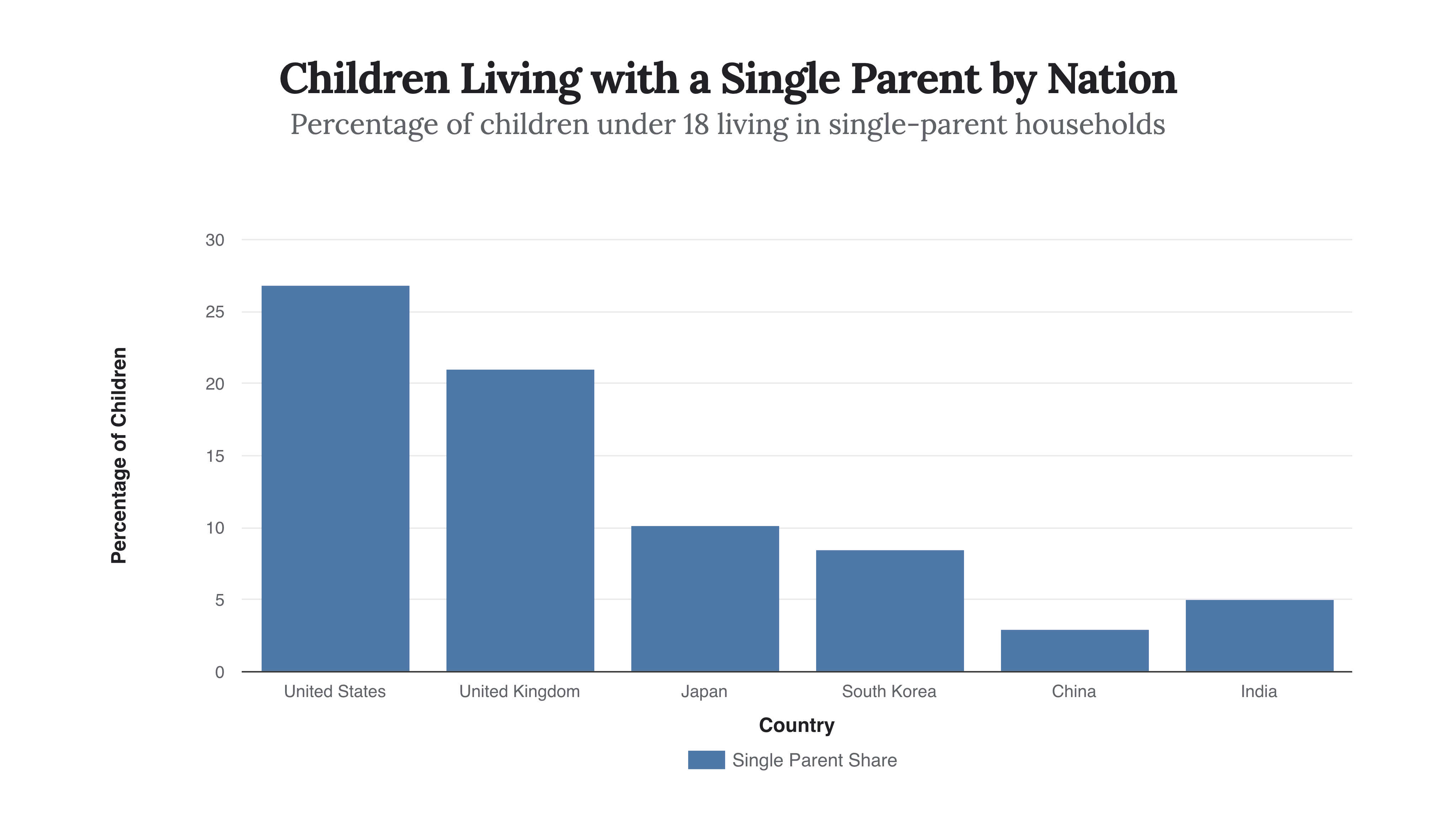
The global landscape of family structures has split along clear geopolitical lines. In the West, particularly within the United States and the United Kingdom, the prevalence of single-mother households has risen dramatically over the past several decades, driven by shifting cultural norms, rising divorce rates, and policy changes. Recent data indicates that approximately 26.8% of children in the United States and 21.0% in the United Kingdom live in single-parent households, of which over 80% are headed by single mothers.

By contrast, Eastern nations maintain exceptionally low rates of single parenting. In East Asia, traditional family structures remain the social and legal norm. China reports only about 3.0% of children living in single-parent households, while South Korea stands at approximately 8.5%. This stark contrast highlights a profound divergence in societal expectations and legal frameworks. The structural erosion of the nuclear family is not a global inevitability, but a distinctly Western phenomenon driven by deliberate policy and cultural incentives. This demographic divergence has profound second-order effects on domestic labor markets, government safety nets, and generational wealth transfers.
Unlock deeper strategic alpha with a 10% discount on the annual plan.
Support the data-driven foresight required to navigate an era of radical uncertainty and join a community of institutional-grade analysts committed to the truth.

The Economic Penalty of Solo Caregiving
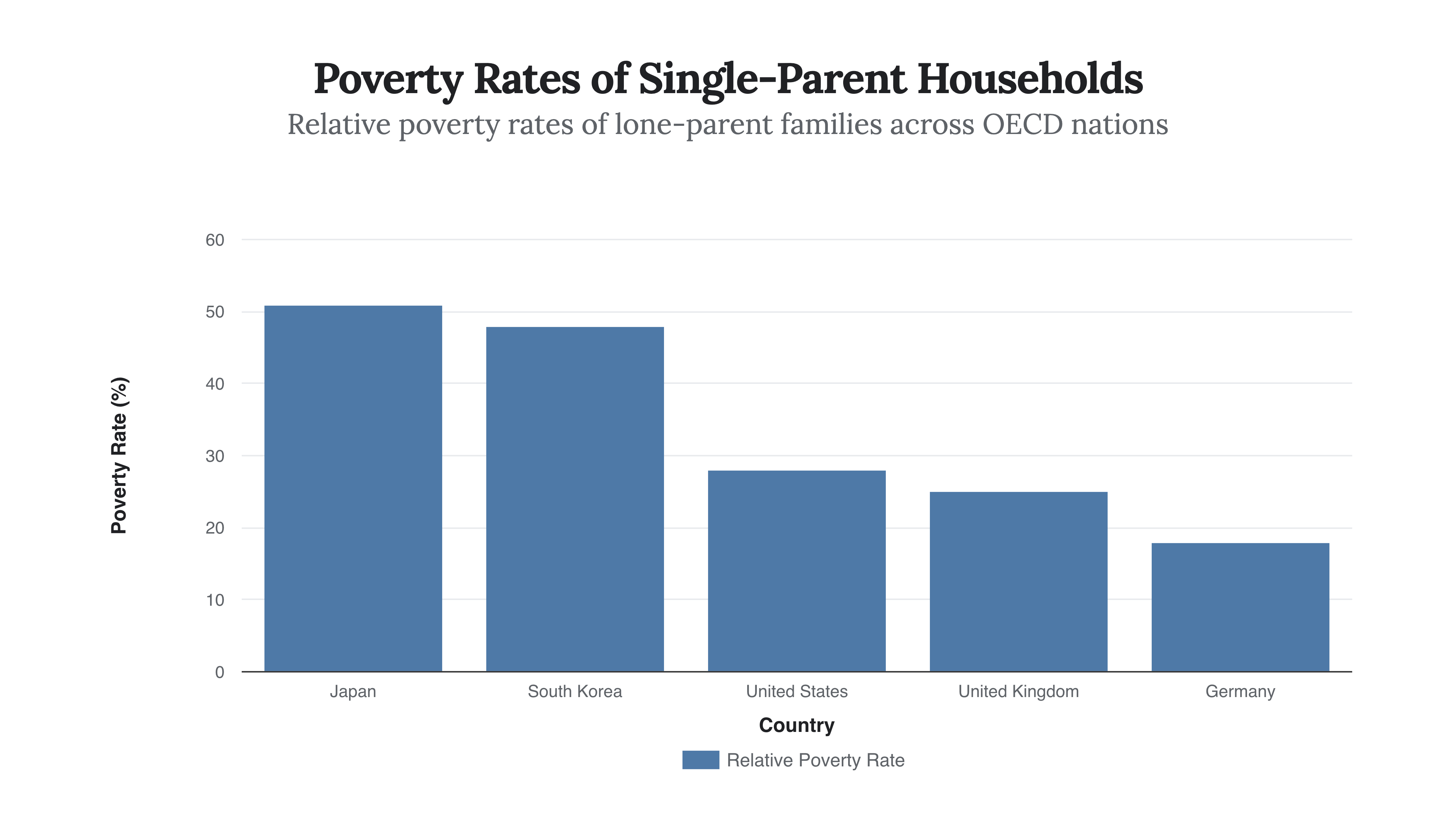
While Eastern societies boast far lower rates of single motherhood, those who do navigate this path face severe financial hardships. In Japan and South Korea, a lack of institutional support, persistent gender wage gaps, and corporate cultures that demand extreme hours create a hostile environment for working single mothers. Strikingly, Japan’s relative poverty rate for single-parent households hovers around 51.0%, one of the highest in the OECD. In the United States, single mothers face a poverty rate of 28.0%, which, while lower than in Japan, remains triple the poverty rate of married-couple families. This reveals a critical paradox. Despite the lower prevalence of single motherhood in the East, those who do fall through the cracks face significantly harsher economic penalties and poverty rates than their Western counterparts. In Western Europe, comprehensive social safety nets, such as subsidized childcare and direct cash transfers, help buffer single-parent families, keeping the relative poverty rate in Germany at approximately 18.0%.
Societal Norms and Support Paradigms
The fundamental difference between Western and Eastern single motherhood lies in the cultural framing of the family unit. Western systems emphasize individual autonomy and rely on the state to provide a baseline level of support when partnerships dissolve. In contrast, Eastern cultures place primacy on the collective family unit, where out-of-wedlock births are heavily stigmatized. For instance, less than 3.0% of births in Japan and South Korea occur outside of marriage, compared to over 40.0% in the United States and several European nations. Consequently, single mothers in the East often rely on multigenerational cohabitation, living with grandparents to share the burden of childcare. This social pressure, however, has a dark side. The East’s reliance on ancestral and multigenerational households masks an under-reported mental health and economic crisis for single mothers. Without formal institutional pathways or structural flexibility in the workplace, Eastern single mothers remain highly vulnerable to long-term economic exclusion, while their Western counterparts, despite facing severe time-poverty, operate within a far more socially accepted and legally protected status.