



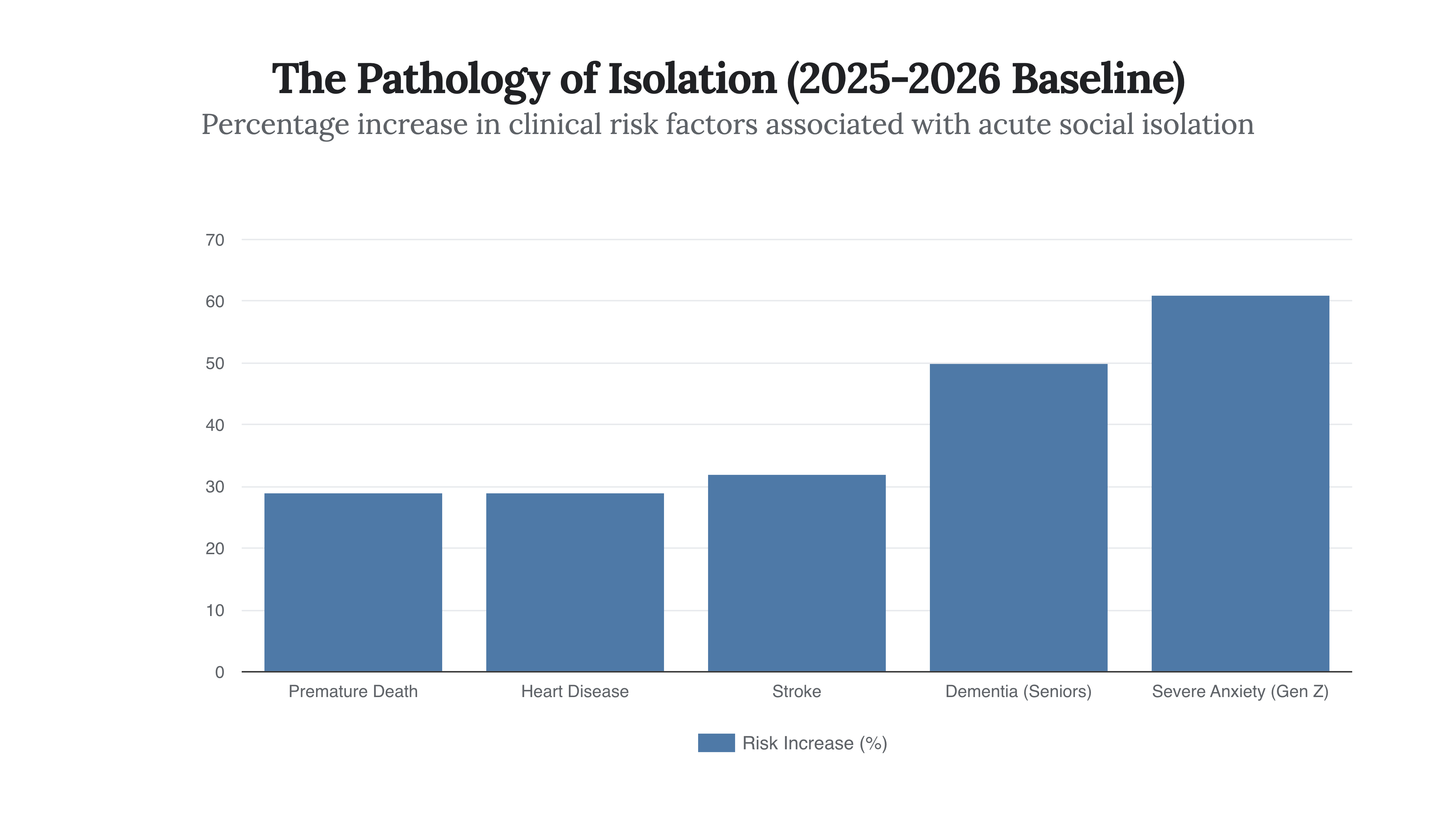
In June 2025, the World Health Organization released a landmark epidemiological baseline linking acute loneliness to an estimated 100 deaths globally every single hour—totaling more than 871,000 deaths annually. By Q1 2026, the data has crystallized into a stark, unavoidable reality: this is no longer a localized psychological phenomenon; it is a systemic structural output. The loneliness epidemic is not the result of technological acceleration alone. It is the downstream consequence of our housing market’s incentive structures.
To understand the modern real estate landscape, we must abandon traditional supply-and-demand frameworks and view housing through the clinical lens of Game Theory. The players are institutional capital, municipal planners, and the individual renter. The stakes are physical shelter versus biological well-being. Currently, the system has locked all participants into a brutal Prisoner’s Dilemma where the rational pursuit of housing guarantees the collapse of human connection.
The Demographic Nash Equilibrium
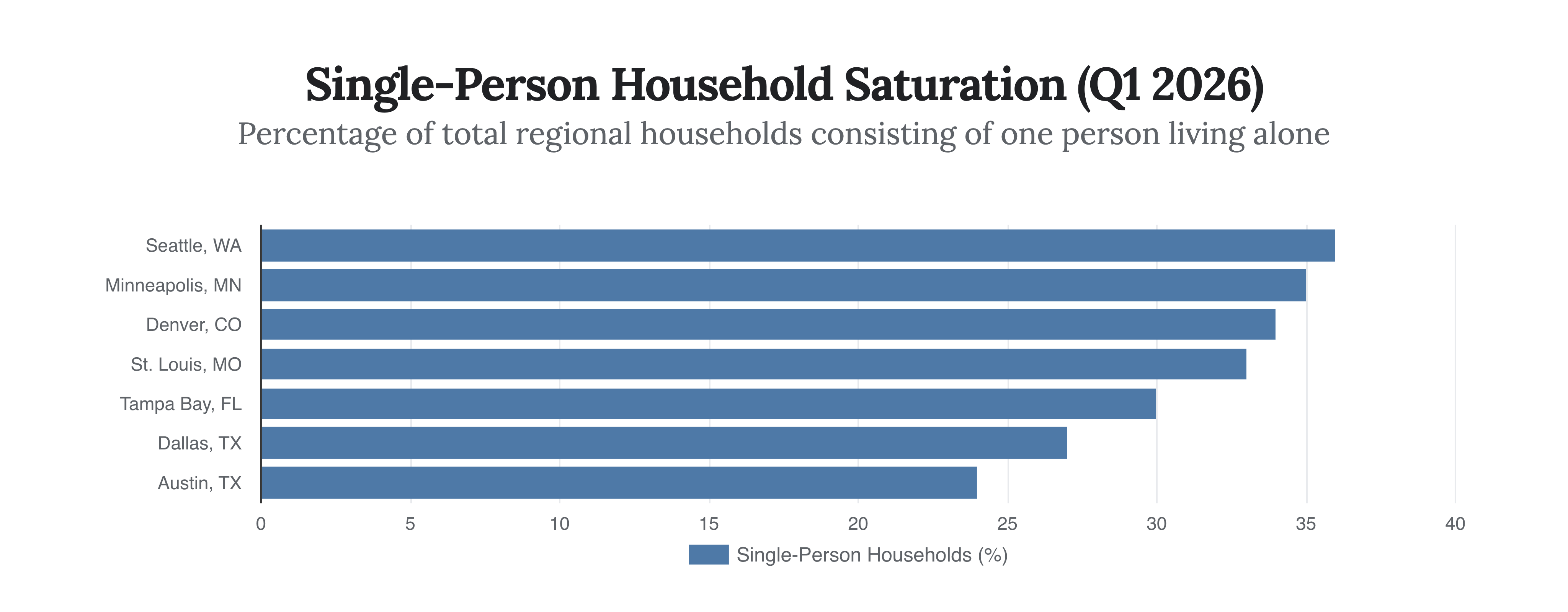
The defining demographic shift of the 2020s has been the explosive growth of the single-person household. As of early 2026, metropolitan statistical areas like Seattle, Denver, and Minneapolis report that single-person households comprise between 32% and 36% of their total housing inventory. Concurrently, over 20 million single women owned homes in 2025—the highest metric on historical record.
From a purely economic standpoint, fracturing communal or multi-generational living into hyper-individualized units is the market’s dominant strategy. For developers and real estate investment trusts (REITs), maximizing the number of single-occupancy units per acre generates the highest yield per square foot. For the individual, pursuing autonomous shelter is perceived as the ultimate marker of socioeconomic stability.
However, this strategy creates a devastating Nash Equilibrium. Because both capital and the consumer optimize for the smallest viable autonomous unit, communal “third spaces” are priced out of development, and the geographical distance between familial nodes expands. We have engineered a Nash Equilibrium where the mathematically optimal housing strategy requires the total sacrifice of human connection. The market successfully clears, but it leaves 36% of all Americans—and a staggering 79% of Generation Z—reporting chronic, serious loneliness.
The Zero-Sum Payoff Matrix of Shelter
The financial physics of the 2026 housing market operate as a strict zero-sum arena. The National Low Income Housing Coalition’s (NLIHC) July 2025 “Out of Reach” report calculated the national “Housing Wage”—the hourly rate required to afford a modest two-bedroom apartment—at $33.63. With over 87% of extremely low-income renters facing moderate to severe cost burdens, the capital required simply to exist indoors consumes the totality of the tenant’s discretionary resources.
In Game Theory, a zero-sum game dictates that one player’s gain is exactly balanced by the other’s loss. When shelter consumes 50% to 60% of an individual’s net income, the capital required for social mobility, communal engagement, and familial formation drops to zero. The landlord’s yield is directly extracted from the tenant’s social capital. The modern housing market operates as a strict zero-sum arena where the premium paid for shelter is directly subtracted from the tenant’s lifespan.
The biological cost of this extraction is perfectly quantifiable. The chronic stress of housing instability elevates cortisol, disrupts immune function, and triggers profound neurobiological withdrawal. The individual, lacking the resources to engage in non-transactional socialization, retreats. The resulting biological decay—equivalent to smoking 15 cigarettes a day—is the unpriced externality of high-yield real estate.
Unlock deeper strategic alpha with a 10% discount on the annual plan.
Support the data-driven foresight required to navigate an era of radical uncertainty and join a community of institutional-grade analysts committed to the truth.
Institutional Incentive Structures and Information Asymmetry
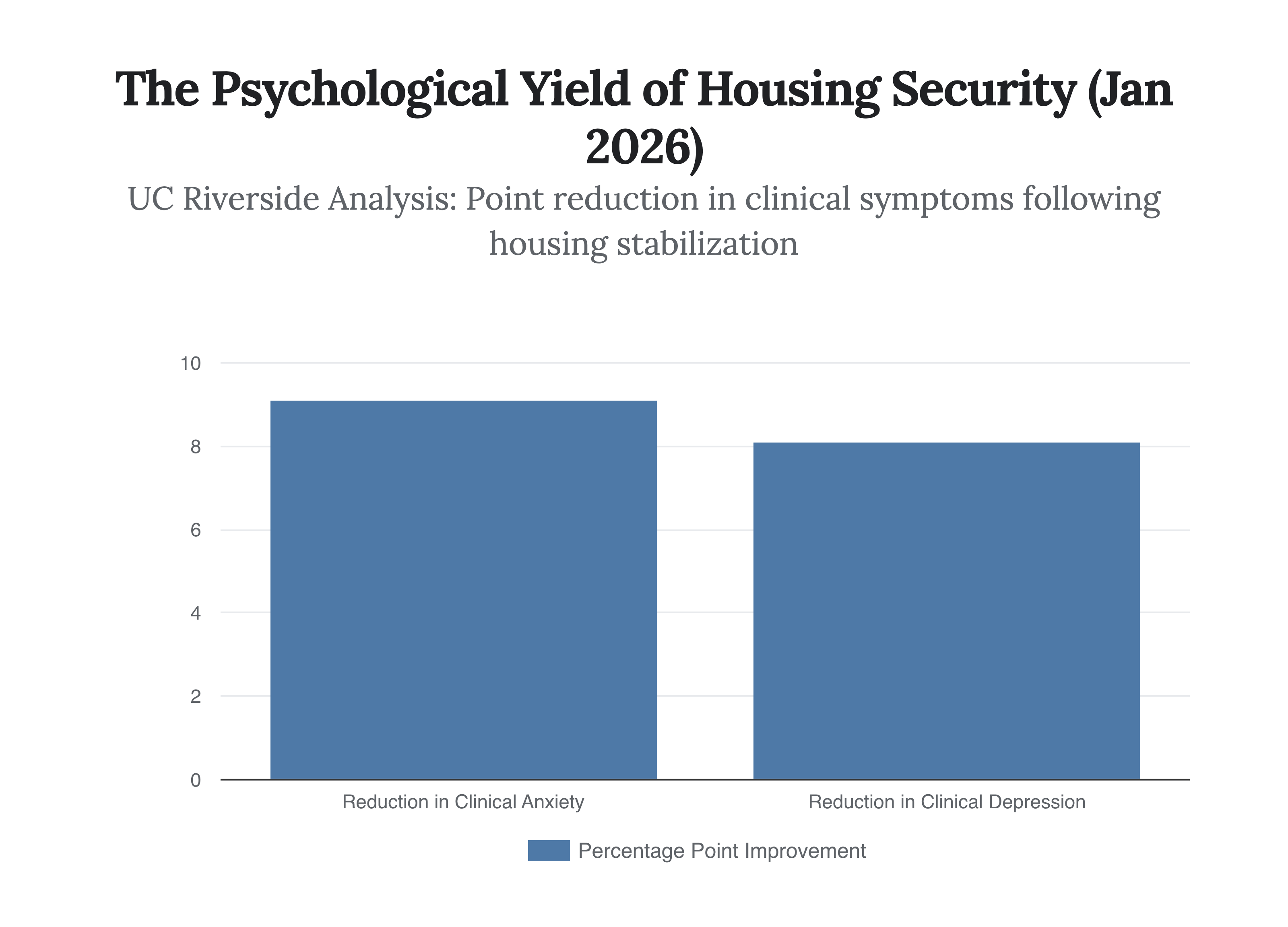
If housing instability creates social isolation, does housing security reverse it? The data confirms it does. A definitive January 2026 analysis from UC Riverside measured the clinical mental health impacts of federal housing assistance. By treating the housing market as an epidemiological variable, researchers found that receiving rent stabilization directly reduced clinical anxiety by 9.1 percentage points and clinical depression by 8.1 percentage points.
Despite this data, the macro-economy is suffering from a massive failure of information asymmetry. Corporate entities and healthcare networks are absorbing the collateral damage of real estate yields without realizing the source of the hemorrhage. According to the Journal of Organizational Effectiveness, stress-related absenteeism directly attributed to loneliness now costs U.S. employers an estimated $154 billion annually.
We are witnessing a macroeconomic game of Tit-for-Tat gone wrong. Landlords and municipalities extract maximum capital via rent and property taxes; in retaliation, the isolated, hollowed-out workforce inadvertently extracts capital from the broader economy via healthcare burdens and lost productivity. Capital markets are currently mispricing the greatest negative externality of the decade: a physically decaying, isolated workforce that costs the economy more in absenteeism than it generates in rent.
The Forward Projection: Non-Zero-Sum Architecture
Breaking this isolation equilibrium requires shifting the housing market from a zero-sum extraction model to a non-zero-sum cooperative model. The current trajectory—building millions of disconnected, high-cost micro-units—is clinically unsustainable. The $154 billion annual corporate penalty for loneliness will eventually force institutional players to internalize the cost of isolation.
Real estate strategy over the next decade must pivot. The integration of “pro-social architecture”—developments engineered specifically to force incidental communal interaction, subsidized by healthcare systems seeking to lower their cardiovascular and psychiatric liabilities—will become a major institutional asset class. Until the payoff matrix changes, the data remains absolute: we are building ourselves into early graves, one apartment at a time.