



The Brutal Math of Capital Reallocation
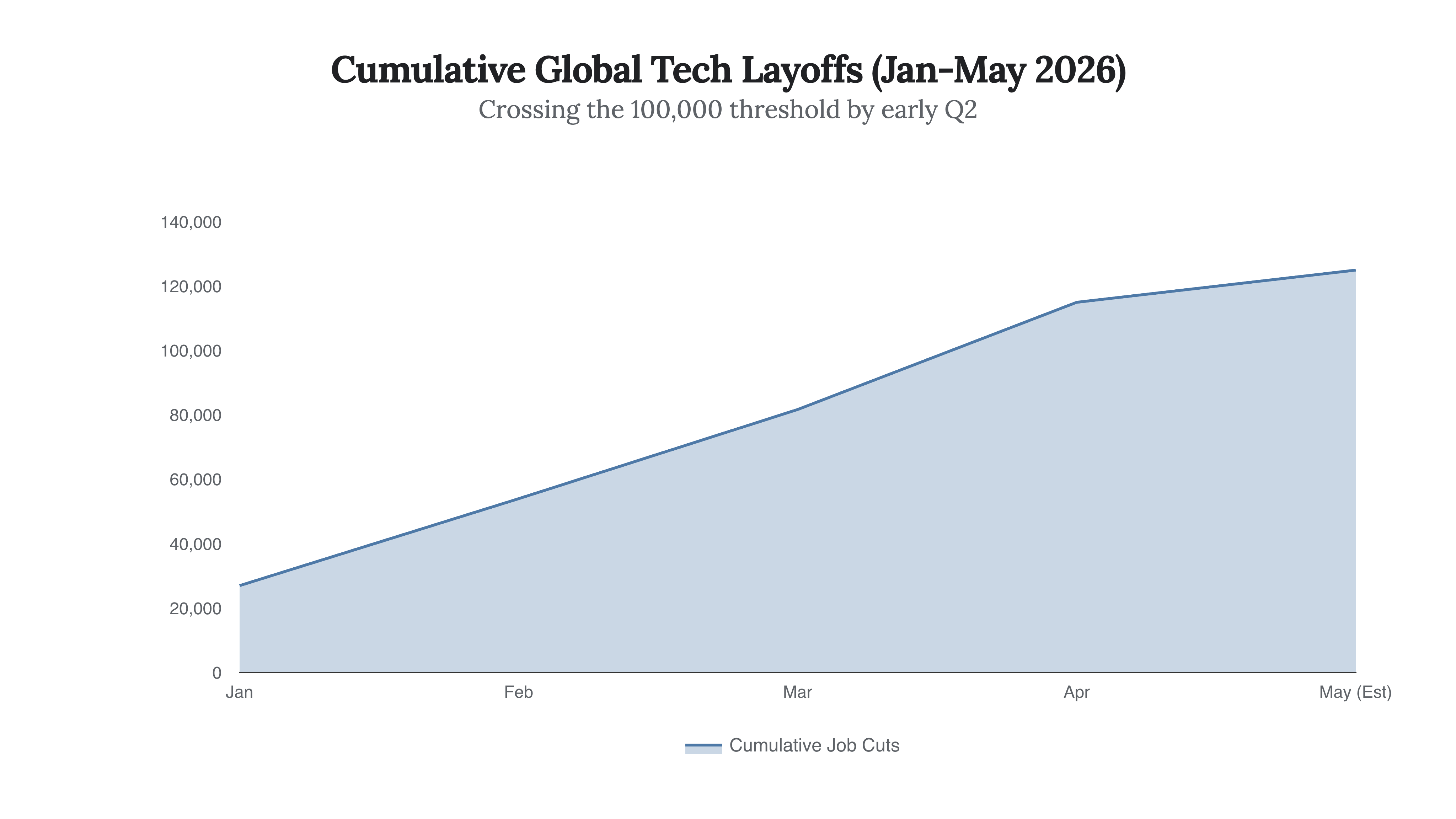
As of May 2026, the technology sector has crossed a psychological and macroeconomic Rubicon. According to verified industry tracking from Layoffs.fyi and corroborating data from Statista, over 100,000 tech workers have been structurally eliminated from the global workforce in just the first five months of the year. The first quarter alone witnessed 81,700 terminations—the highest quarterly bloodletting since the immediate post-pandemic correction of early 2023. Yet, comparing the 2026 contraction to the 2023 correction is a fundamental analytical error.
The tech sector is not shrinking due to financial distress; it is executing the most aggressive, capital-intensive cannibalization of human labor in modern economic history.
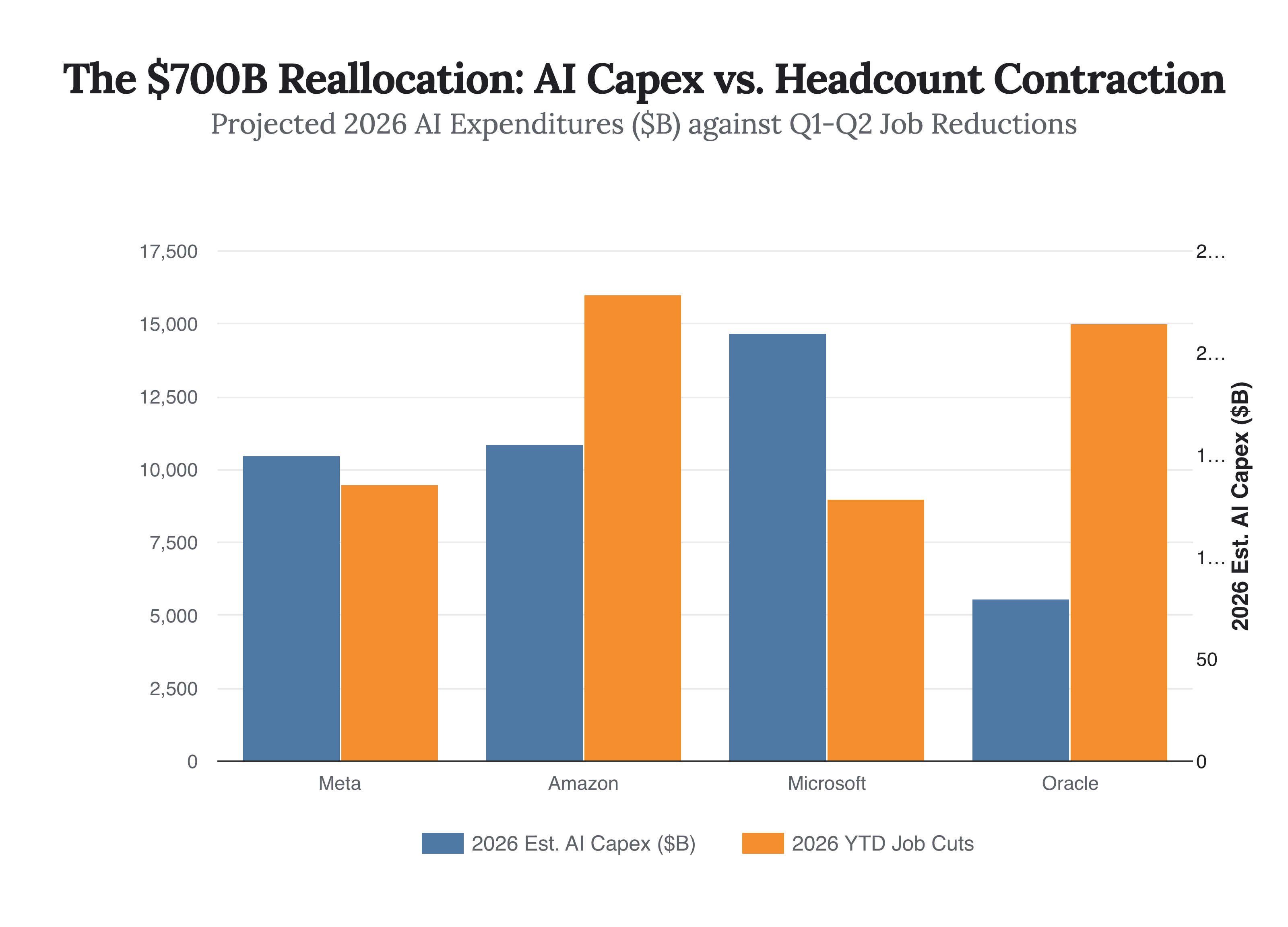
This is not a story of falling demand. It is a story of capital reallocation. The very companies accelerating the severance of their workforce—Alphabet, Microsoft, Meta, and Amazon—are simultaneously projecting a combined $700 billion in artificial intelligence capital expenditures for 2026. The balance sheet is being rewritten in real-time: operational expenditure (OPEX) allocated for human payroll is being ruthlessly converted into capital expenditure (CAPEX) for GPU clusters, proprietary silicon, and autonomous agent infrastructure.
The Mechanics of the Reallocation
The announcements landing in April and May 2026 provide the empirical proof of this pivot. On May 20, 2026, Meta will execute a targeted termination of 8,000 employees—roughly 10% of its global workforce. This structural reduction follows a 1,500-person cut from its Reality Labs division in January. The strategic intent was laid bare when CEO Mark Zuckerberg simultaneously eliminated 6,000 open job requisitions while confirming a staggering $21 billion commitment to AI cloud provider CoreWeave. The human capital was not just trimmed; the budget for that capital was incinerated and respawned as compute power.
Similarly, Amazon has quietly eliminated 16,000 roles over the past six months, even as it scales its AI agent deployment. Microsoft initiated voluntary buyouts for nearly 9,000 U.S. workers in the same quarter that its CFO flagged surging AI expenditures. Oracle is reportedly in the middle of a massive global restructuring that could see up to 30,000 roles eliminated to free up an estimated $8 billion to $10 billion in cash flow—capital that will be immediately redirected toward AI infrastructure.
For every dollar repurposed toward synthetic intelligence, the equivalent human capital is being permanently and unapologetically deleted from the enterprise architecture.
Unlock deeper strategic alpha with a 10% discount on the annual plan.
Support the data-driven foresight required to navigate an era of radical uncertainty and join a community of institutional-grade analysts committed to the truth.
The April 2026 Autopsy: AI as the Primary Catalyst
For those relying on lagging indicators, the “AI washing” narrative—the theory that executives are simply using artificial intelligence as a convenient scapegoat for poor macroeconomic performance—has been demonstrably disproven. The Data Reality is far more clinical.
According to the April 2026 employment report from outplacement firm Challenger, Gray & Christmas, artificial intelligence was explicitly cited as the primary driver for 26% of all U.S. job cuts across all sectors, accounting for 21,490 of the 88,387 total terminations. This marks the second consecutive month where AI restructuring led the data. For context, in all of 2025, AI was explicitly linked to 55,000 job cuts globally. We are on pace to shatter that annual figure before the close of Q2 2026.
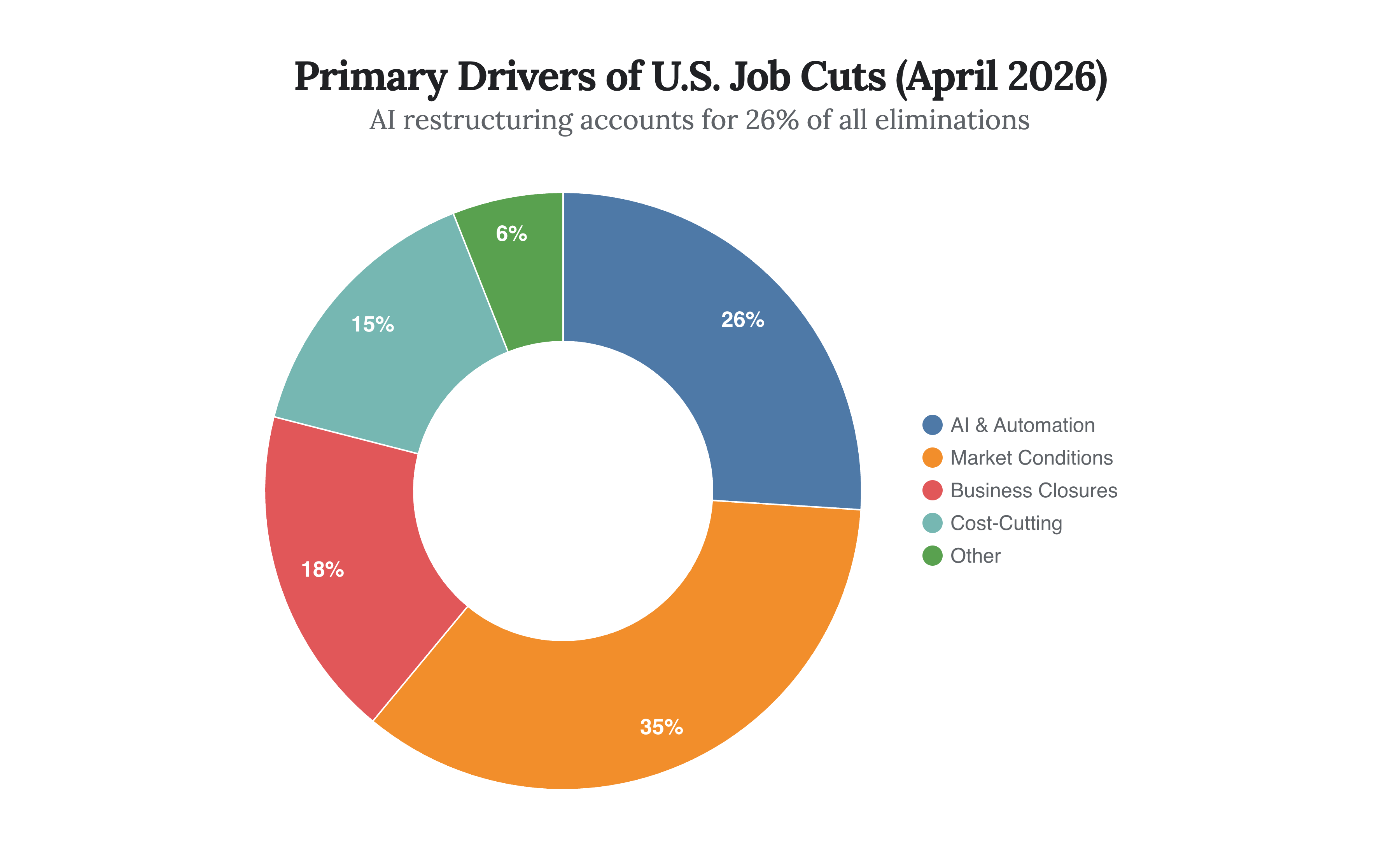
In the tech industry specifically, the velocity of the shift is staggering. Data aggregated from TrueUp, TechCrunch, and WARN filings across 98 major tech firms reveals that out of approximately 118,000 global cuts tracked through early May 2026, nearly 58% were tied directly to internal AI adoption and infrastructure investments.
Snap Inc. provided the blueprint for the mid-cap tech sector. In April 2026, CEO Evan Spiegel eliminated 16% of his workforce (1,000 employees), bluntly stating to investors that advancements in AI had neutralized the need for repetitive work. The maneuver will generate $500 million in annualized cost savings by the second half of 2026—capital that Snap is already deploying to roll out internal AI agents across the enterprise. It is a closed-loop system of human displacement funding synthetic replacement.
The “One-Person Team” Paradigm and the Collapse of the Middle
The second-order effects of this zero-sum pivot are already fracturing the traditional tech labor pyramid. We are witnessing the immediate obsolescence of the junior developer, the entry-level analyst, and the middle-management coordinator.
We have reached the terminal velocity of the speculative tech workforce; the new enterprise era demands senior operators who can manage fleets of autonomous agents, not managers who oversee teams of junior engineers.
In May 2026, Coinbase CEO Brian Armstrong announced a 14% workforce reduction (700 roles), specifically noting that the company is actively experimenting with “one-person teams.” By combining multiple traditional roles into single, high-agency operators augmented by AI, Coinbase is proving that the theoretical efficiency gains of 2024 are the operational realities of 2026. Block followed a similar trajectory, slashing its 10,000-person workforce by 40% as AI accelerated internal productivity to the point where thousands of roles became structurally redundant.
The warnings from the frontier model builders have shifted from theoretical to immediate. Microsoft’s AI chief, Mustafa Suleyman, recently projected that a majority of professional white-collar cognitive tasks will be replaceable within an 18-month window. Anthropic CEO Dario Amodei has publicly forecasted the disruption of up to 50% of entry-level white-collar roles. The tech sector is acting on these forecasts today, using its own proprietary tools to hollow out its operational middle.
The Contagion Effect: Beyond Silicon Valley
The technology sector has historically served as the vanguard for broader macroeconomic corporate behavior. What begins in Menlo Park or Seattle inevitably becomes the standard operating procedure in Chicago, London, and Tokyo. If the most highly capitalized, highest-margin businesses on the planet are aggressively shedding human labor to fund automation, the traditional enterprise space will inevitably follow suit. The data confirms this contagion is already underway.
According to the same April 2026 Challenger, Gray & Christmas findings, the automation-driven contraction has aggressively bled into legacy industries. Chemical manufacturing companies announced nearly 5,000 job cuts in April—an astonishing 167% year-over-year increase—with artificial intelligence and automated efficiency cited as the primary drivers. Industrial goods manufacturers followed closely, announcing nearly 7,800 job cuts through the end of April 2026, representing a 71% surge over 2025 figures. The justification remains mathematically identical across sectors: capital must be freed from payroll to finance the integration of generative AI tools.
Nowhere is this shift more pronounced than in the global IT services sector, the traditional backbone of corporate software deployment. Cognizant, historically reliant on vast armies of entry-level engineers, is currently finalizing “Project Leap”—a massive restructuring initiative expected to eliminate between 12,000 and 15,000 jobs globally by the end of Q2 2026. The rationale provided to stakeholders centers entirely on slower client spending combined with a rapid shift toward AI-led delivery models. Competitors like TCS, Accenture, and HCLTech are executing identical, albeit quieter, workforce reductions.
The offshore outsourcing model of human arbitrage is dead; the global economy is transitioning to an era of compute arbitrage, where the cheapest labor is no longer in developing nations, but inside a data center.
The Synthetic Balance Sheet and Institutional Alpha
For the institutional investor, the signals are overwhelmingly clear. The market is actively rewarding the transition from human capital to synthetic compute. The psychological shift in capital markets is absolute: payroll is now viewed as an inefficient legacy cost, while AI capital expenditure is viewed as future-proofed leverage.
The tech industry’s Q2 2026 landscape is defined by this ruthless arithmetic. Companies are no longer being judged by revenue per employee; they are being judged by compute deployed per capita. The firms that can scale their infrastructure while simultaneously deflating their human headcount are the ones capturing the premium. The tension on the ground is palpable, reflected in the Glassdoor Employee Confidence Index, which plummeted to 47.2% in early 2026 as tech sector employees realized the ground beneath them had permanently shifted. Voluntary attrition has stalled; employees are clinging to their remaining roles out of fear of a hyper-competitive, shrinking market, allowing executives to adopt even stricter performance evaluations and further streamline their organizations.
The 100,000 jobs lost in the first five months of 2026 are not coming back when interest rates fall or consumer demand spikes. They are gone forever, replaced by code that writes itself, agents that execute workflows autonomously, and server farms that do not require stock options or health benefits. The tech industry has successfully automated the very workers who built the automation, and the global labor market will never look the same.
The forecast has come forth. The torch has been passed to AI to hold aloft. The compute has left the human head and compounds in highly efficient post-human data centers. A restructuring of not only work contribution but of the meaning of being human. Surely an audit will come. What have we gained? And what have we lost? We knew it was coming. Are we societally prepared for the transition?