


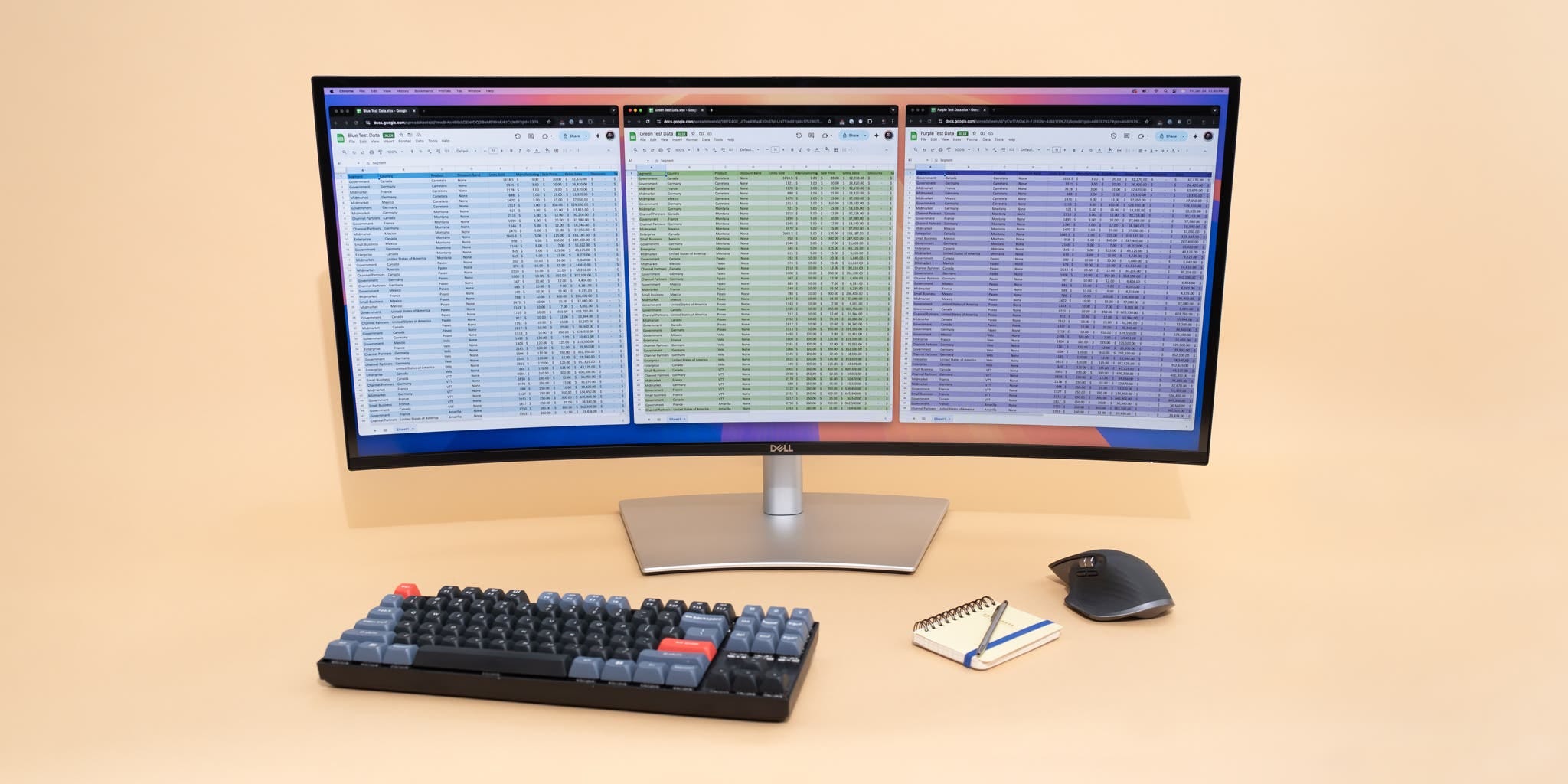
The 275-Ping Reality Check
The philosophical model of Stoicism rests on a single, biological assumption: that a temporal gap exists between a stimulus and your response to it. Viktor Frankl, often cited alongside Marcus Aurelius in modern resilience literature, famously defined this: “Between stimulus and response there is a space. In that space is our power to choose our response.”
As of January 2026, that space has been algorithmically liquidated.
We are no longer operating in an environment where the dichotomy of control (distinguishing what is up to us vs. what is not) is a viable real-time strategy. The latest telemetry from the 2025 productivity landscape reveals a structural collapse of the cognitive conditions required for Stoic discipline. This is not a failure of will; it is a failure of biology to adapt to a hyper-scaled extraction economy.
Data finalized in late 2025 paints a brutal picture of the “Knowledge Worker” battlefield. The average digital employee is now interrupted every two minutes during core work hours. Specifically, they endure 275 distinct cognitive interruptions per day—a mix of Slack pings, email notifications, and algorithmic nudges. When you overlay this frequency against the neurological “resumption lag” (the time required to refocus attention), the math becomes impossible.
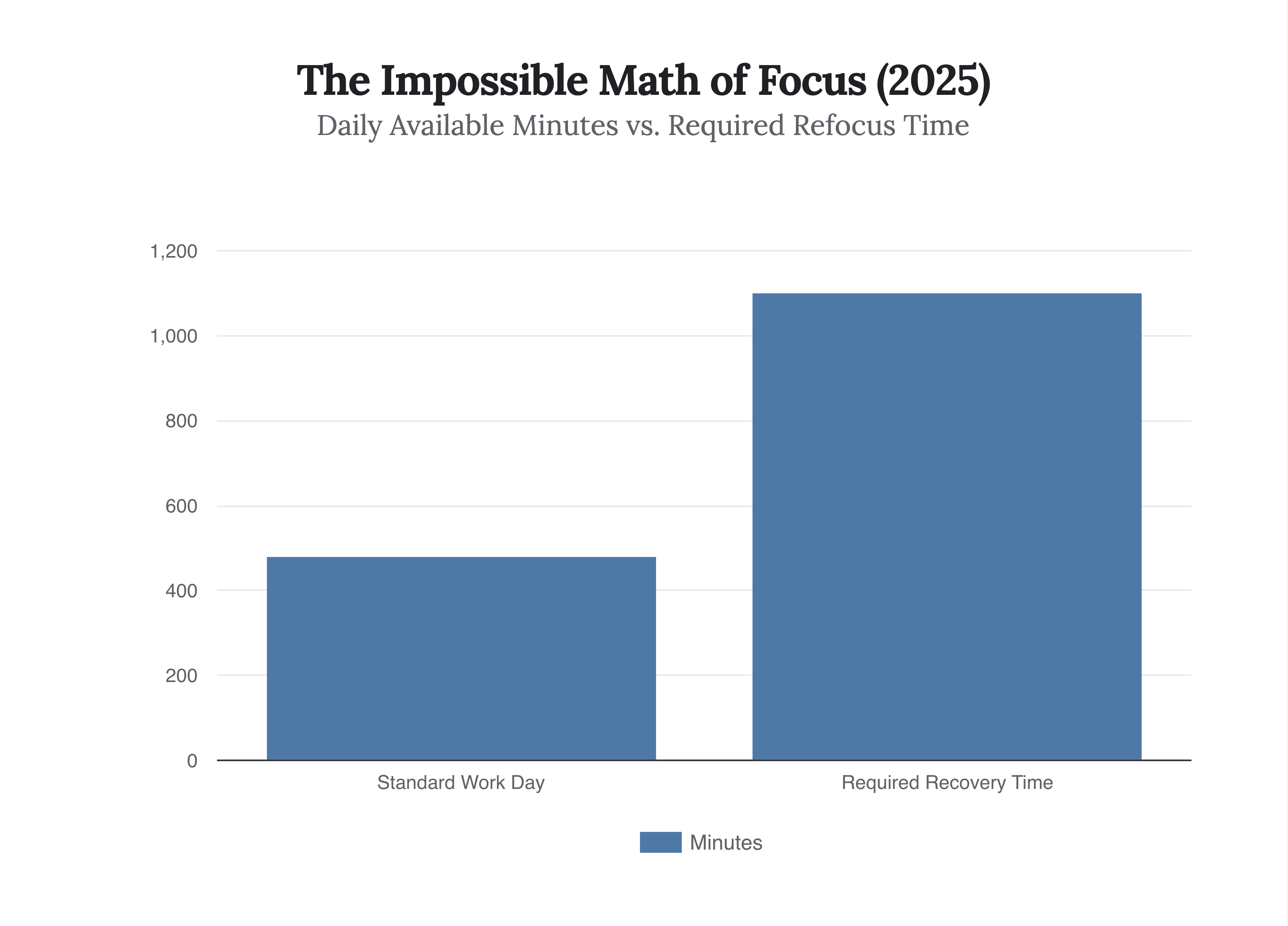
The chart above visualizes the “Cognitive Deficit.” With 275 interruptions daily, and a conservative 4-minute refocus cost (optimistic compared to Gloria Mark’s 15-minute standard), the brain requires 1,100 minutes of processing time just to return to baseline focus within a 480-minute workday. You are in cognitive debt before you open your first email.
The Biological Failure of “Amor Fati”
Stoicism demands the rational processing of impressions (phantasiai). To love one’s fate (Amor Fati) requires the executive function to contextualize a stressor, reframe it, and accept it. This process is metabolically expensive. It requires the prefrontal cortex (PFC) to override the amygdala.
However, the 2025 ecosystem is engineered to keep the user in a permanent state of “Continuous Partial Attention.” Real-time data shows that the average knowledge worker now utilizes 9.4 different applications daily, spending 21% of their total billable time simply switching between interfaces.
This “Toggle Tax” does more than waste time; it physically erodes the brain’s capacity for emotional regulation. Every context switch releases a micro-dose of cortisol. By 11:00 AM, the average worker has spiked their cortisol baseline to levels associated with chronic fight-or-flight responses. In this chemical state, the Stoic discipline of “rational assent” is biologically inaccessible. You cannot philosophize your way out of a cortisol loop that is being reinforced every 120 seconds.
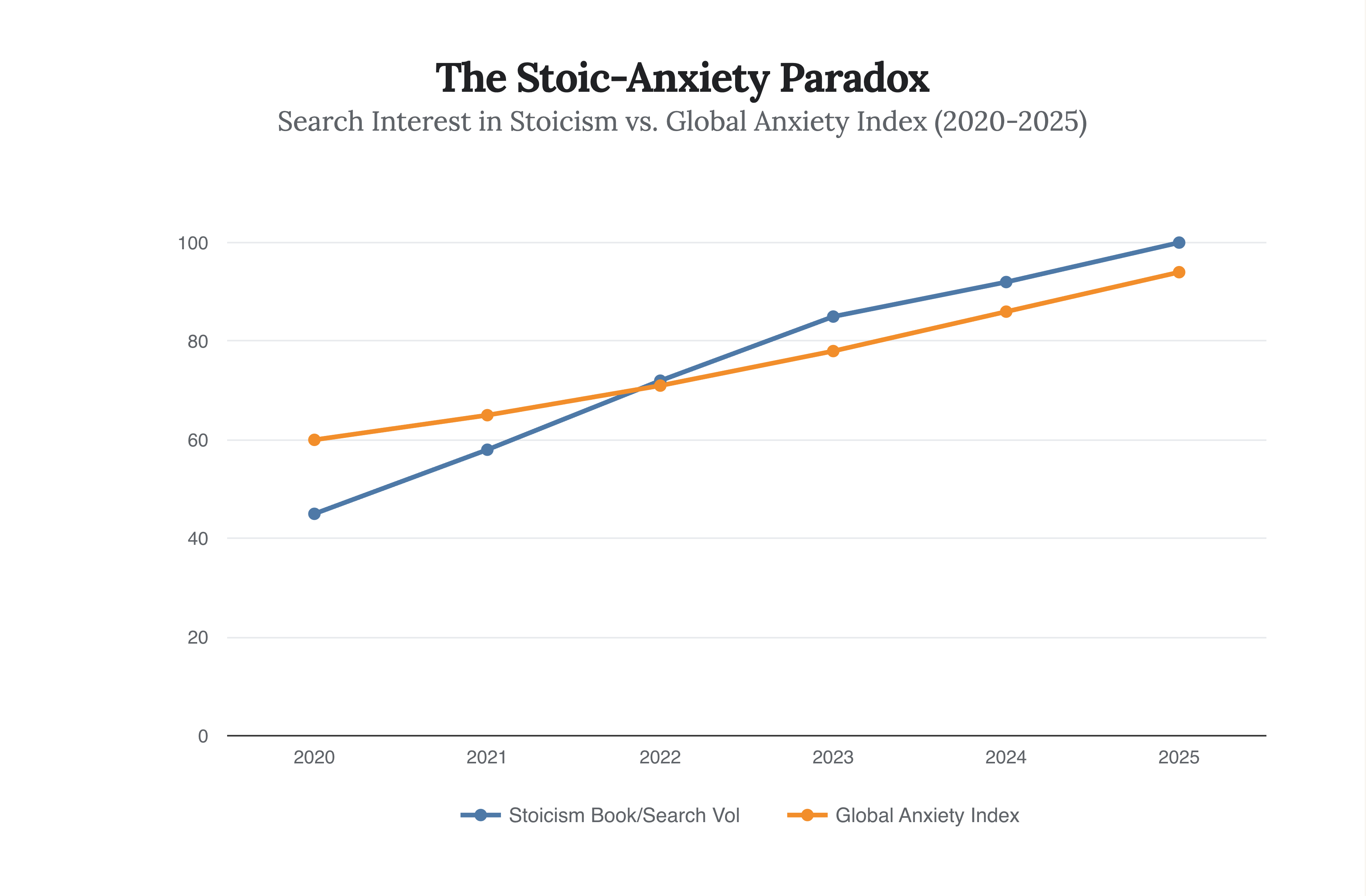
This decoupling is the smoking gun. If Stoicism were an effective antidote to the attention economy, we would expect to see an inverse correlation: as adoption of Stoic texts rises, anxiety should stabilize or fall. Instead, we see a parallel ascent. The consumption of Stoicism has become “performative resilience”—a luxury good purchased by the very demographic (Gen Z and Millennials) most ravaged by the algorithms.
The 9-Hour Siege: Gen Z and the Dopamine Floor
The situation is most critical for the emerging workforce. Confirmed 2025 data sets the global average screen time at 6 hours 54 minutes, but for Gen Z, that figure explodes to over 9 hours per day. In markets like South Africa, it nears 9.5 hours.
This is not merely “consumption”; it is neural rewiring. The “Dopamine Floor”—the baseline level of stimulation required to feel normal—has been raised so high that silence is registered as pain. When a brain acclimated to 9 hours of algorithmic pacing attempts to sit in Stoic silence, it does not find tranquility; it enters withdrawal.
The 2025 “Stress in America” report flags a 65% stress rate specifically linked to AI and information overload among 18-34 year olds. This demographic is buying Marcus Aurelius’ Meditations in record numbers, yet reporting the highest levels of “Technostress” in recorded history. They are armoring themselves with philosophy, but the enemy is bypassing the armor and attacking the nervous system directly.
Unlock deeper strategic alpha with a 10% discount on the annual plan.
Support the data-driven foresight required to navigate an era of radical uncertainty and join a community of institutional-grade analysts committed to the truth.
