



Yesterday, as fireworks illuminated the Alexander Nevsky Cathedral in Sofia, Bulgaria didn’t just ring in 2026—it ended a nineteen-year marathon. On January 1, the Balkan nation officially became the 21st member of the Eurozone, retiring the lev after a 147-year run. The transition marks the final step of a journey that began with EU accession in 2007, but the celebrations mask a deeply fractured reality. Just twelve months ago, nearly six in ten Bulgarians opposed the move, and the country’s inflation rate was still hovering dangerously above the Maastricht limit. The story of how Sofia crossed the finish line is not one of smooth sailing, but of a high-stakes economic gamble paid off at the eleventh hour.
For policymakers in Sofia, the victory is mathematical. The conversion rate has been irrevocably fixed at 1.95583 leva to the euro—a figure familiar to every Bulgarian since the currency board was established in 1997 to crush hyperinflation. Yet, the road to this fixed peg was paved with political chaos. Between 2021 and 2025, the country endured seven parliamentary elections, a cycle of instability that threatened to derail the adoption process entirely. The turning point came only in mid-2025, when inflation figures finally dipped below the European Central Bank’s reference value, granting Sofia the green light it had chased for nearly two decades.
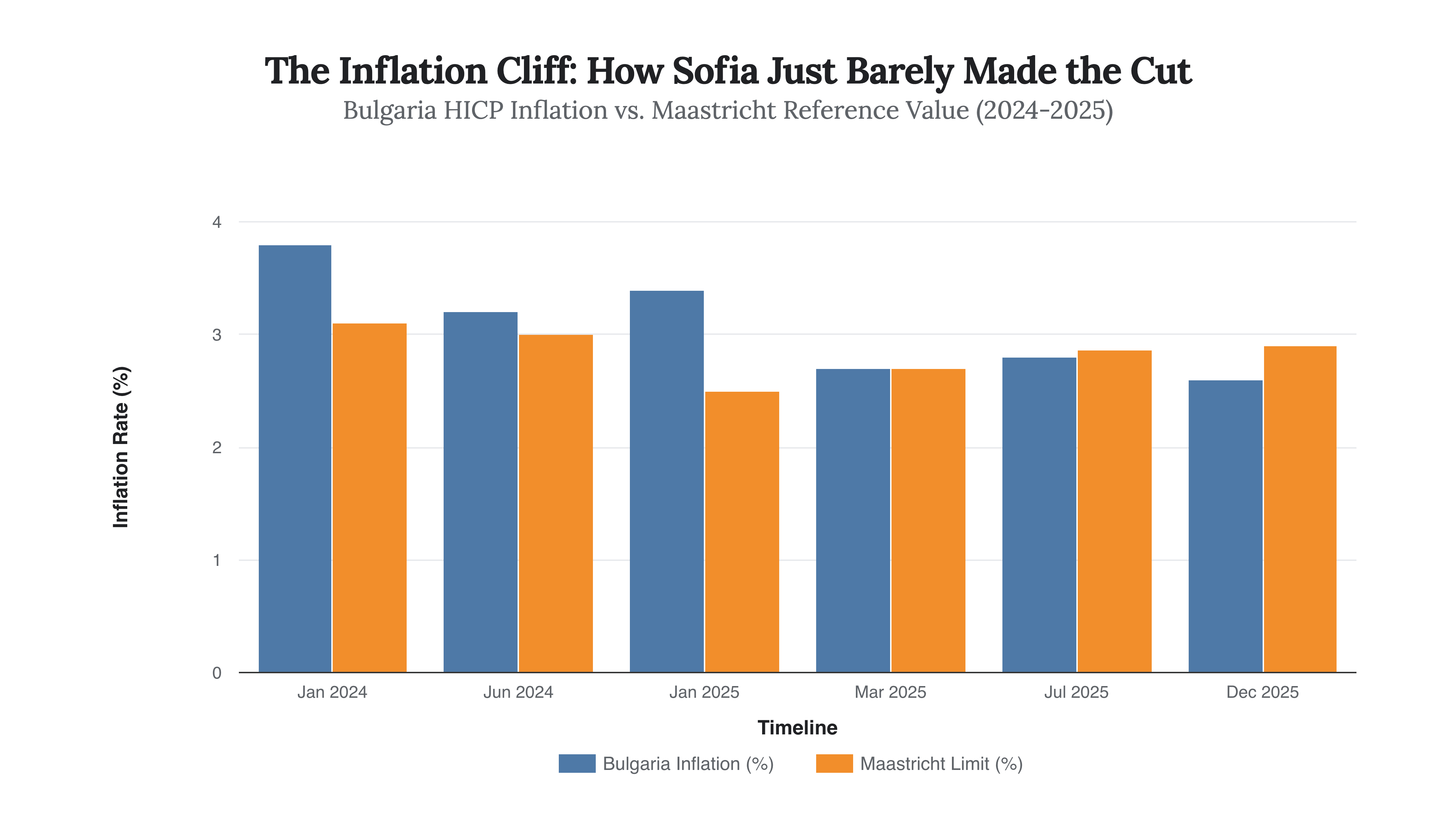
The chart above illustrates the perilous proximity of Bulgaria’s economic metrics to the disqualification line. For most of 2024 and early 2025, Sofia’s inflation remained stubbornly above the Maastricht criterion, driven by energy costs and wage hikes. It was only in March 2025—a mere four months before the final EU vote—that the country hit the magic number of 2.7%, exactly matching the reference value derived from the best-performing EU economies. This narrow margin allowed the European Commission to issue a positive convergence report in June, effectively sealing the deal.
“Joining now will make things worse and faster. In my opinion there is not a single serious positive in adopting the euro.”
This sentiment, voiced by opposition leaders and echoed by nearly half the population throughout 2025, highlights the disconnect between Sofia’s technocrats and the broader public. While the government touted the benefits of lower transaction costs and eliminated exchange rate risks, many citizens feared a “cappuccino effect”—hidden price hikes on everyday goods rounded up during the changeover. The anxiety was palpable: in January 2025, opposition to the euro hit a staggering 57%, fueled by disinformation campaigns suggesting the loss of monetary sovereignty would wipe out savings.
However, a massive information campaign launched in the spring of 2025 appears to have turned the tide just in time for the switch. By November, polls showed a dramatic reversal, with support climbing to 51% as the inevitability of the adoption settled in and the government guaranteed a “dual circulation” period—currently in effect until January 31—where both leva and euros are legal tender.
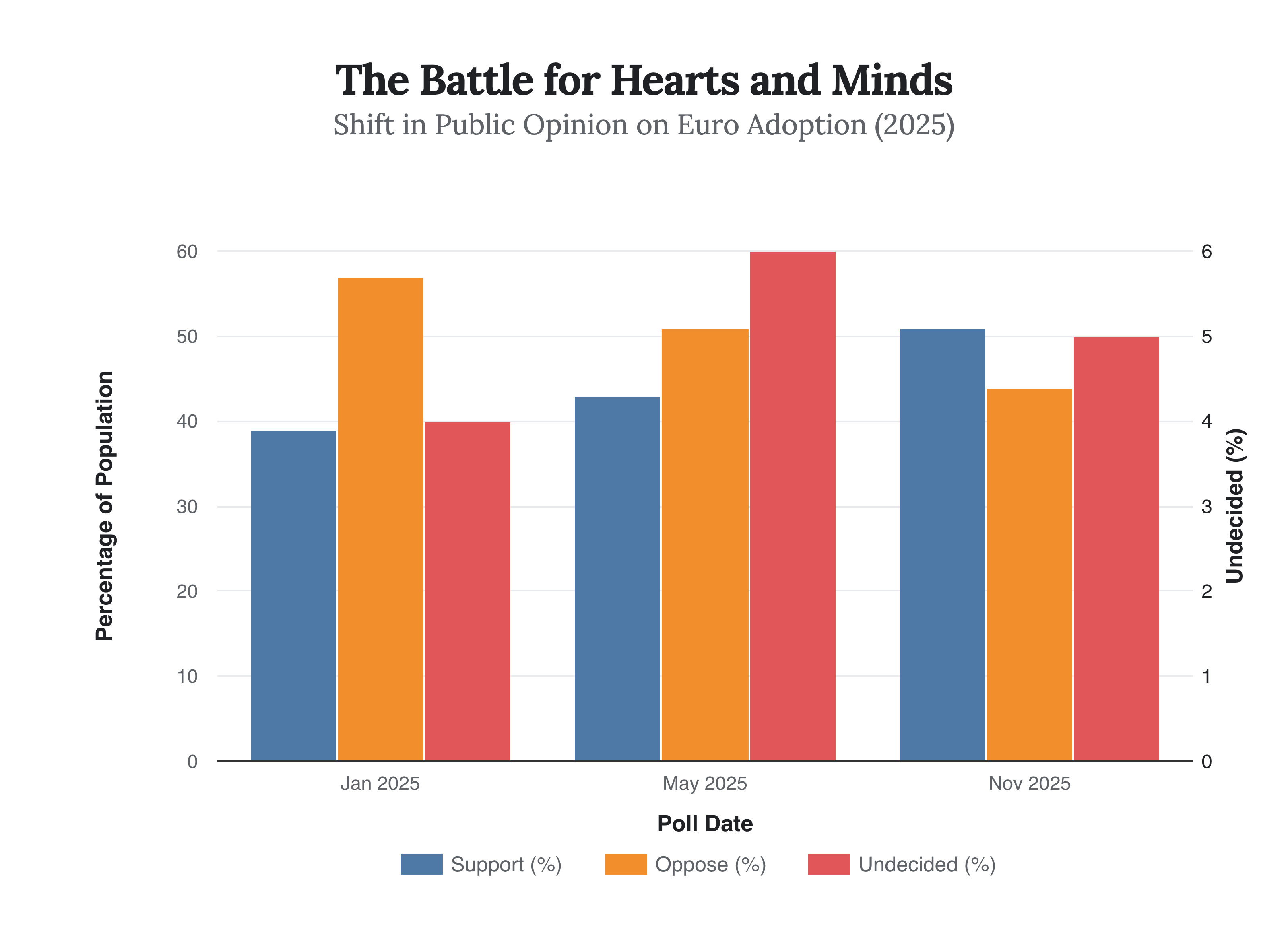
This volatility in public opinion underscores the fragility of the mandate. The government’s victory in winning over the public was likely aided by the tangible economic convergence seen over the last decade. Since joining the EU, Bulgaria has quietly transformed from an economic outlier to a rapidly integrating market.
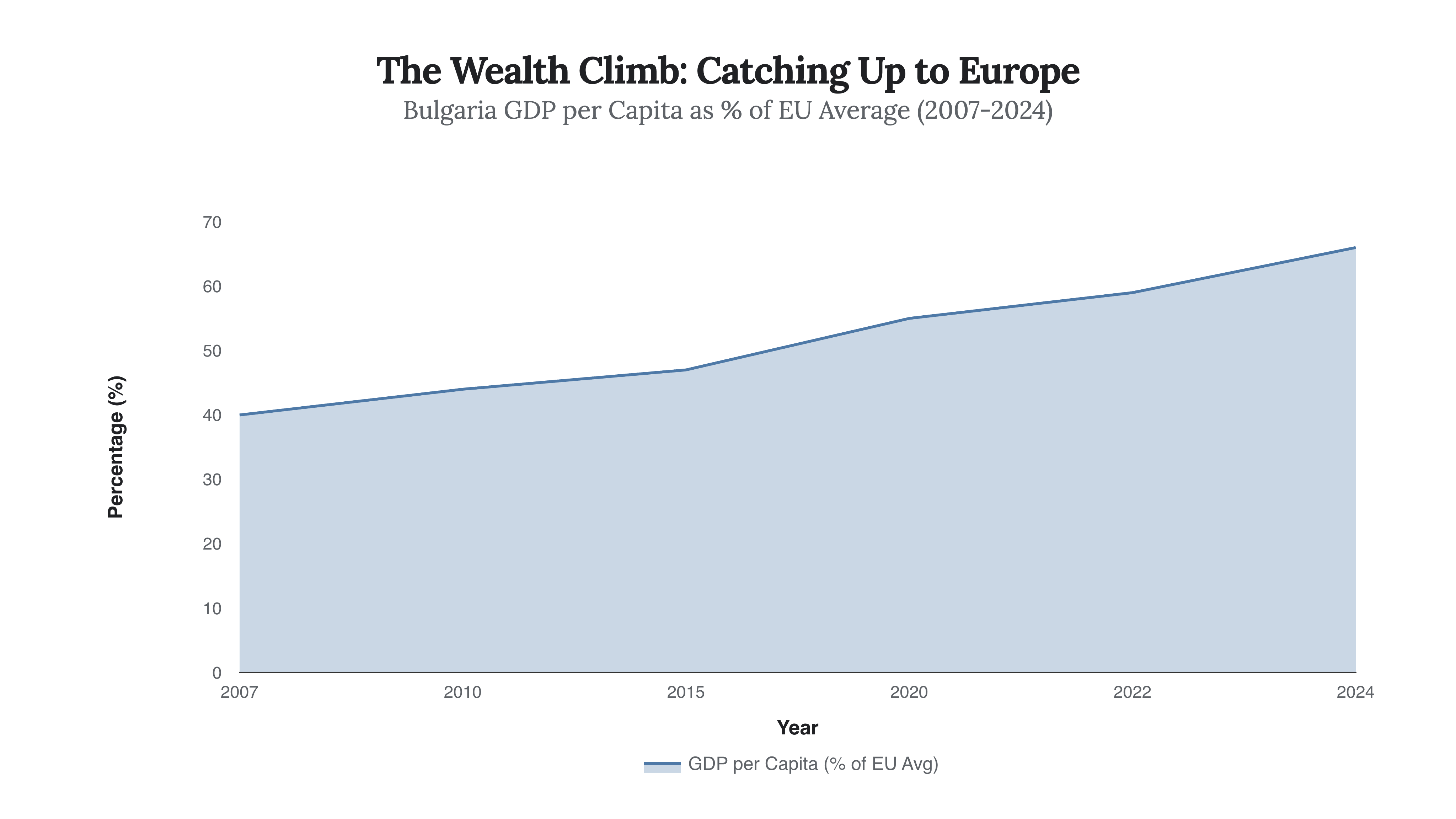
GDP per capita, which stood at a meager 40% of the EU average in 2007, has climbed to 66% as of 2024. The adoption of the euro is expected to accelerate this trend by reducing interest rates for borrowers and integrating Bulgarian businesses more deeply into the single market supply chains.
As Bulgarians spend their first euros today, the dual price displays—mandatory since August 2025—offer a safety net against the feared price gouging. Retailers breaking the conversion rules face fines up to €10,000, a strict enforcement measure designed to build trust in the new currency.
“For Bulgaria, 2026 is a turning point, because it marks the full membership of our country in the euro area... a strategic step that brings greater security.”
While the political elite in Sofia celebrate a mission accomplished, the real test begins now. The adoption of the euro is not a magic wand for prosperity, but a magnifying glass for competitiveness; it removes the shield of devaluation, forcing Bulgaria’s economy to swim or sink on merit alone.