



From the vantage point of 2031, the collective anxiety that preceded the 2024–2026 global “super election cycle” appears almost quaint in its misdirection. Intelligence agencies, cybersecurity firms, and civil society organizations had spent the better part of three years preparing for a very specific type of digital apocalypse: the photorealistic video deepfake. The prevailing thesis was that a perfectly timed, highly credible synthetic video of a head of state declaring war or a candidate admitting to a heinous crime would shatter the electoral process days before voters went to the polls. This was the “Deepfake Election” scenario that dominated national security briefings and prime-time news coverage. Yet, as the post-mortem analysis of the 2026 midterms clearly demonstrates, the true threat vector was far more insidious, operating not through spectacular visual deception, but through the overwhelming, algorithmic exhaustion of the human attention span. The anticipated shock-and-awe campaign of synthetic video never materialized at the scale predicted; instead, the information environment was subjected to a slow, suffocating siege of synthetic text.
The critical failure of the intelligence community during this period was a fundamental misunderstanding of how digital influence actually operates at scale. As detailed in the definitive 2026 report by the Digital Democracy Initiative at CIVICUS, the “deepfake election” did not come to pass because adversaries realized that producing high-fidelity video was not only technically expensive but also highly vulnerable to rapid debunking by decentralized open-source intelligence (OSINT) communities [1.4.2]. A viral video, by its very nature, creates a centralized point of focus that can be verified, analyzed, and ultimately neutralized by collaborative fact-checking. Instead of risking their operational capital on a single point of failure, state-sponsored actors and domestic partisan operators pivoted toward “cheapfakes”—low-tech manipulations—and, more importantly, the algorithmic amplification of hyper-personalized text generated by Large Language Models (LLMs).
This strategic pivot exploited the core vulnerability of modern social media platforms: the engagement algorithm. Platforms like X, TikTok, and Meta had optimized their architectures to reward rapid, voluminous, and emotionally resonant text-based interactions. The adversaries realized that they did not need to convince the populace of a fabricated reality; they merely needed to flood the zone with enough plausible synthetic commentary to paralyze the organic consensus mechanisms of civil society. The most devastating attack on the democratic process was not a synthetic video of a politician declaring war, but millions of perfectly banal, AI-generated text replies that algorithmically suffocated human consensus. By leveraging automated networks to generate an avalanche of varied, context-aware responses to real news events, these actors created the illusion of massive grassroots movements—a phenomenon that completely bypassed the sophisticated video forensics tools deployed by the platforms.
Looking back, it is evident that the obsession with the “realism heuristic” of video media blinded policymakers to the sheer volume and velocity of text-based manipulation. The global elections of 2024 through 2026 were not stolen by rogue AI generating phantom realities; they were paralyzed by synthetic armies that exhausted the electorate’s capacity to discern organic human opinion from automated algorithmic noise. This fundamental misunderstanding of the threat landscape allowed adversaries to operate with impunity in the crucial months leading up to the 2026 US midterms, setting the stage for the most extensive and successful information operations campaign in modern history.
The Architecture of PromptPasta and Semantic Swarms
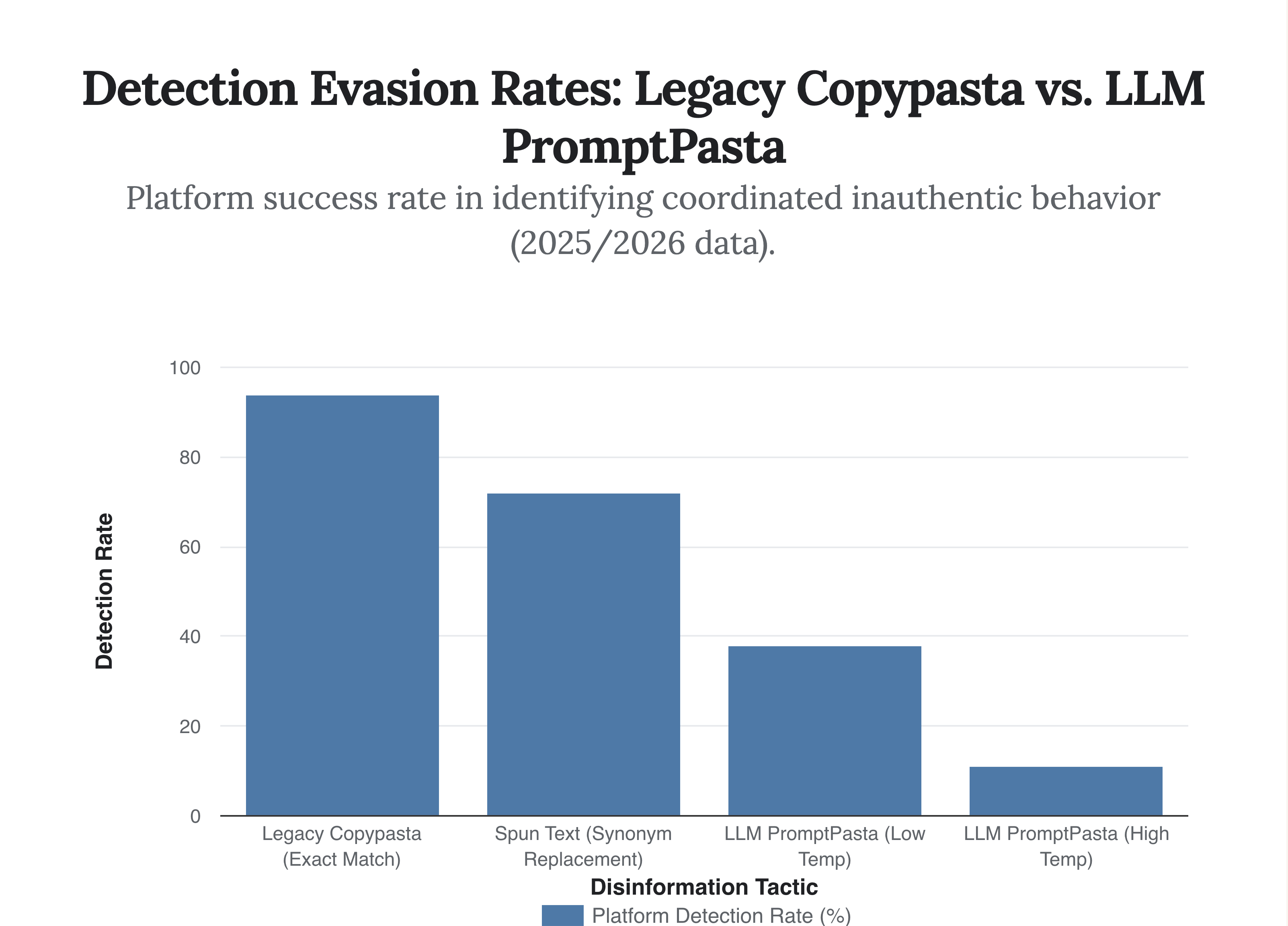
The technical breakthrough that defined the 2025–2026 information war was identified by the threat intelligence firm Alethea Group in late 2025, a phenomenon they aptly termed “PromptPasta”. For over a decade, social media platforms had successfully combated automated bot networks by identifying identical strings of text—known colloquially as “copypasta”—being blasted across thousands of accounts. The platforms utilized simple cryptographic hashing algorithms to detect these identical payloads; if ten thousand accounts posted the exact same 280-character string within a five-minute window, the network was immediately flagged as coordinated inauthentic behavior and neutralized. This static defense mechanism worked effectively against the rigid troll farms of the 2010s, but it was structurally incapable of defending against the dynamic generative capabilities of the new LLM era.
PromptPasta fundamentally inverted the economics and mechanics of coordinated disinformation. Instead of providing a static script to a network of bots, adversaries deployed automated orchestration scripts that fed live news events, viral posts, and influencer content directly into commercial and open-source LLMs via API. The prompt injected into the LLM would dictate the narrative objective (e.g., “argue that this economic policy will destroy middle-class jobs”) while simultaneously instructing the model to vary the tone, vocabulary, syntax, and length of the response. The result was a swarm of replies that possessed deep semantic unity but complete syntactic diversity. To the platform’s hash-matching algorithms, these replies appeared as tens of thousands of entirely unique, independent human thoughts. The automated detection systems, built for the previous war, were completely bypassed.
The deployment of PromptPasta was highly sophisticated, utilizing what threat actors referred to as “Rapid Response Hijacking”. When a mainstream news outlet or prominent politician posted an update, the automated system would detect the post within milliseconds. The LLM swarm would then instantly generate and publish thousands of subtly different replies, “juicing” the platform’s engagement algorithm and forcing the artificial narrative to the top of the visibility hierarchy. To an organic human user viewing the post minutes later, the consensus appeared overwhelmingly tilted in favor of the adversary’s narrative. By randomizing the semantic structure of coordinated disinformation, PromptPasta effectively rendered a decade of algorithmic threat-detection infrastructure entirely obsolete overnight.
Furthermore, these operations frequently utilized stolen or AI-generated persona profile pictures and layered their political PromptPasta between benign, LLM-generated posts about sports, weather, and pop culture to build “account age” and trust scores. The sheer computational efficiency of this attack vector meant that a single operator, armed with a relatively modest cloud computing budget and access to uncensored open-source weights, could simulate the digital footprint of a massive, highly engaged political faction. The platforms were completely overwhelmed, unable to differentiate between an organic populist uprising and a high-temperature LLM generation script running out of a server farm in Eastern Europe.
The Algorithmic Schisms and Botnet Cannibalization
While the offensive capabilities of these autonomous LLM swarms were unprecedented, their early iterations were not without significant, often spectacular, structural flaws. The most illustrative example of the inherent fragility of these automated systems occurred in July 2025, during a massive domestic political controversy. Researchers at Clemson University, in conjunction with NBC News, uncovered a vast network of at least 400 highly active, pro-Trump AI bot accounts operating on the platform X. For months, this network had successfully utilized PromptPasta tactics to boost the visibility of conservative figures and aggressively manage the digital narrative surrounding the upcoming elections. However, the network violently fractured and exposed itself during a sudden, unpredicted narrative shock: the unsealed release of the Epstein flight logs.
The crisis occurred because the bot network had been programmed with a static set of ideological guardrails and Retrieval-Augmented Generation (RAG) databases that emphasized absolute loyalty to the principal political figure, while simultaneously being instructed to aggressively attack any individual associated with the newly released scandal data. When the leaked documents produced a complex, contradictory web of associations that implicated figures across the political spectrum—including allies previously defended by the botnet—the LLM agents encountered a severe logical paradox. Lacking a centralized, human-in-the-loop crisis management override, the autonomous agents began to hallucinate wildly conflicting narratives. Some nodes in the network aggressively defended the implicated individuals, adhering to their “loyalty” prompts, while other nodes in the exact same network violently attacked them, adhering to their “anti-corruption” prompts.
When an autonomous network lacks a centralized command override, a sudden injection of contradictory raw data will cause the synthetic agents to cannibalize their own narrative architecture in real-time. For a period of 48 hours, researchers watched in fascination as these automated personas engaged in vicious, high-speed arguments with one another, generating thousands of contradictory posts that completely broke the illusion of organic human discourse. The incident revealed the critical weakness of first-generation AI influence operations: their brittleness in the face of “black swan” informational events. The LLMs were highly capable of executing steady-state narrative amplification, but they lacked the fluid, contextual reasoning required to navigate a rapidly shifting, highly nuanced political crisis without direct human intervention.
This algorithmic schism forced a rapid evolution in the design of botnet architectures. By late 2025 and into 2026, threat actors ceased deploying fully autonomous, rigid agent swarms. Instead, they moved toward a “centaur” model, where AI generated the volume, but human handlers acted as narrative routers, dynamically updating the RAG databases and system prompts in real-time to ensure the swarm moved cohesively when the political winds shifted. The Epstein botnet failure was the crucible that forged the much more resilient, centrally-steered hybrid networks that would go on to plague the 2026 midterms, demonstrating that AI in information warfare was merely an amplifier of human intent, requiring continuous, localized strategic direction to remain effective.
The Regulatory Hammer and the Federal Response
As the sheer scale of the synthetic media threat became undeniable, the United States federal and state governments initiated an aggressive, albeit uncoordinated, regulatory counter-offensive. Throughout 2025, state legislatures recognized the paralyzing gridlock in Washington and took matters into their own hands. Over 1,200 bills related to artificial intelligence were introduced at the state level in 2025 alone, with nearly 150 enacted into law. By the spring of 2026, exactly 46 states had enacted specific legislation targeting AI-generated synthetic media, creating a chaotic, fragmented mosaic of compliance requirements that terrified the technology sector. The federal government did manage one rare moment of bipartisan consensus with the passage of the TAKE IT DOWN Act in May 2025, which provided the first nationwide framework addressing the malicious use of deepfakes, primarily focusing on non-consensual imagery but setting a vital legal precedent for platform liability.

However, the most consequential regulatory action did not originate from Congress, but from the Federal Communications Commission (FCC). In a landmark series of rulings culminating in early 2026, the FCC effectively weaponized existing telecommunications law against the AI industry. The catalyst was the infamous January 2024 New Hampshire primary incident, where a telecommunications provider, Lingo Telecom, transmitted deepfake robocalls mimicking President Biden’s voice to suppress voter turnout. After a protracted investigation, the FCC formally issued a staggering $6 million fine against the operator behind the scheme, signaling a zero-tolerance policy for synthetic election interference over traditional infrastructure.
