


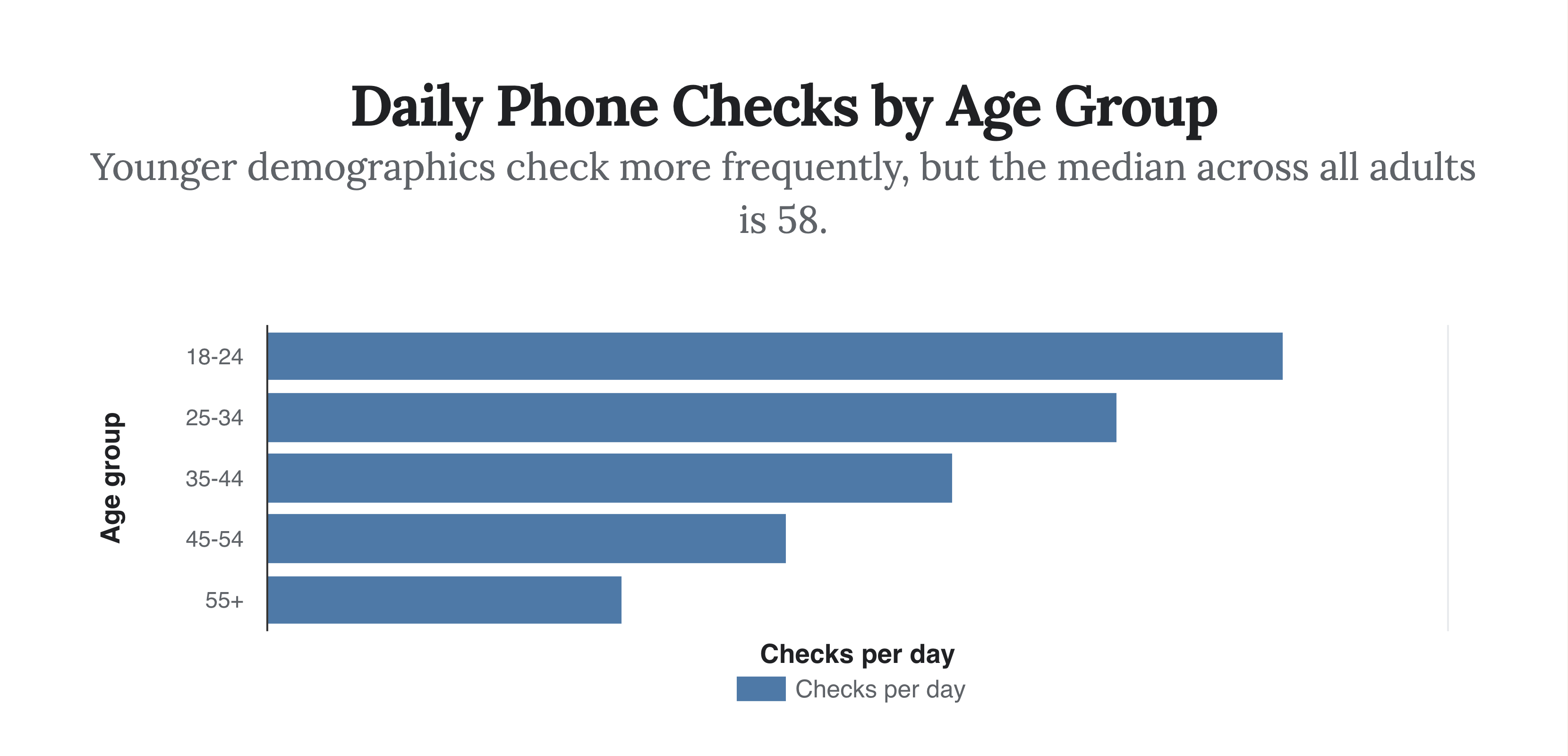
Americans check their phones an average of 58 times per day. This figure, drawn from a 2024 Pew Research Center survey of 2,500 adults, captures a behavior so ingrained it barely registers as a choice. The phone is unlocked while waiting for coffee, at red lights, in the middle of conversations, in the 45 seconds it takes for a laptop to boot. The number has climbed steadily from 30 checks a day a decade ago and shows no sign of plateauing.

The distribution is uneven but pervasive: while the 18-24 demographic averages 86 daily checks, even those over 55 log 30. This is not merely a habit of the young. It is the baseline rhythm of waking life. Each check is a micro-event—a glance, a swipe, a brief immersion—lasting on average 47 seconds before the next interruption. Cumulatively, these fragments add up to something like a second life lived in the interstitial spaces of the day. The statistic is precise, but what it measures is more than a count: it quantifies the frequency with which we turn away from the present moment toward a glowing rectangle of infinite content.
Pascal’s Divertissement: The Flight from the Self
Three centuries before the first smartphone notification, Blaise Pascal diagnosed the psychological engine that now runs in every pocket. In his unfinished Pensées (published posthumously in 1670), Pascal argued that the natural condition of man is misery and that all human activity, properly understood, is an attempt to escape from awareness of that misery. He called this escape divertissement—diversion. The term covers everything from gambling and hunting to the intricate social rituals of the French court. The common thread: anything that fills the mind and prevents it from turning back upon itself.
Pascal’s most quoted line on the subject is a diagnosis, not a proverb: “All of humanity’s problems stem from man’s inability to sit quietly in a room alone” (Pensées, 136, Brunschvicg numbering, trans. A.J. Krailsheimer). The sentence strips away the pretense that our busyness is productive. For Pascal, the inability to be still is not a quirk but a universal pathology. The reason we cannot sit alone is that, when we do, we are forced to confront the silence of our own existence: our contingency, our mortality, our lack of inherent purpose. This is unbearable, so we seek noise—any noise—to drown it out. The king, the hunter, the gambler, and now, the phone checker, are all driven by the same terror of the quiet room.
From Royal Courts to Infinite Scrolls
Pascal’s examples were drawn from his own 17th-century world: the soldier seeking glory, the magistrate absorbed in legal texts, the courtier lost in the elaborate choreography of Versailles. In each case, the diversion is sufficiently absorbing to prevent the mind from wandering back to its essential condition. The contemporary equivalent is not merely analogous; it is a technological amplification of the same principle. The smartphone offers an infinite array of divertissements—social media feeds, news alerts, messaging threads, short-form video—each engineered to capture attention for a few dozen seconds before nudging it toward the next stimulus.
The structure of the diversion has changed, but the underlying need has not. Where Pascal’s contemporaries required external props—cards, horses, conversation—the smartphone internalizes the entire apparatus into a single device. It is a portable diversion machine, always on, always refreshing, always offering a bright alternative to the silence of the self. Pascal would recognize the behavior instantly. What he could not have anticipated is the industrial scale at which this diversion is now produced, measured, and monetized.
The Diversion Machine: How 58 Checks a Day Are Engineered
Each of the 58 daily checks is not a random impulse but the output of a meticulously engineered system. The smartphone’s operating system, its apps, and their notification architecture are designed around one core metric: engagement. The dopamine-driven variable reward schedule, first identified by B.F. Skinner and optimized by the attention economy, turns the phone into a slot machine that pays out in likes, replies, and breaking news. Each unlock offers the possibility of a reward, and the unpredictability of what that reward might be keeps the user pulling the lever.
