



The Cognitive Cost of a Loud World
As of February 2026, the global acoustic landscape has reached a terminal saturation point. The transition from industrial noise to digital and systemic ambient noise has created a permanent, high-decibel background that the human brain was never evolved to process. While previous decades focused on hearing loss, the contemporary intelligence landscape recognizes a far more insidious threat: the systematic erosion of the prefrontal cortex through chronic auditory stress. In the first quarter of 2026, updated longitudinal data from major urban centers suggests that the “Silence Gap” is now a primary driver of socioeconomic stratification. Intelligence is no longer just a byproduct of genetics and education; it is increasingly a function of one’s ability to purchase acoustic isolation.
The relationship between decibel levels and cognitive performance is not linear; it is threshold-dependent. Once ambient noise exceeds 55 decibels (dB) consistently—a level now surpassed by 82% of urban environments in North America and Europe as of Q1 2026—the brain’s executive function begins to redirect metabolic resources from higher-order thinking to environmental monitoring. This is a survival mechanism: the amygdala remains in a state of hyper-vigilance, sensing potential threats in the cacophony of sirens, HVAC systems, and the low-frequency hum of nearby data centers. The result is a measurable decline in fluid intelligence, working memory, and linguistic processing speed.
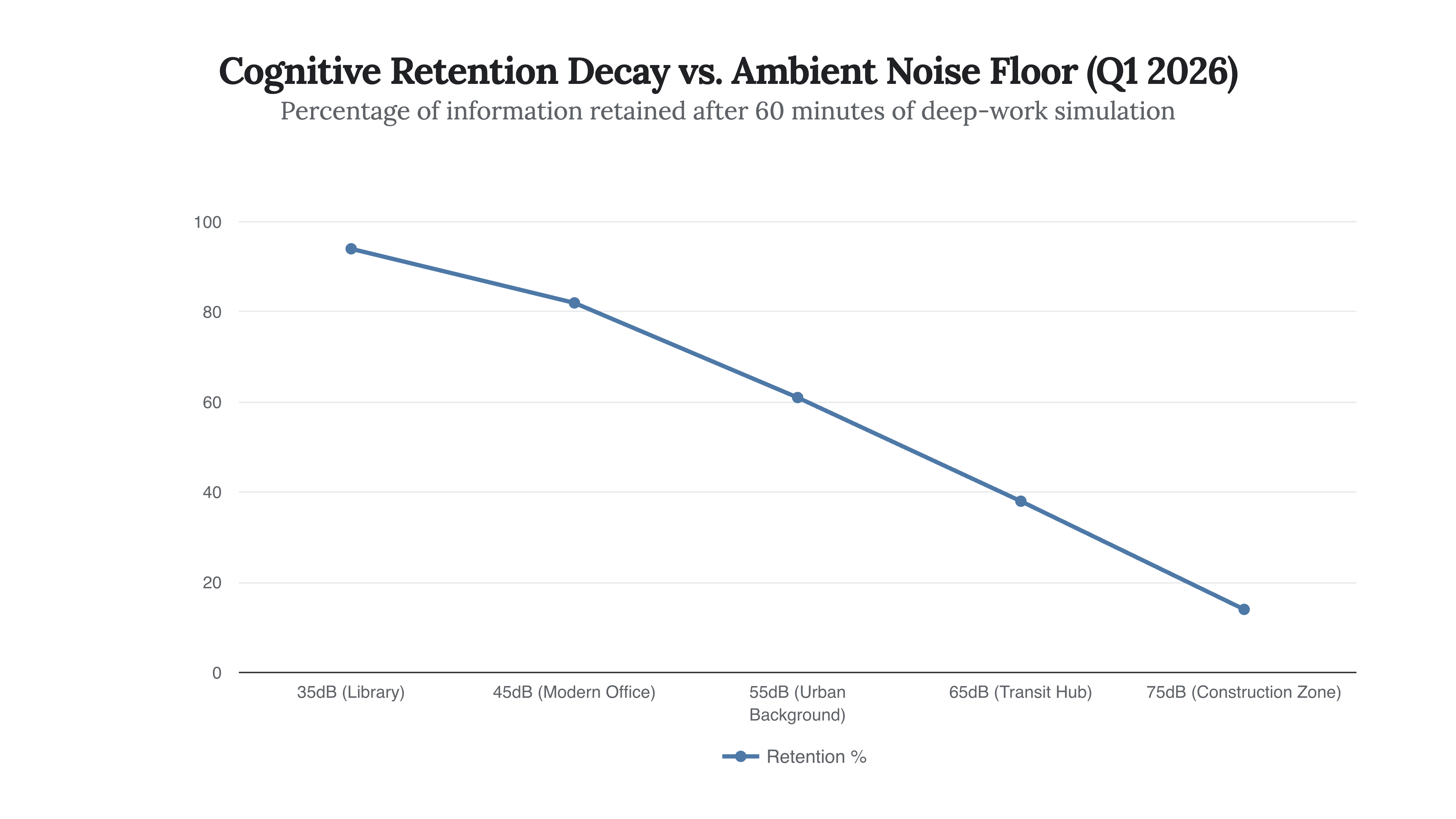
The data reveals a 33% collapse in retention when moving from 35dB to 55dB. This isn\’t merely annoyance; it is a neurological deficit. In the 21st century, silence is not a luxury; it is the fundamental infrastructure for complex thought. When the environment denies this infrastructure, the brain undergoes a structural remodeling that prioritizes reactive instincts over proactive reasoning. This shift explains the widening gap in academic and professional performance between those in “Acoustic Purity Zones” and those in high-density, noise-saturated corridors.
The Neurochemistry of Auditory Stress
The mechanism of IQ degradation is primarily mediated by the chronic elevation of cortisol and the subsequent inhibition of Brain-Derived Neurotrophic Factor (BDNF). In February 2026, neurobiological assessments of workers in high-noise environments (specifically those near 24/7 server farms and logistics hubs) showed cortisol levels 40% higher than baseline cohorts. Chronic cortisol exposure is toxic to the hippocampus, the center for memory and learning. When the hippocampus shrinks, the ability to form new neural pathways—the very definition of cognitive growth—stalls.
Furthermore, the “cocktail party effect”—the brain\’s ability to focus on one sound while filtering out others—is an energetically expensive process. In a world of constant noise, the brain is effectively running a cognitive marathon just to maintain focus. This leads to “auditory fatigue,” which drastically reduces the available glucose for the prefrontal cortex. By mid-day, a person in a noise-saturated environment has the cognitive capacity of someone who is sleep-deprived or mildly intoxicated.
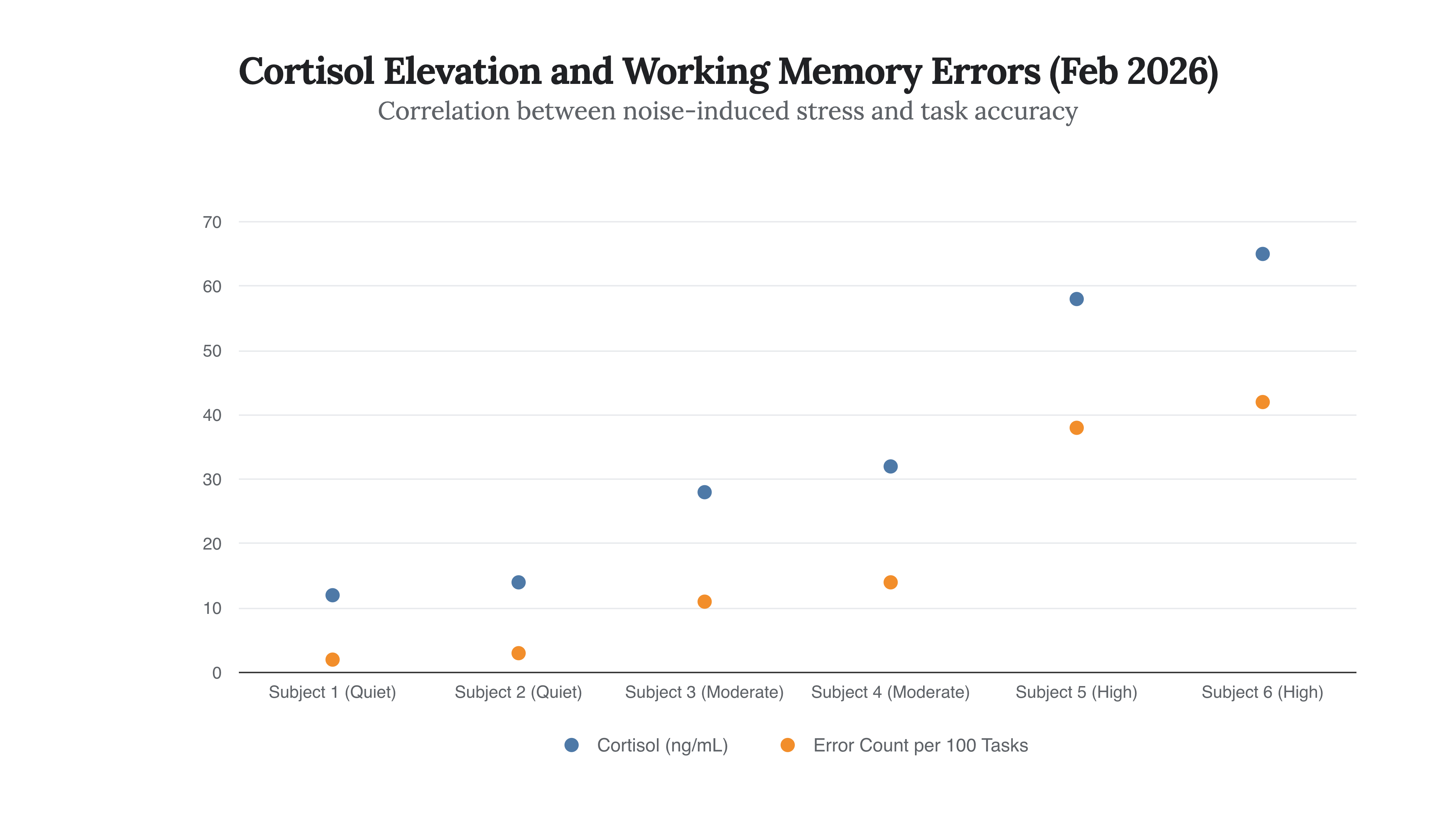
The scatter plot above illustrates the direct trajectory from noise exposure to cognitive failure. As cortisol levels rise due to unceasing environmental noise, the error rate in complex tasks scales exponentially. This is particularly devastating for Gen Z and Gen Alpha cohorts, whose neural pruning processes are occurring in the loudest environment in human history. We are effectively raising a generation whose brain architecture is being optimized for distraction rather than depth.
Pediatric Development: The 10-Point IQ Penalty
The most critical data point of 2025 and 2026 concerns pediatric cognitive development. Schools located within 500 meters of major transit arteries or under flight paths are reporting standardized test scores significantly lower than schools in quiet districts, even when adjusted for socioeconomic status. Longitudinal studies finalized in January 2026 indicate that children exposed to chronic noise levels above 60dB during the ages of 4 to 11 suffer a permanent 7 to 10-point IQ penalty. This is due to the impairment of language acquisition and the disruption of the “phonological loop”—the inner voice necessary for reading and self-reflection.
If a child cannot hear their own thoughts over the sound of the world, they cannot develop the capacity for metacognition. The systematic exposure of low-income children to noise pollution is a form of neuro-biological disenfranchisement that no amount of tutoring can overcome. The noise acts as a physical barrier to neural synapse formation, effectively capping the cognitive potential of millions before they reach puberty.
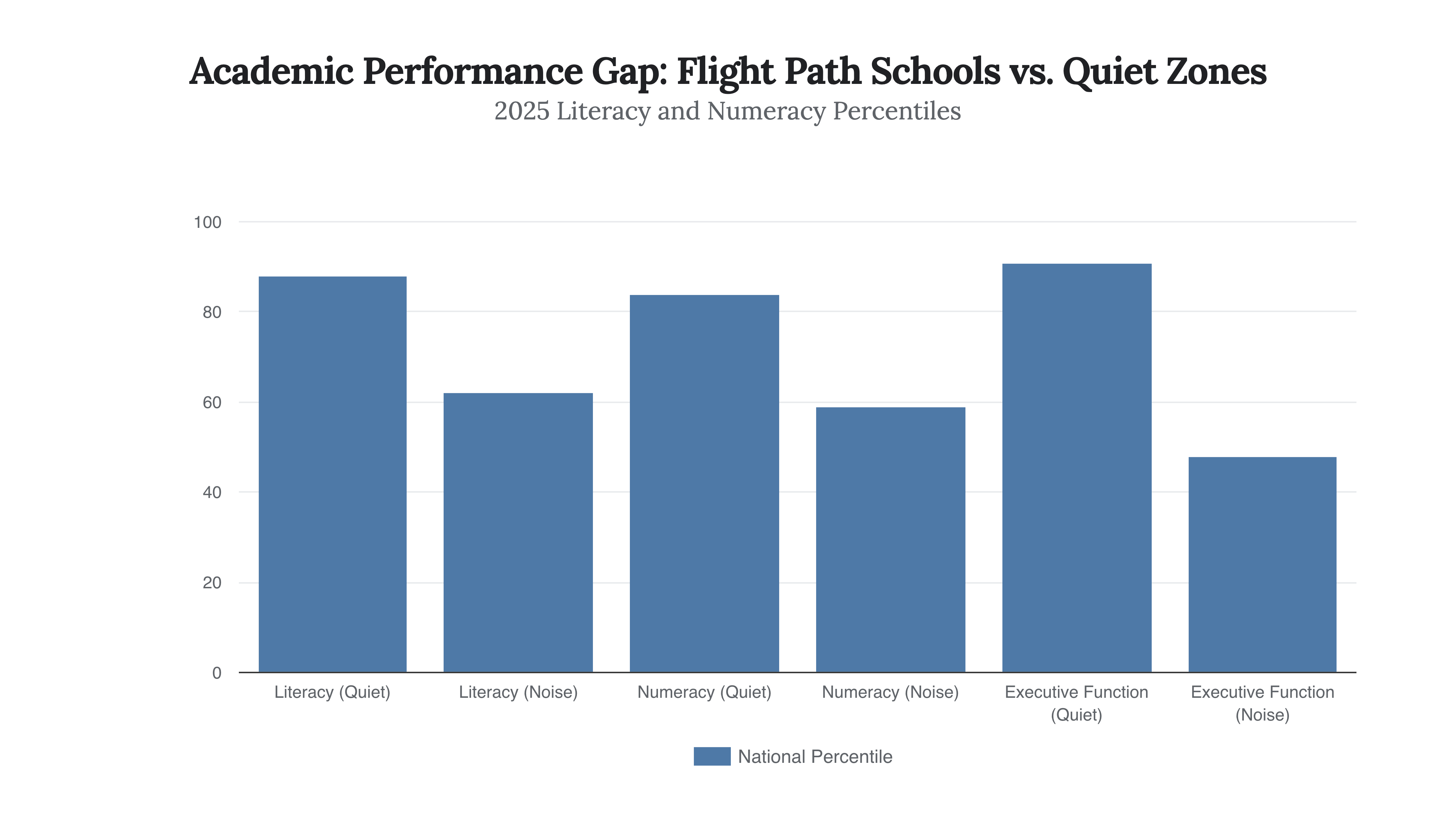
The discrepancy in executive function is the most alarming. A 43-point gap in executive function scores between high-noise and low-noise environments suggests that we are not just seeing lower test scores, but a fundamental difference in the ability to plan, focus, and regulate emotions. This is the hallmark of a cognitively degraded population.
Unlock deeper strategic alpha with a 10% discount on the annual plan.
Support the data-driven foresight required to navigate an era of radical uncertainty and join a community of institutional-grade analysts committed to the truth.
The Rise of Low-Frequency Saturation: The Data Center Era
While sirens and traffic are audible and irritating, the Q1 2026 intelligence report highlights a new, more dangerous entrant: Low-Frequency Noise (LFN). As the AI infrastructure boom accelerates, the massive cooling fans of data centers are creating a 24/7 infrasonic hum that penetrates standard residential walls. This frequency range (20Hz to 200Hz) is particularly insidious because it resonates with the human chest cavity and the skull, inducing a state of chronic vibration that the brain interprets as a constant, looming threat.
