

The year is 2026, and the most dangerous threat to global economic vitality is not inflation, war, or AI alignment—it is the widespread psychological collapse into what Friedrich Nietzsche called the Last Man. Nietzsche prophesied a time when humanity would lose its “arrows of longing,” trading the chaos of creation for a modest, risk-free happiness. Today, that prophecy has hardened into hard data. From the “job hugging” phenomenon in labor markets to record-high personal liability insurance premiums and the collapse of entrepreneurial intent, we are witnessing the architectural completion of a Zero-Risk Society. This briefing analyzes how the 2026 “safetyism” pivot is eroding GDP potential, crushing fertility, and creating a fragility trap where the avoidance of pain guarantees the death of progress.
The Architecture of Zero-Risk: The Death of the Garage
For decades, the “garage entrepreneur” was the engine of Western capitalism. In 2026, that engine has seized. The latest data reveals a stark “Ambition Gap” that has opened between the stability-seeking workforce and the risk-capital demands of the future economy. We have moved from the “Great Resignation” of the early 2020s to the “Great Detachment” or “Job Hugging” of the mid-2020s, where employees cling to corporate roles not out of loyalty, but out of a profound aversion to market volatility.
Recent surveys indicate that the percentage of individuals considering starting a new business has dropped from 17% in 2022 to just 14% in 2025/2026. This is not merely cyclical; it is structural. The modern workforce is prioritizing “earnings protection” and comprehensive benefits over equity upside. The result is an economy that is calcifying. When talent refuses to move, innovation stagnates, and corporate dynamism is replaced by bureaucratic stasis.
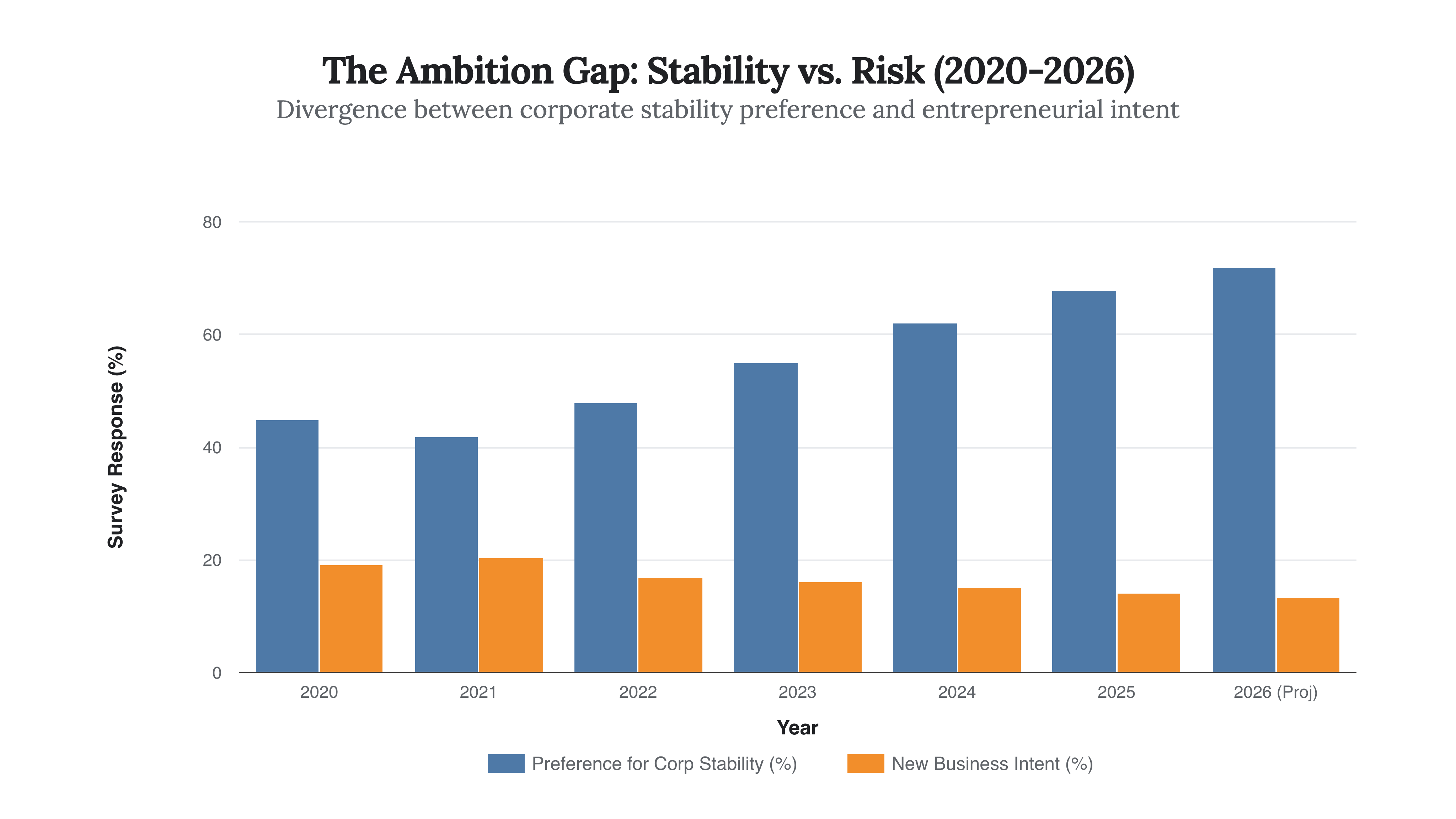
The chart above illustrates the decoupling. As economic uncertainty and geopolitical friction—exemplified by recent tariff tensions—rise, the human response has been to retreat into the perceived safety of large organizations. This is the economic manifestation of the Last Man: “One still works, for work is a form of entertainment. But one is careful lest the entertainment be too harrowing.”
The Liability Shield
This aversion to risk is monetized by the insurance industry. 2025 and 2026 have seen record increases in personal liability and “umbrella” insurance policies. We are not just insuring our cars; we are insuring our interactions. The “legal system abuse” and social inflation cited by industry reports have created a tax on existence. We are paying a premium to exist in a state of pre-emptive defense.
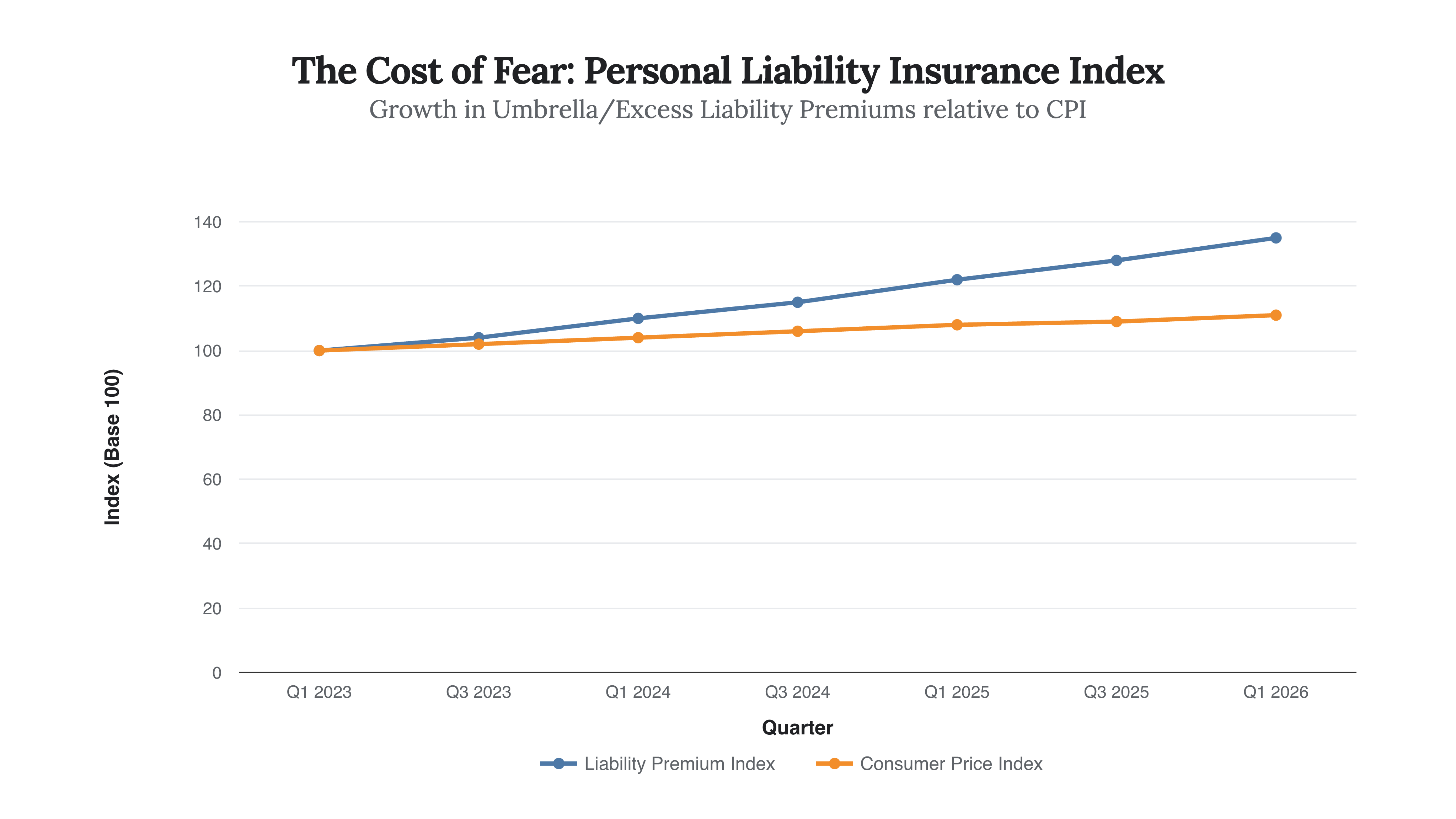
As the data shows, the cost of insulating oneself from risk is outpacing inflation. This capital, diverted to defensive hedging, is capital starved from productive risk-taking. It is the fee we pay to maintain the illusion of control.
The Sedation Feedback Loop: Digital Somatic Compliance
Nietzsche described the Last Man as having “invented happiness” while engaging in small pleasures. Today, that happiness is algorithmically served. The 2024-2025 Time Use Surveys reveal a disturbing trend: as we withdraw from the physical risks of the world, we are filling the void with passive digital consumption. The “hikikomori” phenomenon is no longer just Japanese; it is global.
Gen Z and Alpha cohorts are reporting 4+ hours of daily social media usage, often citing it as a primary source of “connection,” yet 94% report mental health challenges. This is the paradox of the Last Man: we are safer than ever, connected than ever, yet more anxious than ever. The removal of friction—the very thing we evolved to overcome—has resulted in a dopamine trough.
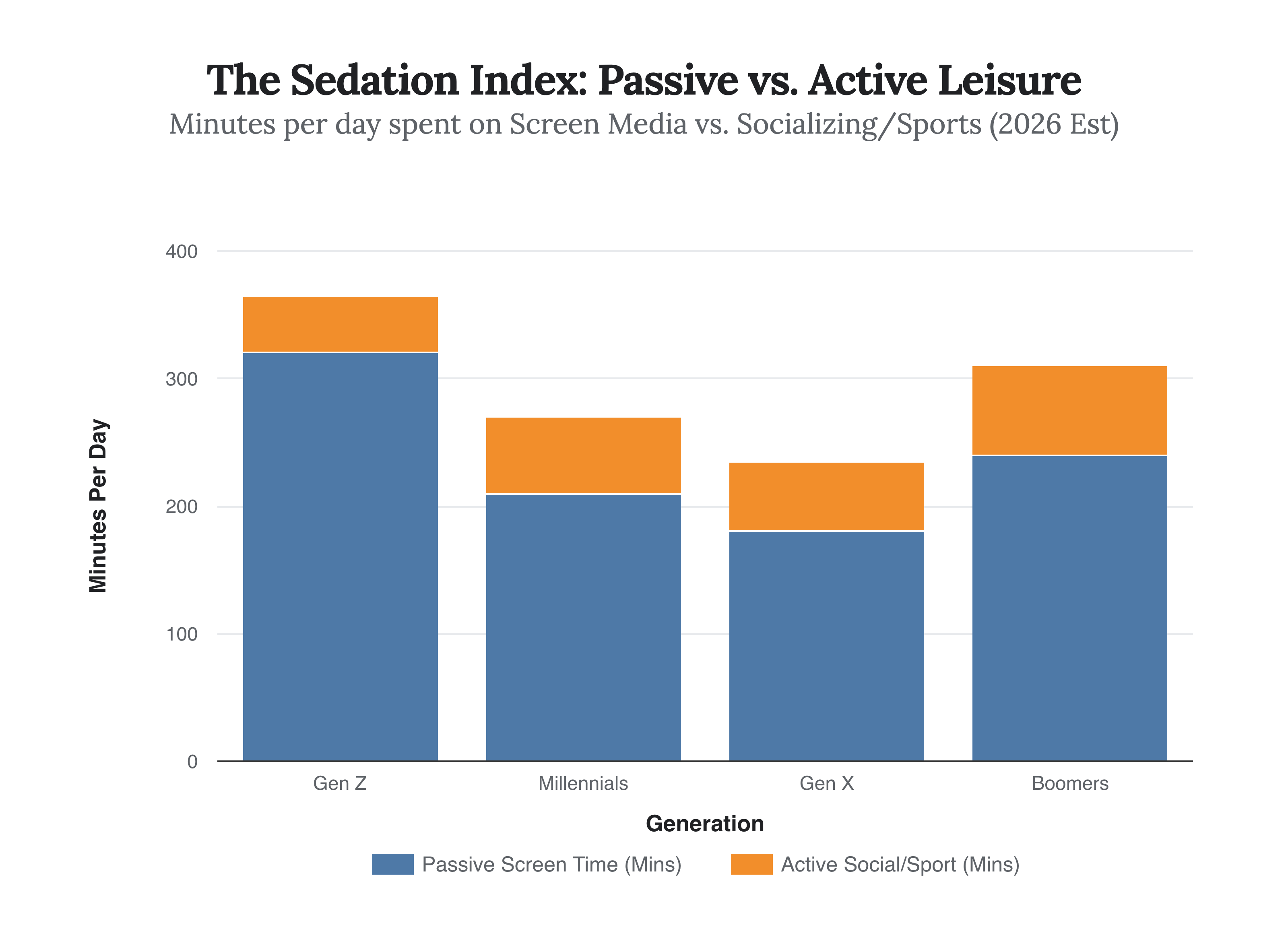
The chart above highlights the generational decay of active agency. Gen Z spends nearly seven times as much energy on passive reception as they do on active engagement. This is not merely “laziness”; it is a risk-mitigation strategy. To act is to risk failure, rejection, or injury. To consume is safe. The Last Man chooses safety every time.
The Algorithm as Nanny
By 2026, AI has evolved from a tool of productivity to a tool of decision offloading. We are seeing the rise of “Menu Anxiety” where consumers—and increasingly junior executives—are paralyzed by choice. The reliance on AI to dictate schedules, draft responses, and even suggest life choices is the ultimate surrender of the Will to Power. We are building a digital panopticon that protects us from the burden of our own autonomy.
