


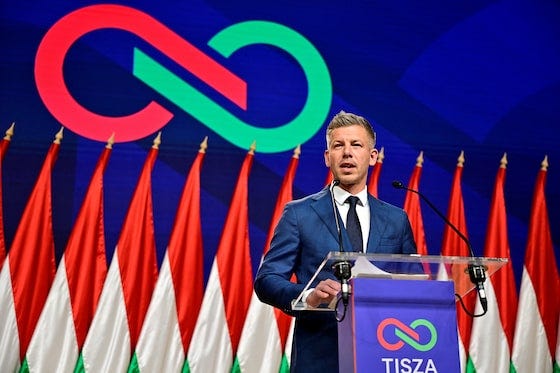
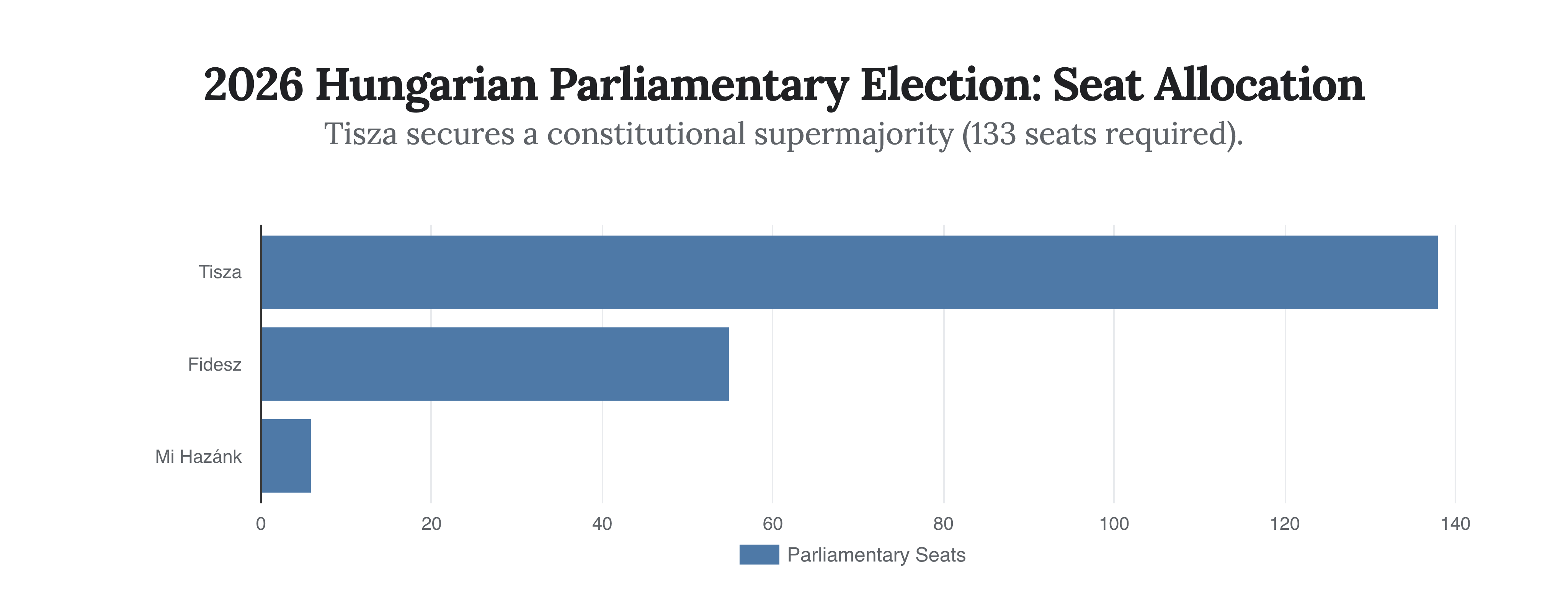
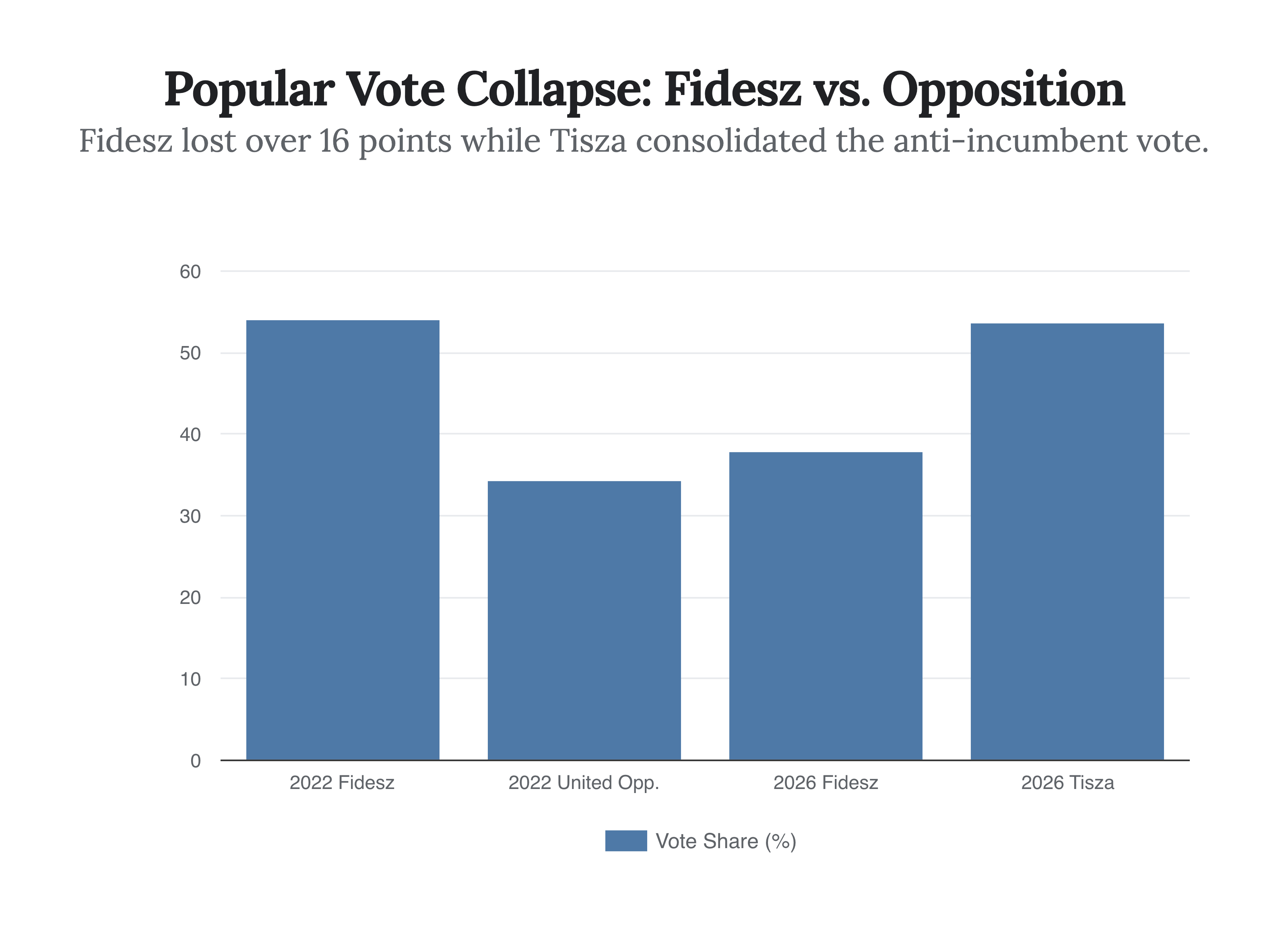
On April 12, 2026, the political gravity of Europe fundamentally shifted. Viktor Orbán, the European Union’s longest-serving leader and the self-proclaimed pioneer of “illiberal democracy,” conceded a crushing electoral defeat. The victor, 45-year-old Péter Magyar and his recently formed Tisza party, did not merely scrape together a coalition to oust the incumbent; they executed a hostile takeover of the Hungarian parliament. Securing 53.6% of the popular vote against Fidesz’s 37.8%, Tisza captured an astonishing 138 of the 199 parliamentary seats.
This is not a simple transfer of power; it is a structural reset of a nation. By surpassing the 133-seat threshold required for a two-thirds constitutional supermajority, Magyar’s government holds the mandate to completely dismantle the deeply entrenched legal frameworks Orbán spent 16 consecutive years building. For institutional investors and geopolitical strategists, the immediate lesson is clear: heavily centralized, seemingly impregnable political systems are highly susceptible to sudden, catastrophic failure when a credible, insider threat emerges.
The strategic architecture of Magyar’s victory is a masterclass in solving the opposition’s coordination problem. Prior to this cycle, Orbán’s Fidesz party maintained an iron grip not necessarily because they held overwhelming popular support, but because the opposition was hopelessly fractured. In previous elections, anti-Orbán voters were forced to choose between a myriad of disjointed, ideological micro-parties, effectively diluting their electoral leverage.
Magyar, a former Fidesz insider who broke with the party in 2024, recognized this systemic inefficiency. He did not build a fragile coalition of disparate interests; he built a monopoly on dissent. By presenting himself as a pragmatic, uncorrupted alternative who intimately understood the mechanics of the ruling party, Magyar created an informational cascade. The moment his viability was proven during the 2024 European Parliament elections, anti-Orbán capital—both political and financial—consolidated rapidly under the Tisza banner.
The Mathematics of Mobilization
An election in an entrenched, semi-autocratic system is rarely decided by changing minds; it is decided by altering the perceived utility of showing up. For over a decade, Fidesz benefited from a pervasive sense of electoral fatalism among the youth and urban populations. If the game is rigged, the rational choice is not to play. Magyar fundamentally changed this payoff matrix.
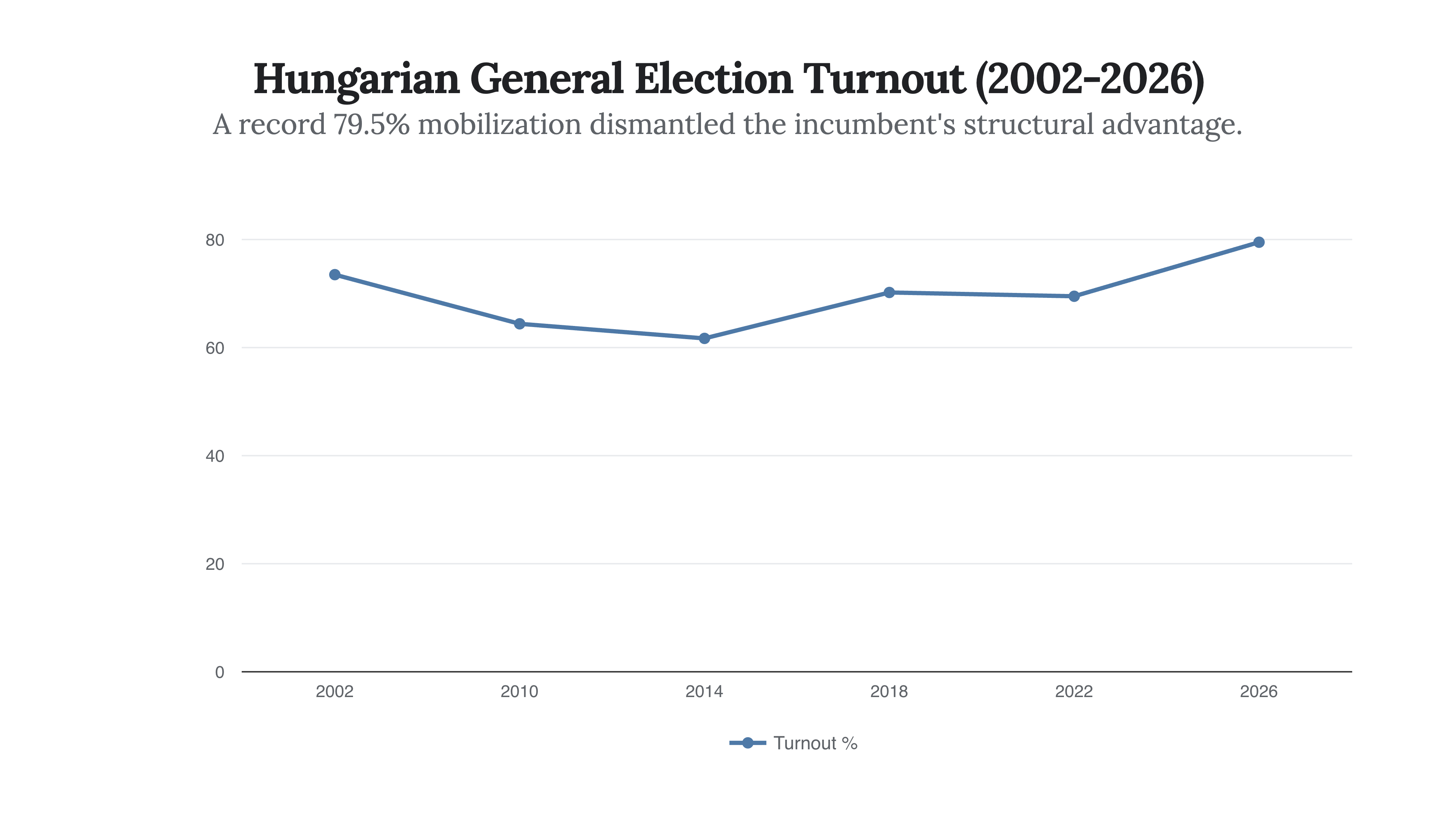
By aggressively touring rural Fidesz strongholds, holding rallies in up to six towns a day, and leveraging decentralized digital networks, Magyar bypassed the state-controlled media apparatus. He convinced the electorate that the margin of victory was entirely dependent on their individual participation. The result was a staggering 79.5% voter turnout—the highest since Hungary’s first free elections following the fall of communism in 1990.
When the perceived cost of inaction eclipses the friction of participation, a previously dormant electorate can overwhelm even the most sophisticated gerrymandering. Fidesz had engineered the electoral map to ensure that a fragmented opposition would need to win the popular vote by at least five percentage points just to secure a simple majority. They never modeled a scenario where a unified opposition would win the popular vote by nearly 16 points. As the April 12 results poured in, the geographic fortress Fidesz had built in rural districts collapsed entirely, with Tisza securing leads in 95 of the 106 electoral constituencies.
Unlock deeper strategic alpha with a 10% discount on the annual plan.
Support the data-driven foresight required to navigate an era of radical uncertainty and join a community of institutional-grade analysts committed to the truth.
The Geopolitical Recalibration
The international reverberations of the April 2026 vote are immediate, severe, and far-reaching. Viktor Orbán was not merely a prime minister; he was the primary European node for a rising global nationalist network. He cultivated profound ties with Moscow, routinely stalling European Union military aid and sanctions directed at Russia, and positioned himself as the ideological darling of the American MAGA movement. Just days prior to the election, U.S. Vice President JD Vance arrived in Budapest to bolster Orbán’s flailing campaign, touting his leadership as a “model to the Continent”.
That model has now been overwhelmingly rejected by the very citizens subjected to it.
The collapse of Fidesz—dropping from a dominant 54.1% in 2022 to a meager 37.8% in Q2 2026—deprives Moscow of its most reliable veto in Brussels. For the European Union, Magyar’s victory is an unparalleled strategic windfall. The new Prime Minister-elect has vowed to immediately unfreeze billions in EU cohesion funds that had been withheld due to Orbán’s rule-of-law violations. By realigning Hungary with mainstream European democratic standards, Magyar effectively closes the geopolitical backdoor that foreign adversaries had long utilized to disrupt EU consensus.
The loss of Budapest as a strategic safe haven forces a massive recalculation for both the Kremlin and populist factions in Washington, as their highest-leverage European asset has been abruptly liquidated. The strategic value of an ally is wholly contingent on their domestic stability. Orbán’s defeat underscores the deep fragility of relying on highly personalized, autocratic proxies. The moment the domestic population solves the coordination problem and unifies behind a viable alternative, the international leverage of the autocrat evaporates overnight.
The Constitutional Mandate and Economic Reality
Moving forward into the remainder of 2026, the focus shifts entirely from electoral victory to institutional implementation. A simple majority would have meant Magyar stepping into an administrative quagmire, forced to battle a deeply embedded Fidesz apparatus across the judiciary, media, and state-owned enterprises. But 138 seats change the strategic calculus from the ground up.
With a two-thirds supermajority, Tisza holds the undisputed legal mandate to amend the constitution. They possess the legislative firepower to systematically dismantle the patronage networks Fidesz constructed, restore independence to the courts, and break up the state-sponsored media monopolies. This is not mere reform; this is institutional reconstruction.
However, we must account for the underlying economic incentives that made this reconstruction possible. The economic reality of April 2026 simply could no longer support the political fiction Fidesz was selling. Years of chronic inflation, a deteriorating forint, and severe underinvestment in essential public services had stripped the regime of its core utility: everyday stability. Once Magyar weaponized this reality—relentlessly pointing out that nationalist rhetoric cannot staff a hospital, run a train, or lower grocery prices—the illusion of Fidesz’s administrative competence shattered.
Magyar recognized that the Fidesz coalition was held together by economic patronage, not purely ideological zeal. By campaigning intensely on deteriorating public health care and unchecked corruption, Magyar offered a highly pragmatic value proposition. He promised a return to functional, transparent governance and the immediate integration of badly needed European capital.
The ultimate strategic lesson of the 2026 Hungarian election is that ideological strongmen rarely fall to foreign diplomatic pressure; they fall when their domestic economic patronage networks run out of capital to buy loyalty. With his new 138-seat supermajority, Magyar now controls that capital.
The rapid nature of this transition introduces its own market volatility, but it is the volatility of a turnaround, not a collapse. The speed at which Fidesz elites recognize their vulnerability and attempt to negotiate safe exits will determine the smoothness of the capital transition over the coming months. Magyar faces the immediate challenge of managing astronomical expectations. His coalition of voters spans from disaffected conservatives to progressive urbanites. The primary glue holding them together was a shared, urgent desire to remove Orbán. Now that the apex predator has been eliminated, the true test of Magyar’s strategic acumen will be maintaining coalition cohesion while executing these complex, structural reforms.
For the international community, institutional investors, and defense strategists, Hungary has transformed overnight from the European Union’s greatest internal liability to its most compelling democratic resurgence story. The market response will likely be swift, as capital allocators price in the unlocking of European funds and the return of a predictable, rule-of-law-based operating environment. The Hungarian election of April 2026 is definitive proof of concept: even the most entrenched, mathematically gerrymandered illiberal machines possess critical, fatal vulnerabilities—waiting only for the right political entrepreneur to arrive and exploit them.