



On Thursday morning, a motorcade of the world’s most powerful technology executives arrived at the White House for a gathering that may well define the next decade of American innovation. The event, a closed-door summit launching the “Genesis Mission,” brought together fierce commercial rivals—including Microsoft, Nvidia, Google, Amazon, and OpenAI—under a single federal mandate. The headline figure isn’t just the number of attendees, but the sheer economic force they represent: the combined market capitalization of the companies in the room exceeds $12 trillion, a sum that eclipses the GDP of every nation on Earth except the United States and China.
The meeting, presided over by Energy Secretary Chris Wright and OSTP Director Michael Kratsios, marks a pivotal shift in U.S. industrial policy. For years, Silicon Valley and Washington have engaged in an awkward dance of regulation and resistance. Thursday’s summit signaled the end of that cold war, replacing it with a “full-stack” alliance designed to knit private sector compute power with the Department of Energy’s (DOE) massive scientific datasets. The goal? To construct the “American Science and Security Platform,” a unified AI engine capable of accelerating breakthroughs in everything from nuclear fusion to drug discovery.
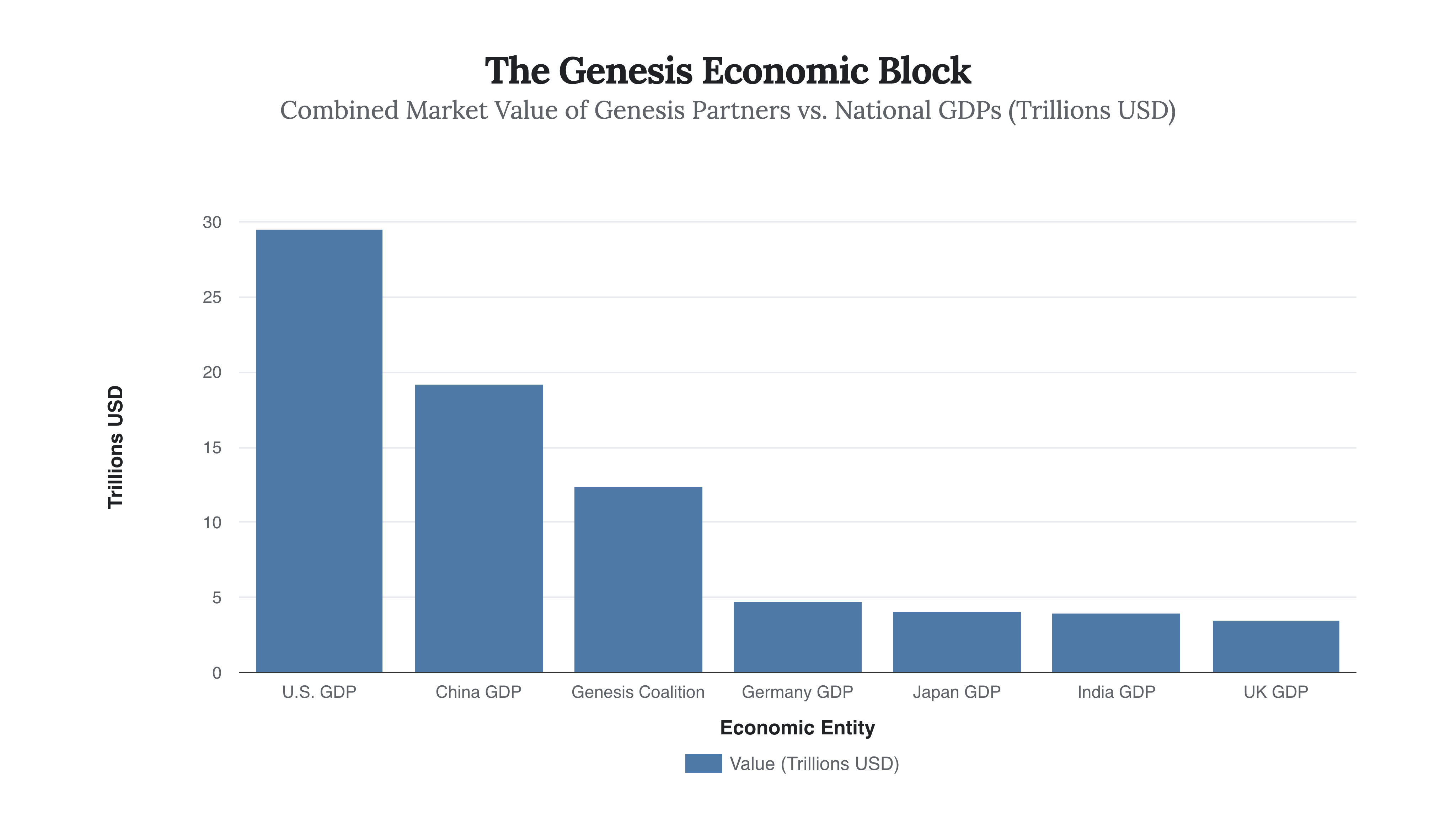
The chart above illustrates the staggering scale of the alliance. By convening “The Big Four” (Microsoft, Nvidia, Google, Amazon) alongside hardware giants like AMD, Intel, and Dell, and AI labs like OpenAI, Anthropic, and xAI, the White House has effectively created a third superpower entity. This “Genesis Coalition” commands more financial resources than the entire economies of Germany, Japan, or India.
The “Full-Stack” Strategy
The significance of the Genesis Mission lies in its diversity. Unlike previous summits focused solely on social media or consumer tech, this meeting emphasized the physical and computational infrastructure required to maintain American hegemony. The attendee list was carefully curated to represent the entire AI supply chain: chip designers (Nvidia, AMD, Groq), cloud infrastructure providers (AWS, Azure, CoreWeave), model builders (OpenAI, Anthropic), and system integrators (IBM, Palantir).
“Today’s announcement of 24 new research partnerships is only the beginning, as we deliver on President Trump’s mandate to bring the entire scientific community... into the Genesis Mission.” — Michael Kratsios, OSTP Director
This “all-hands-on-deck” approach is necessary because the scientific challenges the DOE aims to solve—such as automated experiment design and predictive modeling for critical minerals—require computational resources that no single government agency can afford. By signing Memorandums of Understanding (MOUs) yesterday, these companies have agreed to harmonize their architecture with DOE national labs, effectively creating a bridge between the world’s fastest supercomputers and the world’s most advanced commercial AI models.
The $320 Million Seed Fund
While the private sector brings the trillions in valuation, the Department of Energy is putting immediate cash on the table to grease the wheels. Just days prior to the meeting, the DOE unveiled a targeted $320 million investment to build the initial capabilities of the Genesis Mission. Unlike the broad, nebulous grants of the past, these funds are allocated with surgical precision to specific structural pillars.
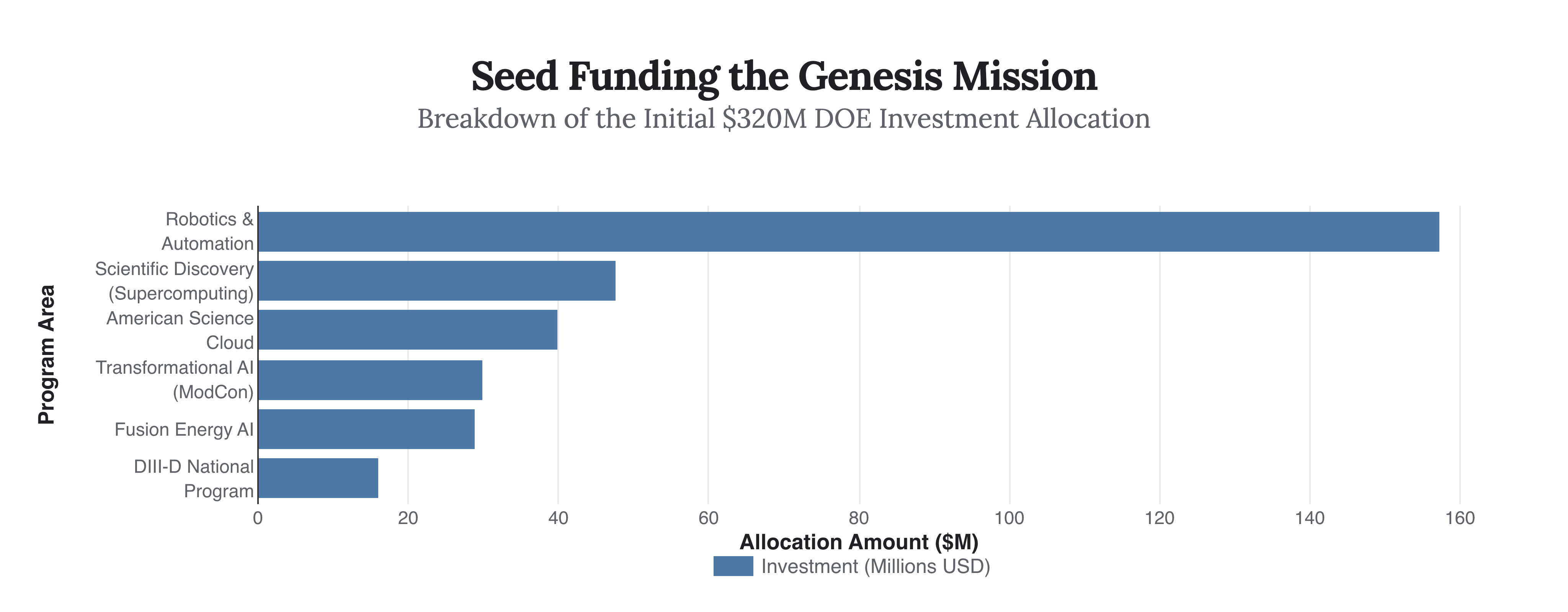
As the breakdown shows, nearly half of the initial funding is directed toward robotics and automation. This reveals the true nature of the Genesis Mission: it is not just about chatbots or large language models. It is about physical AI—robots that can run autonomous experiments in bio-labs, AI that can control fusion reactors in real-time, and systems that can manage the complex logistics of a modern energy grid.
The allocation of $30 million to “ModCon” (the Transformational AI Models Consortium) is particularly notable. This initiative tasks the participants with building “self-improving AI models” that can leverage the DOE’s unique proprietary data—data that private companies could never generate on their own. It is a trade: the tech giants get access to the crown jewels of American scientific data, and the government gets access to the silicon and software that powers the modern world.
The Energy Imperative
Looming over the entire summit was the issue of energy. The “massive infrastructure needs” of AI were a central topic of discussion. With data centers projected to consume an ever-growing share of the U.S. power grid, the presence of energy-focused companies and the leadership of the DOE suggests that the Genesis Mission is as much about powering AI as it is about building it.
“The Genesis Mission will be transformative for our country, uniting industry, academia, and our National Labs to deliver powerful and impactful scientific discovery.” — Dr. Darío Gil, DOE Under Secretary for Science
Ultimately, the White House meeting confirms that the era of laissez-faire AI development is over. The U.S. government has recognized that AI is not merely a commercial product but a strategic national asset on par with nuclear capability. By uniting $12 trillion in private capital with the scientific might of the federal government, the Genesis Mission represents the single largest mobilized effort to direct the trajectory of artificial intelligence in history.
Fascinating. The sheer scale of this 'full-stack' alliance you describe, connecting private compute power with government data, feels like a real inflection point for AI's societal impact. It makes me think of my Pilates practice, where integrating disparate movements creates a surprisingly powerfull, unified strength.