


Navigating the Narrow Path Between Recession and Recovery
Germany enters 2025 at a critical juncture, navigating a narrow and precarious path between outright recession and a meaningful economic recovery. After two consecutive years of contraction, the consensus forecast among leading economic institutes points towards near-stagnation, with growth projections converging in a tight, uninspiring range of 0.1% to 0.4%. This muted outlook reflects a complex interplay of persistent structural weaknesses, significant geopolitical headwinds, and the uncertain impact of a substantial new government fiscal stimulus package.
While domestic demand, buoyed by rising real wages and planned public investment, is expected to be the primary growth driver, the formidable export-oriented industrial sector faces significant challenges from new U.S. tariffs and slowing global demand. The critical question for 2025 is whether the injection of public funds can sufficiently counteract the external pressures and deep-seated domestic issues to pull Europe’s largest economy out of its prolonged torpor. The answer will have profound implications not only for Germany but for the stability and growth prospects of the entire Eurozone.
The Tug-of-War: External Headwinds vs. Domestic Stimulus
Germany’s economic fate in 2025 is being pulled in two opposing directions. On one hand, the powerful export engine that has historically driven its prosperity is sputtering. On the other, a significant fiscal expansion aims to stimulate domestic activity and modernize the country’s infrastructure. The net effect of this economic tug-of-war will define the year.
The Tariff-Shaped Cloud Over German Exports
The most significant external threat is the imposition of new U.S. tariffs, which casts a long shadow over Germany’s export-dependent manufacturing sector. The Bundesbank explicitly identifies this protectionist trade policy as a primary factor clouding the short-term outlook, projecting that German exports will decline significantly in 2025 before a slight recovery in 2026. The Kiel Institute for the World Economy (IfW) and other leading research bodies have downgraded their growth forecasts specifically citing the negative impact of these trade barriers. This external pressure is particularly acute for Germany’s powerhouse automotive and machinery sectors, which are central to its economic identity and have been struggling with a broader global demand slowdown. The BDI, Germany’s main industry lobby, forecasts a grim 0.5% drop in industrial production for 2025, which would mark the fourth consecutive year of decline.
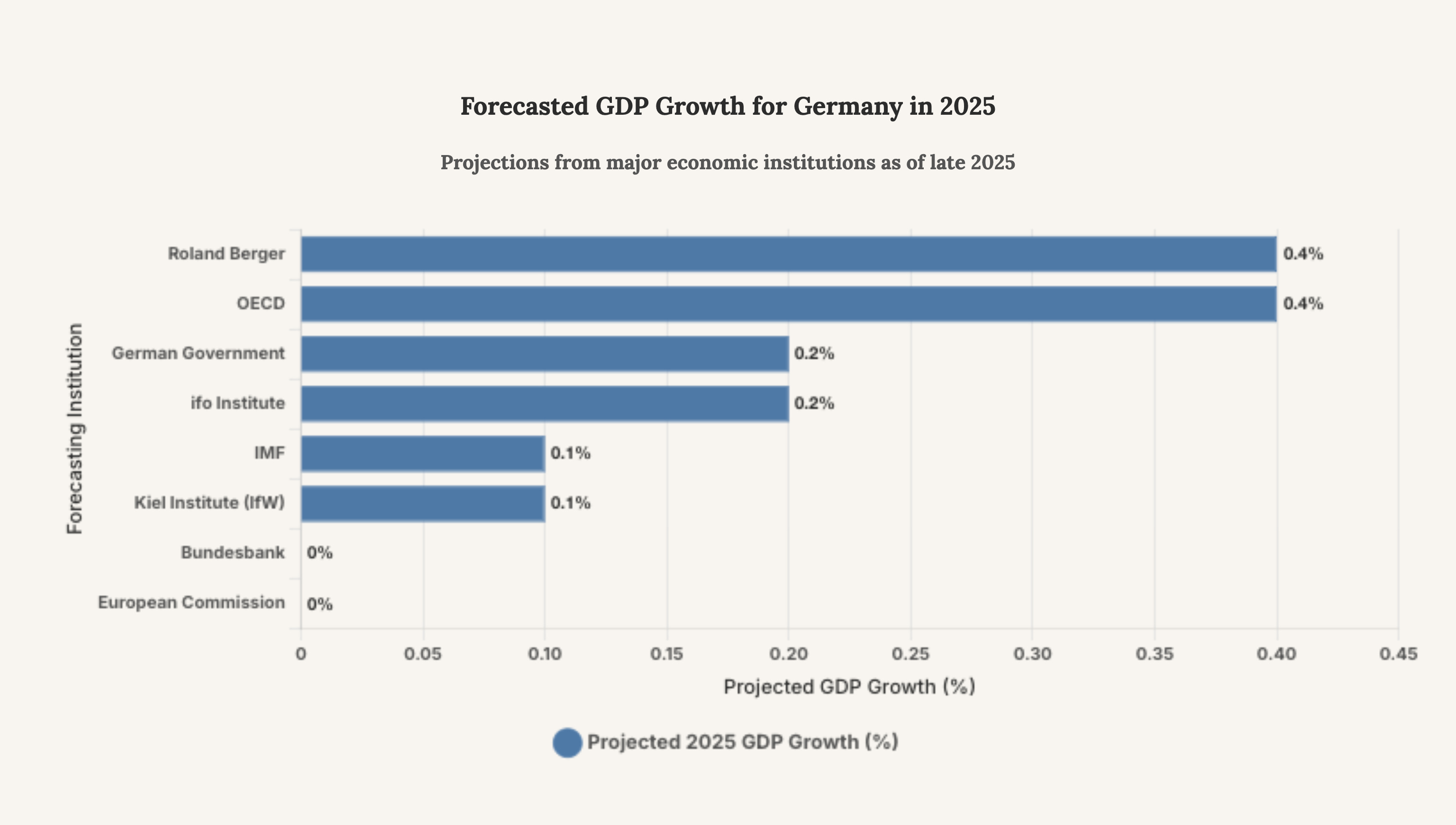
Caption: A tight consensus among forecasters points to near-zero growth for the German economy in 2025, highlighting the significant challenges it faces.
The Government’s €500 Billion Gambit
In response to the economic malaise, the German government has approved a substantial €500 billion spending plan aimed at stimulating the economy. This fiscal package, which includes significant investments in defense and public infrastructure, is the primary reason forecasters haven’t projected another year of outright contraction. The government itself raised its 2025 growth forecast from 0% to 0.2%, attributing the revision entirely to this planned spending. The Bundesbank anticipates that this expansionary fiscal policy will lead to a “marked recovery” starting in 2026, with government investment rising steeply. However, there’s a clear timing mismatch. The negative effects of the U.S. tariffs are immediate, while the positive impact of the fiscal stimulus is expected to be gradual, with most of the growth impulse arriving in 2026 and 2027. This leaves the 2025 economy in a vulnerable position, absorbing the external shock before the domestic support fully materializes.
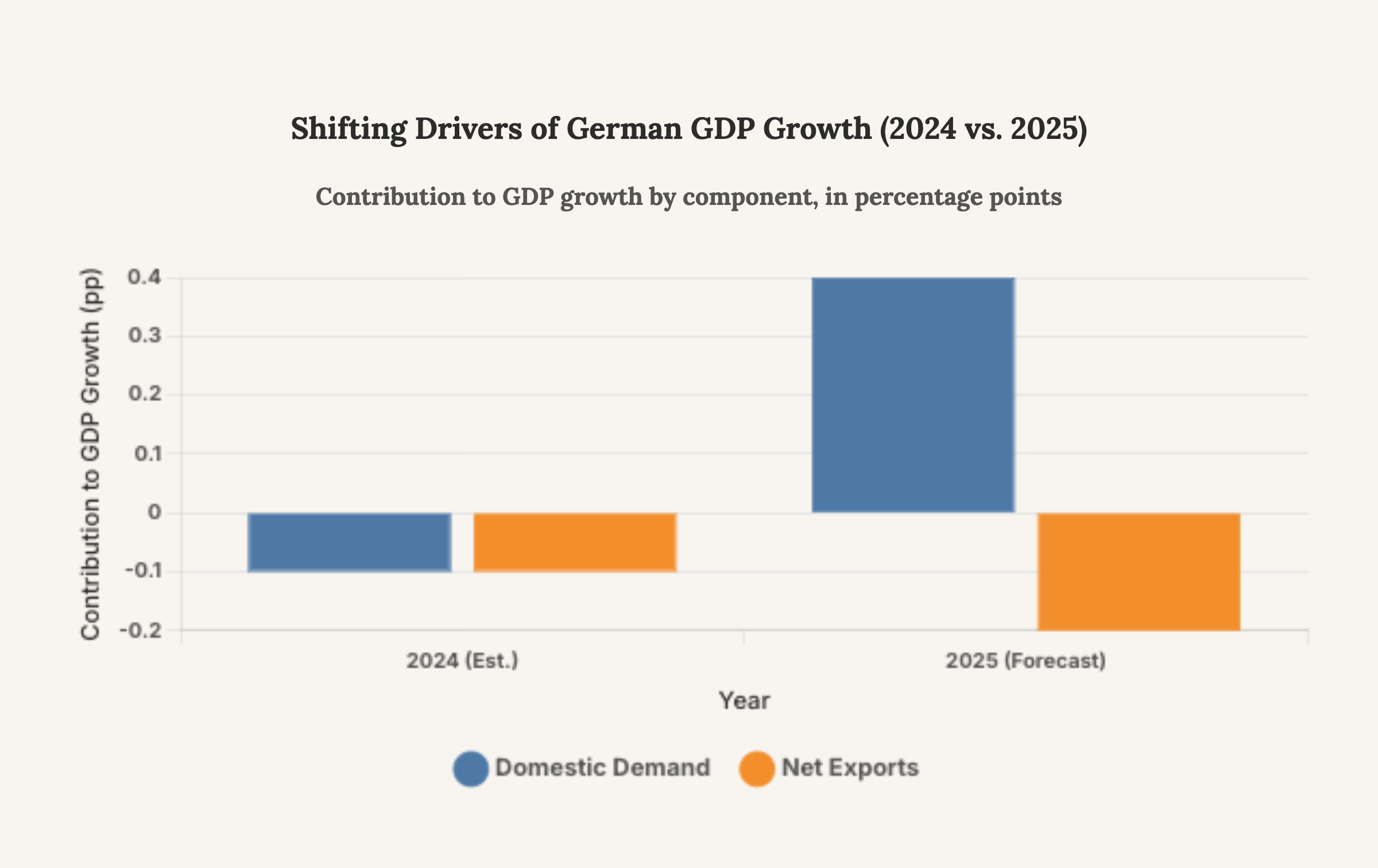
Caption: The chart illustrates the projected shift in Germany’s growth drivers, with domestic demand, fueled by government spending, expected to compensate for the drag from negative net exports in 2025.
Deconstructing the Domestic Landscape
While external trade remains a key variable, Germany’s domestic economic health will be crucial in weathering the storm. The outlook here is mixed, with a resilient labor market and rising wages supporting consumption, but persistent structural issues and high energy costs tempering optimism.
Consumption: The Bright Spot?
A consistent positive note across forecasts is the expected resilience of private consumption. This is underpinned by a robust labor market and, crucially, rising real wages as inflation continues to abate. The European Commission projects HICP inflation to slow from 2.5% in 2024 to 2.4% in 2025, and Roland Berger sees it averaging 2.0%. As nominal wage growth outpaces inflation, household purchasing power increases, which is expected to underpin a moderate increase in consumption. This provides a vital cushion for the economy, shifting the growth impetus inward at a time when export demand is faltering. However, consumer sentiment remains low, weighed down by inflation fears and job security concerns, which could lead to precautionary saving and dampen the expected spending increase.
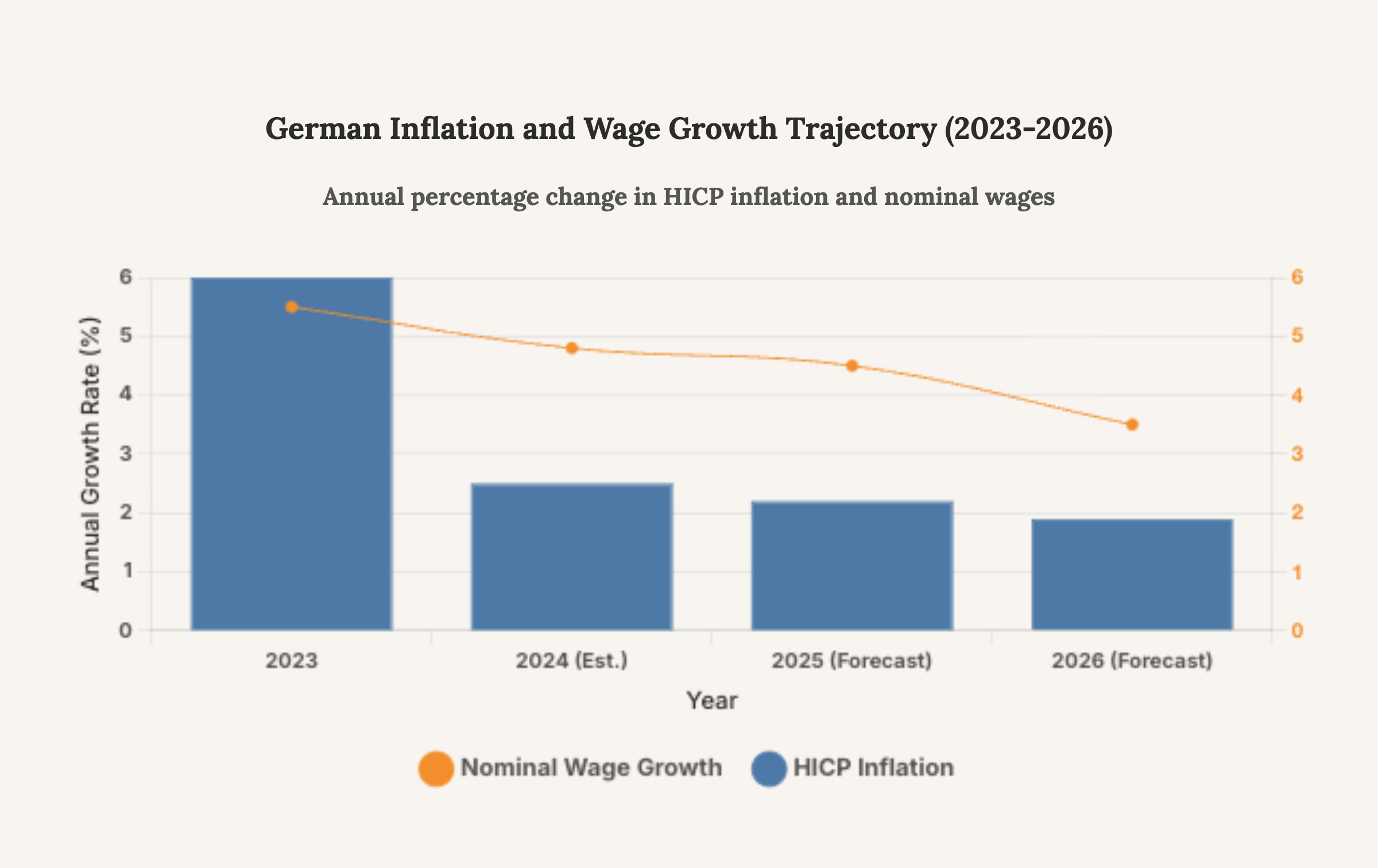
Caption: Inflation is projected to continue its downward trend, allowing nominal wage growth to translate into real purchasing power gains for consumers in 2025, a key pillar of domestic demand.
The Industrial Malaise and Energy Dilemma
Germany’s industrial sector faces more than just trade headwinds. It is grappling with deep-rooted structural challenges. Persistently high energy costs, which are double those of French competitors and up to three times higher than in the U.S., are eroding the competitiveness of energy-intensive industries. This has led to a process of “deindustrialization,” with firms relocating production and investment abroad. The International Energy Agency (IEA) has highlighted that high electricity prices are a major obstacle to the electrification needed for the green transition. While the government has launched programs to support decarbonization, the immediate reality for many firms, particularly in the Mittelstand (small and medium-sized enterprises), is a daily battle for survival against high costs and significant administrative burdens.
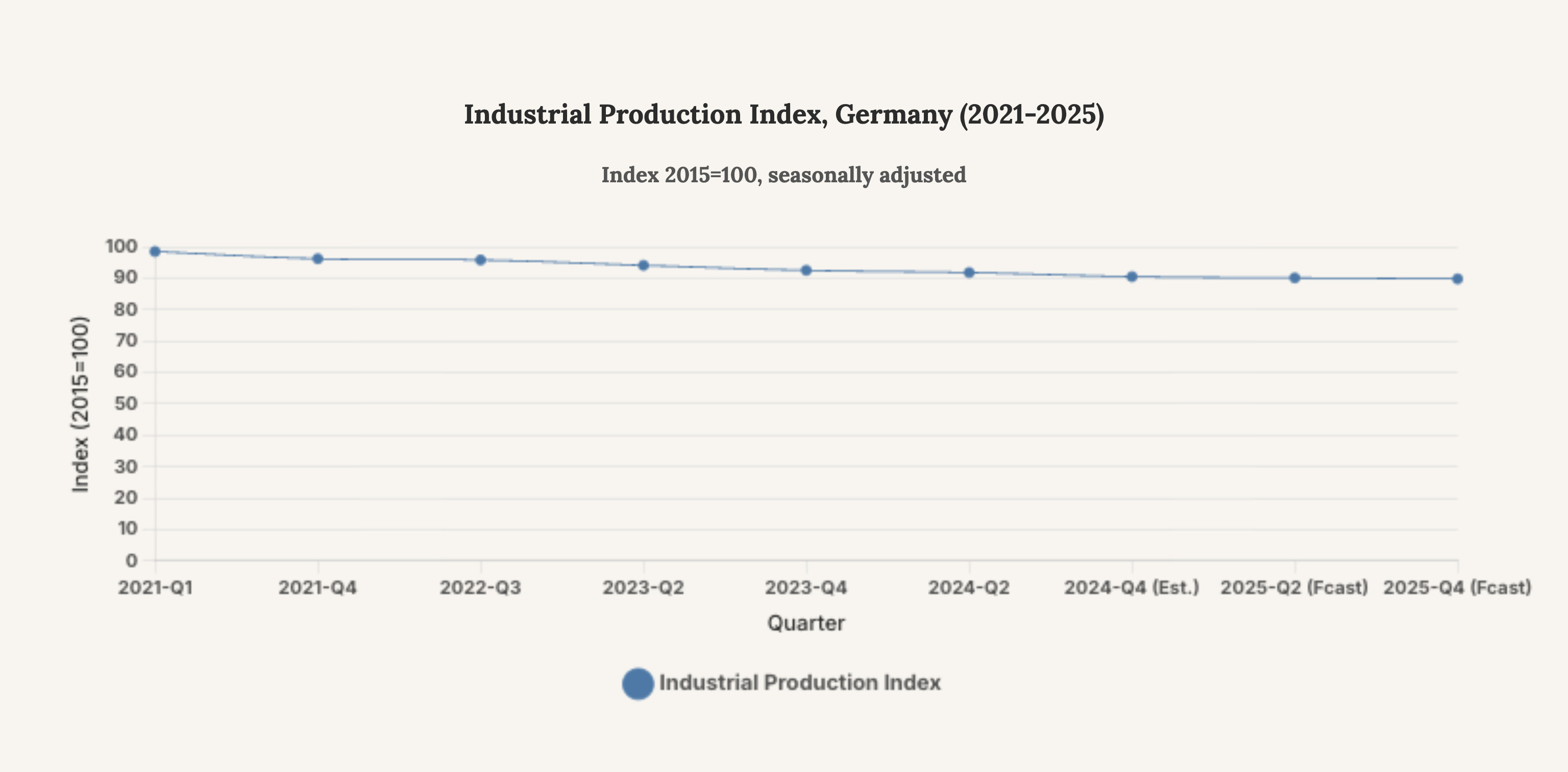
Caption: The steady decline in Germany’s industrial production index highlights the structural crisis facing its manufacturing core, a trend expected to continue through 2025.
“Germany is trying to regain momentum after two years of decline. If economic policy remains stagnant, the country faces further years of paralysis and erosion as a place to do business.”
- Timo Wollmershäuser, head of the Ifo forecasting department
Strategic Outlook and Forward Projections
Looking ahead, Germany’s economic trajectory hinges on the government’s ability to execute its ambitious investment plans while navigating a hostile external environment and addressing long-standing structural issues. The risk profile is tilted to the downside in the short term, with the potential for a more robust recovery emerging only in 2026.
Scenario Analysis: Pathways for 2025
Given the competing forces at play, we can outline three potential scenarios for Germany’s economic performance in 2025.
Base Case (65% Probability): Muddling Through (0.2% Growth). This scenario aligns with the consensus forecast. The government’s fiscal stimulus proves sufficient to offset the drag from weak exports, preventing a third year of recession. Private consumption provides a modest but stable pillar of growth. Industrial weakness persists, and the economy essentially stagnates, but avoids a deeper crisis.
Pessimistic Scenario (25% Probability): Recessionary Relapse (-0.5% Growth). In this scenario, the impact of U.S. tariffs is more severe than anticipated, and global demand weakens further. The domestic fiscal stimulus is slow to deploy due to bureaucratic hurdles. Consumer and business confidence plummets, leading to higher savings and deferred investment, tipping the economy back into contraction.
Optimistic Scenario (10% Probability): Nascent Recovery (0.8% Growth). A de-escalation of trade tensions and a faster-than-expected rebound in the global economy boost German exports. The government’s infrastructure projects are implemented swiftly, providing a significant and early boost to domestic demand and investment. Consumer confidence surges, unlocking pent-up demand.
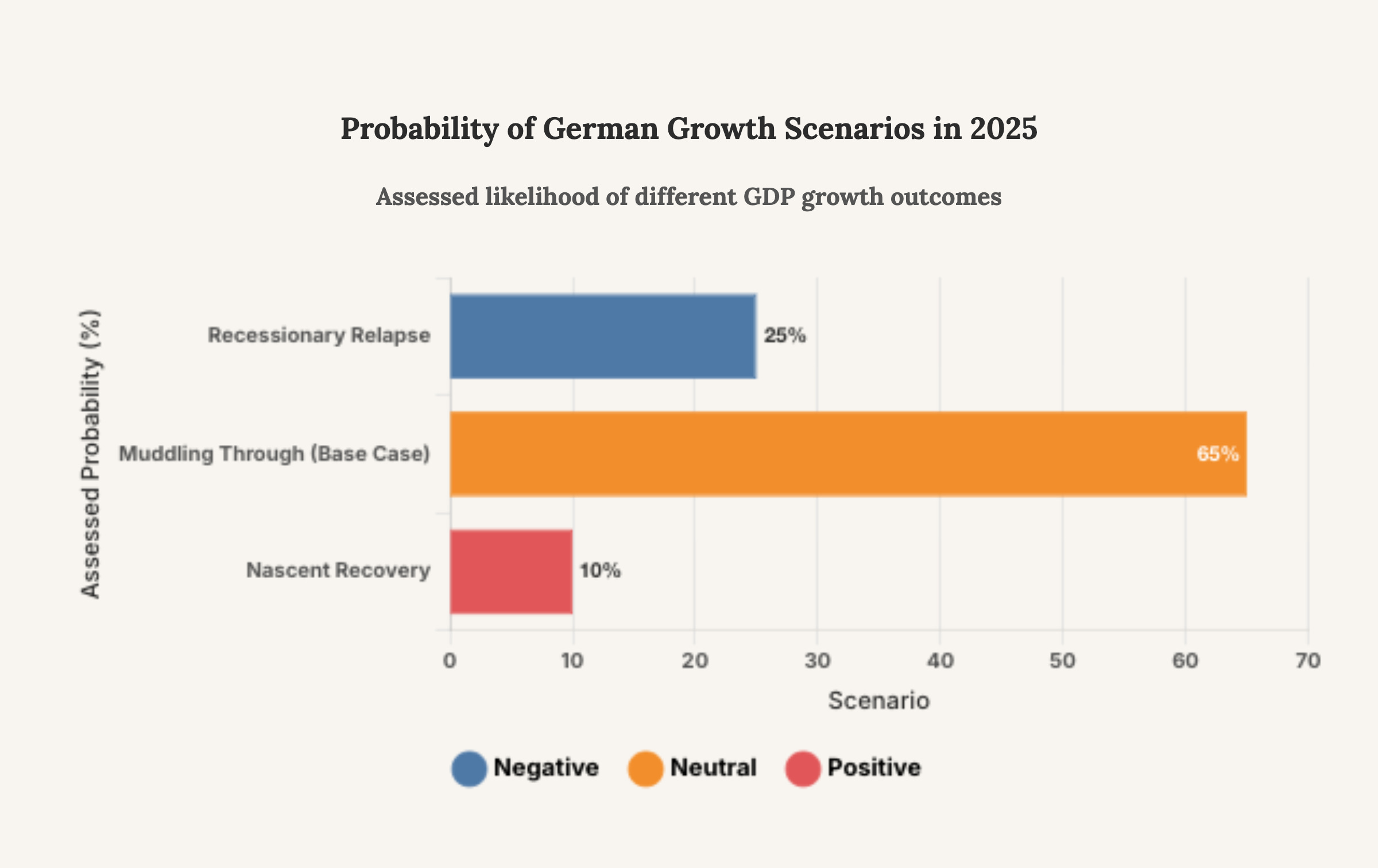
Caption: The probability analysis indicates a high likelihood of continued stagnation, with a significant downside risk of another recession and only a slim chance of a robust recovery in 2025.
The Looming Debt Question
The financing of the stimulus package will push Germany’s debt-to-GDP ratio higher, from 62.5% at the end of 2024 to a projected 63.8% in 2025 and 66% by 2027. While Bundesbank President Joachim Nagel has stated that Germany’s public finances can cope with a temporary increase, this trajectory moves the country further away from the Maastricht Treaty’s 60% guideline. The long-term challenge will be to ensure that the debt-financed investments generate sufficient productivity growth to justify the fiscal expansion and avoid a structural deficit problem, especially as an aging population puts further strain on social expenditures.
“Germany’s public finances can cope with a temporary increase in the deficit and debt ratios.”
- Joachim Nagel, President of the Deutsche Bundesbank
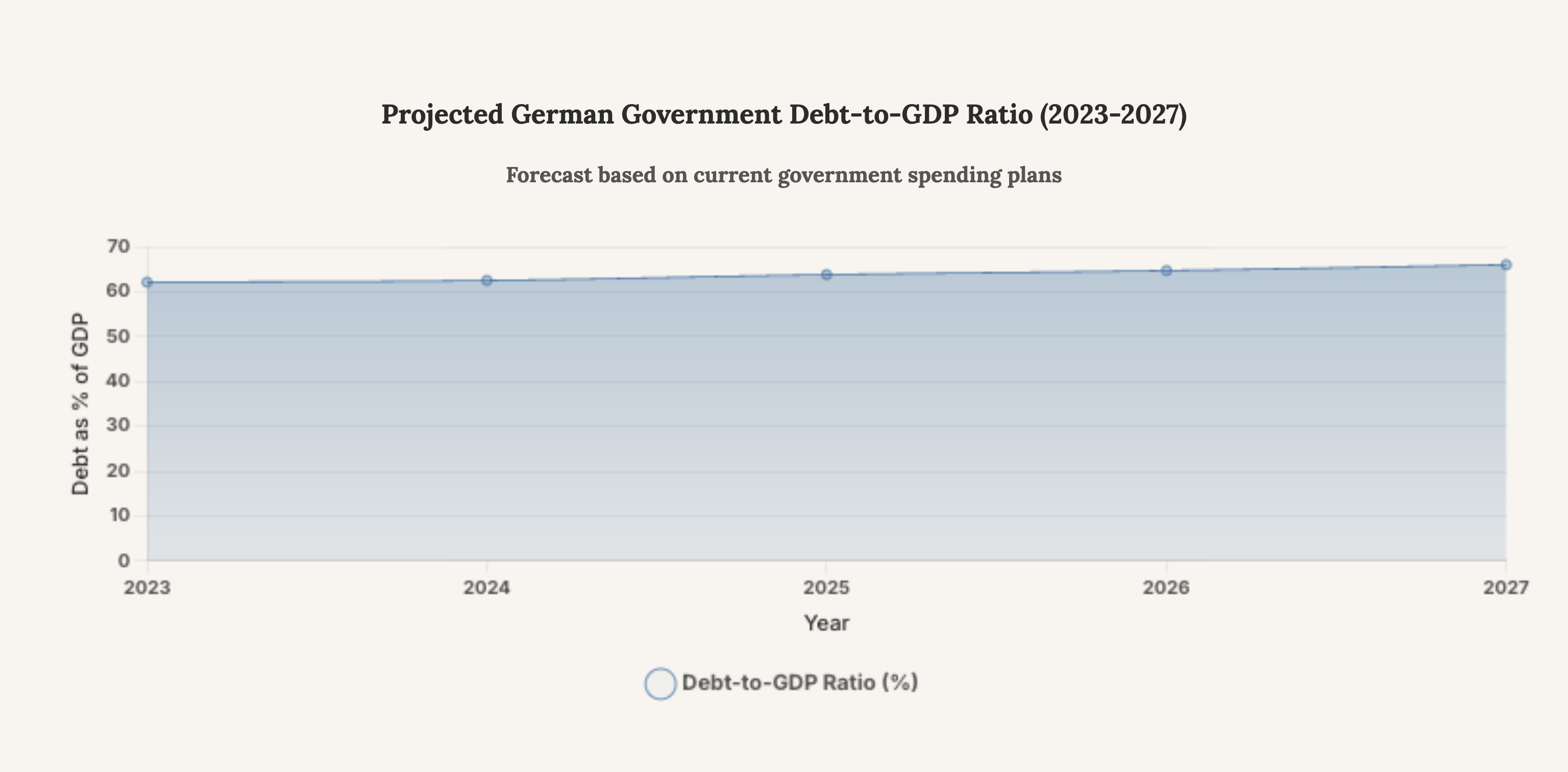
Caption: The fiscal stimulus required to restart growth is projected to push Germany’s public debt ratio steadily upward over the forecast horizon.
In conclusion, Germany’s economy in 2025 is caught in a state of suspended animation. The government’s stimulus has placed a floor under the economy, likely preventing a severe downturn, but the powerful headwinds from global trade conflicts and unresolved domestic structural issues are simultaneously capping any significant upside potential. The year will be a test of policy execution and domestic resilience against a challenging international backdrop. While a foundation is being laid for a potential recovery in 2026, the immediate outlook is one of profound uncertainty and stagnation.
The decisive factor for Germany’s long-term prosperity will be whether the current crisis is used as a catalyst for deep structural reforms, not just a justification for temporary, debt-financed stimulus.