


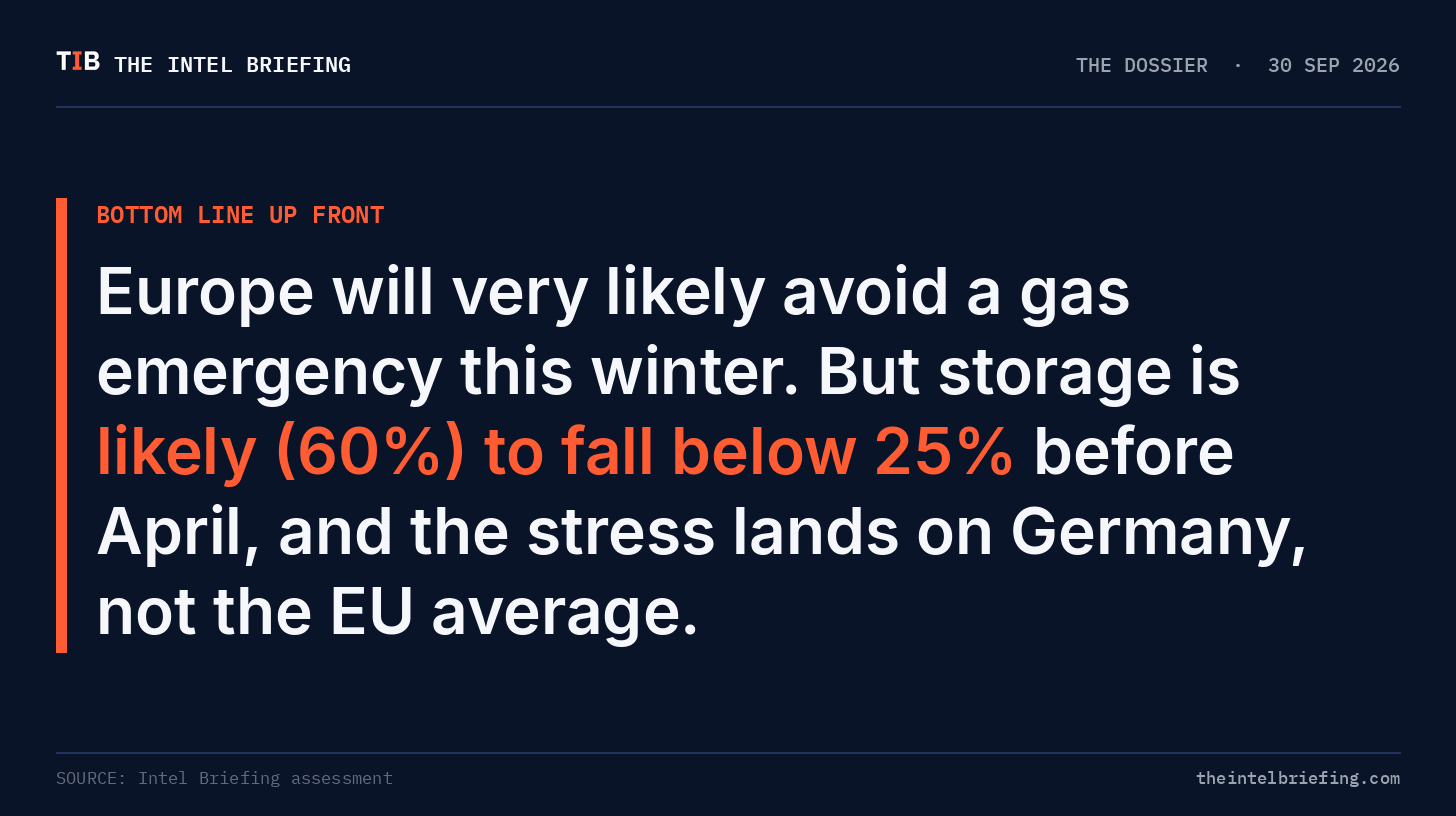
Bottom line up front. Europe will very likely (85%) get through winter 2026–27 without any member state declaring a gas emergency. At the same time, it’s likely (60%) that EU storage falls below 25% before April, lower than any 31 March level of the past six years (AGSI). The risk is concentrated in Germany and its Central European neighbours, not the EU average. The swing factor isn’t Qatar, which will stay mostly offline this winter whatever happens in talks. It’s the weather, and whether Europe is willing to outbid Asia for American cargoes.
Why now
Three things line up this week.
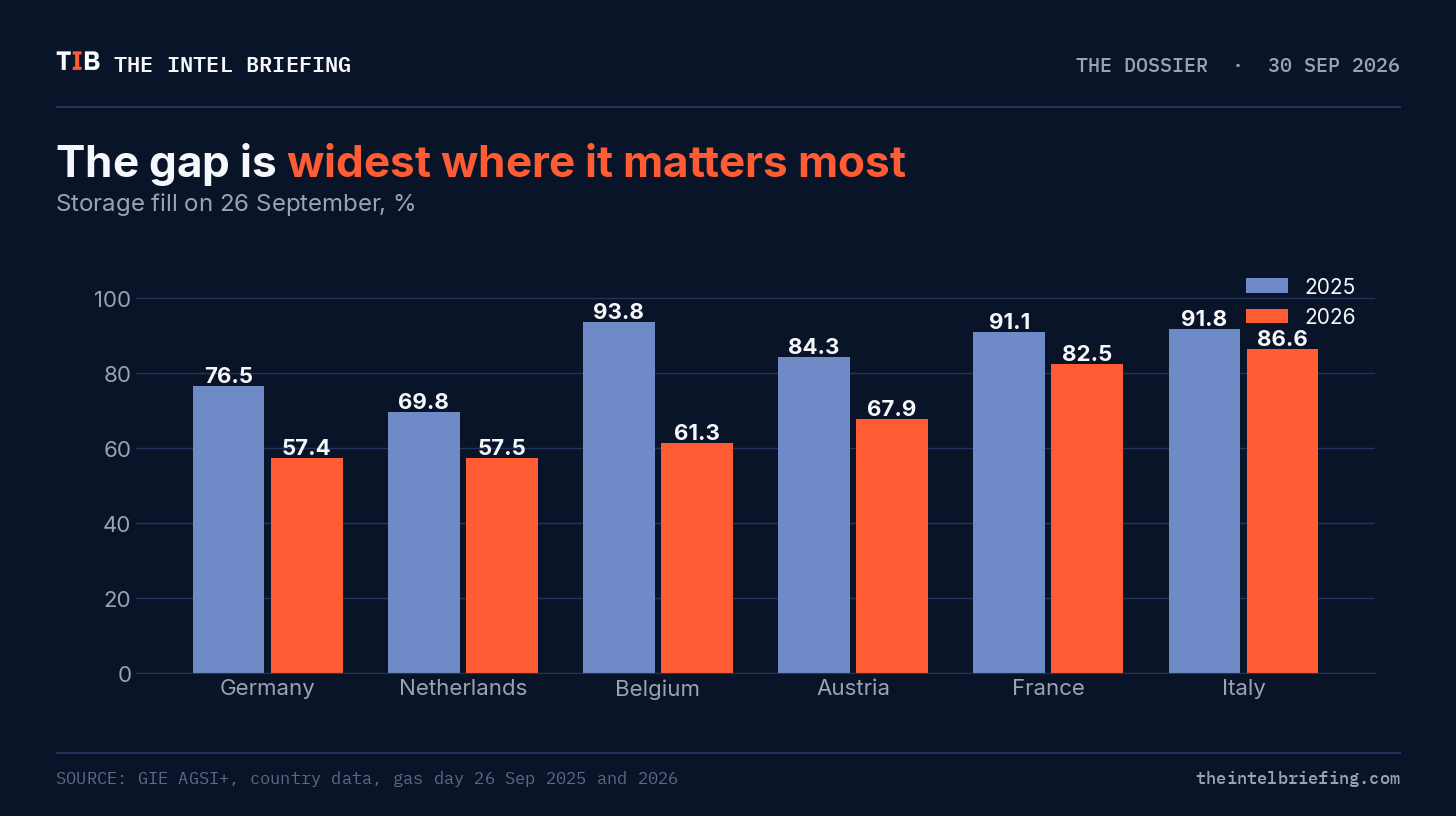
On 26 September, EU storage stood at 70.9% (AGSI+), the lowest for that date since the platform’s records begin in 2011. Germany was at 57.4%.
On 26 September, President Trump rejected Iran’s seven-day proposal to reopen the Strait of Hormuz. He indicated that military operations could resume after the 3 November US midterms.
On 28 September, QatarEnergy extended force majeure on European deliveries until early December.
Together, these mean the injection season will end short, and no Gulf relief can arrive before winter starts. The question is no longer whether Europe starts winter low. It’s how fast the cushion drains.
The evidence
1. Europe’s late-September position is the lowest on record. On 1 November, EU storage was at or near 95% in four of the last six years (AGSI). Last year it was 82.8%. At the current 30-day refill pace of 0.22 points a day, we estimate about 79% on 1 November 2026. If injections slow in October, as they did last year, when the fill flattened at about 82–83% from late September, the result is lower: about 76–78% (TIB estimate).
2. Winters differ by up to 26 points in how much gas they use. Measured from 1 November to 31 March (AGSI), recent winters drew down:
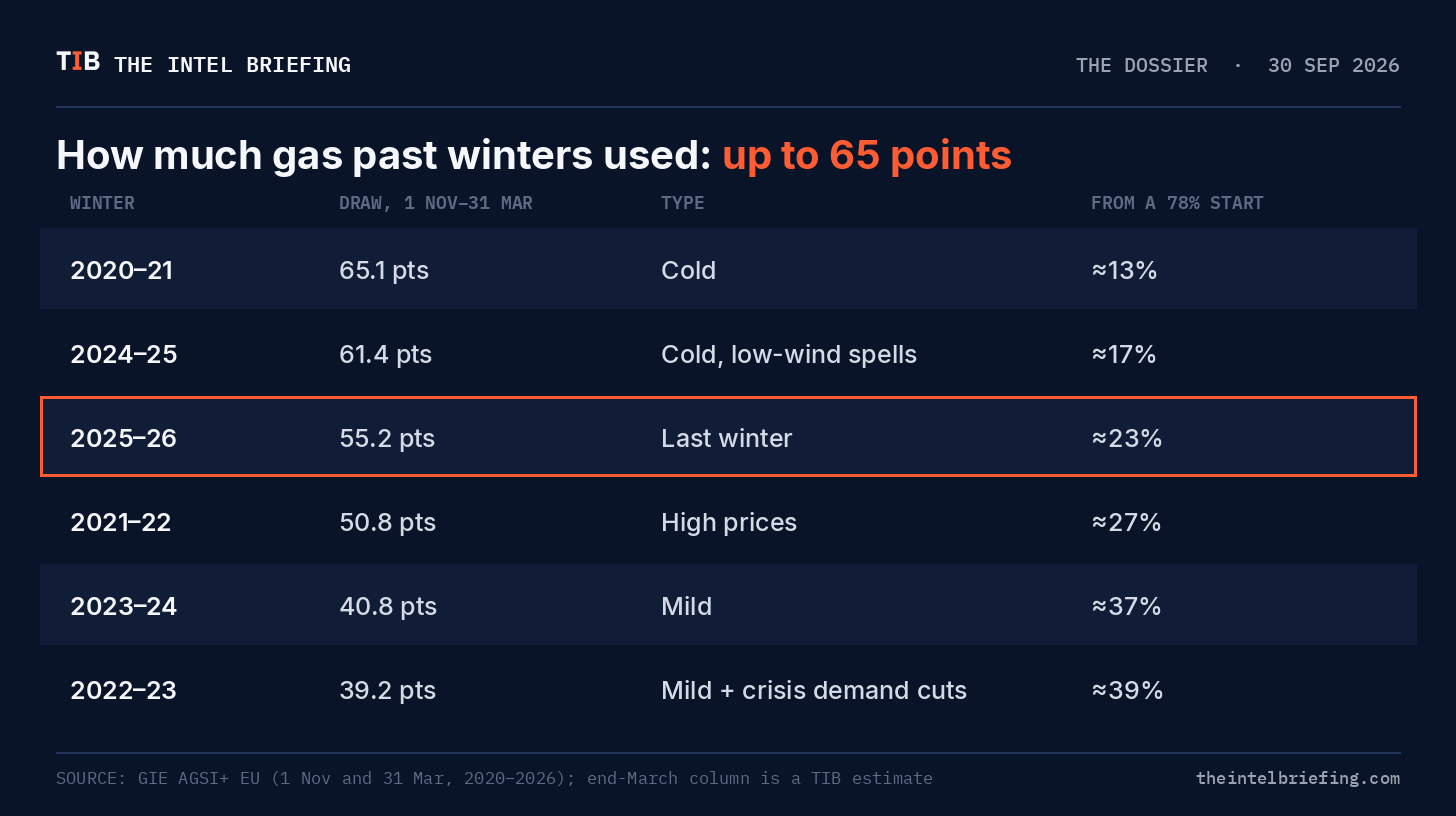
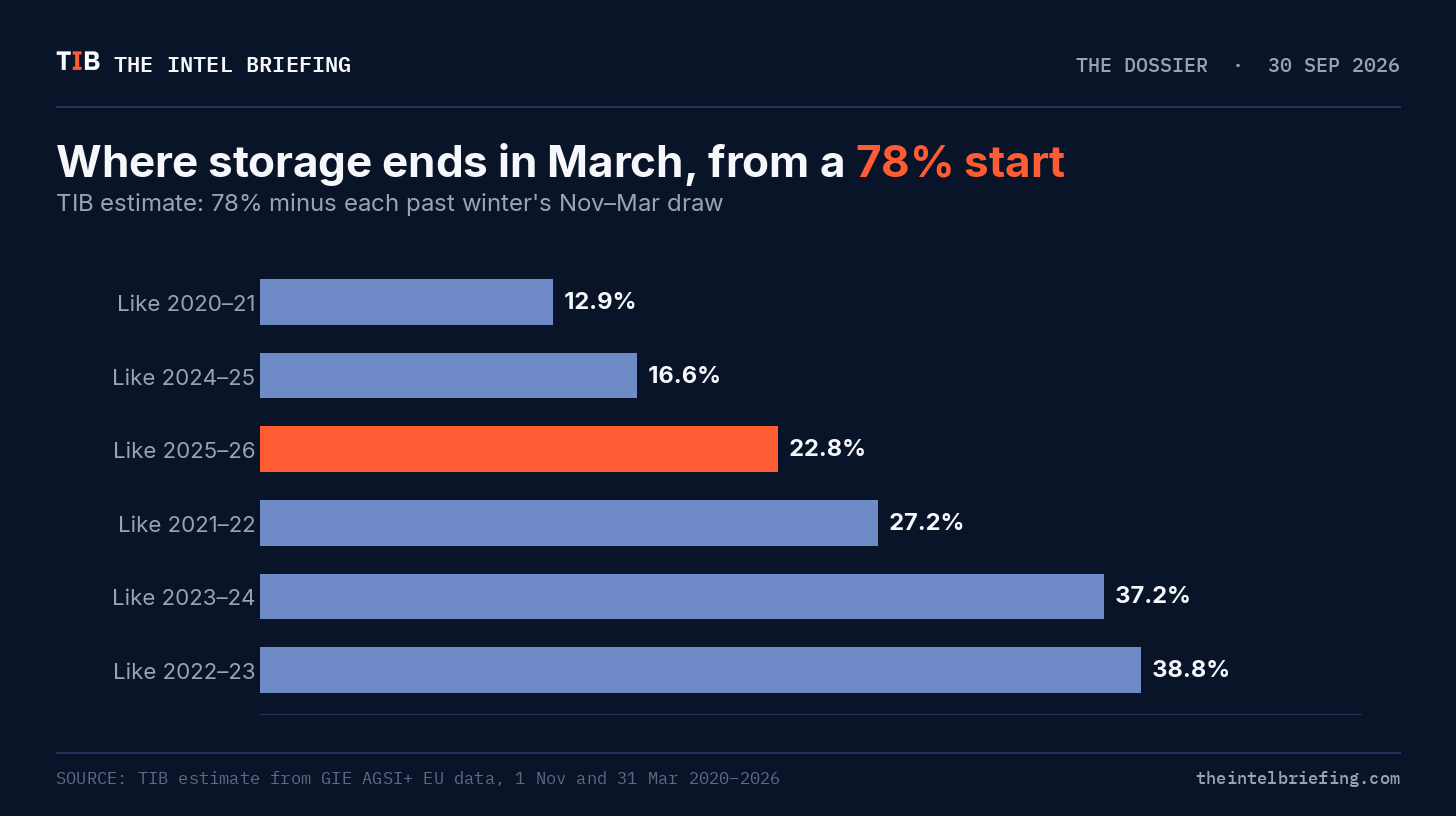
Apply those draws to a 78% start, and end-of-March storage ranges from about 13% (a 2020–21-type winter) to about 39% (a 2022–23-type winter). A repeat of last winter ends at about 23%. These are TIB estimates. Working-gas capacity and demand differ each year, so treat them as a range, not a point.
3. The replacement supply is being bid away. US LNG exports grew 23% in the first half, but exports to Europe grew just 1% while exports to Asia doubled (EIA). Asia’s LNG price has been above Europe’s since March, by about $2.1/MBtu on average from March to June (IEA). To pull cargoes west in a cold snap, TTF must rise above JKM, and stay there.
4. Qatar won’t be back to normal even if Hormuz reopens. Iranian strikes took 2 of Ras Laffan’s 14 trains offline, about 17% of Qatar’s capacity (12.8 Mtpa), with a repair timeline of 3–5 years, according to QatarEnergy as reported by The National. Shell’s president of integrated gas told the same outlet that flows won’t return to pre-war levels immediately after reopening.
The rest of this Dossier is for members. It contains our five Key Judgments with probabilities, the four winter scenarios with the base case marked, the six indicators that decide which one we get, and what it means for markets, operators and policy.