



We are operating in an era defined by cascading systemic friction. The illusion of a seamlessly decoupled, highly efficient global system has shattered. In its place, we find a complex, interlocking web of vulnerabilities where a technological breakthrough in a university laboratory is intrinsically linked to the combat readiness of amphibious assault ships in the Persian Gulf, and where domestic political gridlock instantly ripples outward to suffocate global supply chains.
This dossier is not a mere recitation of the week’s news. It is a forensic examination of the strategic levers currently being pulled across six distinct domains: labor, advanced quantum hardware, global energy chokepoints, macroeconomic structural integrity, military force projection, and domestic border security. To understand the reality of Q1 2026, one must stop looking at these events in isolation. They are not isolated. They are symptoms of a broader realignment of how capital, energy, and state power are deployed under extreme stress.
We will examine the algorithmic rebellion occurring on the picket lines of American hospitals, the military-grade miniaturization of hyperspectral optics, the weaponization of the global oil supply, the self-inflicted wounds of the U.S. economy, the game theory of offshore Marine deployments, and the unprecedented maneuver to militarize civilian transit hubs.
Prepare for the ground truth.
The Algorithmic Picket Line: Labor’s Final Stand Against Healthcare Automation
In early 2026, the American healthcare system became the primary battleground for the defining labor conflict of the 21st century. Thousands of nurses across major hospital systems, including Kaiser Permanente and the Mount Sinai network in New York City, walked off the job. While the headlines predictably focused on wage disputes and staffing ratios—the traditional hallmarks of a labor strike—the underlying, existential catalyst for the walkouts was something entirely different: the rapid, unchecked integration of artificial intelligence into clinical workflows.
The specific flashpoint involves massive corporate partnerships with AI transcription and diagnostic firms, such as Kaiser’s sweeping agreement with Nabla, an AI copilot designed to automate clinical documentation. On the surface, hospital administrators sell these tools as a remedy for burnout, a way to free practitioners from the crushing burden of administrative charting. But the practitioners on the floor understand the underlying strategic calculus far better than the executives in the boardroom.
The modern labor movement is no longer fighting for a larger slice of the pie; they are fighting to prevent the algorithm from realizing they are entirely edible.
When an AI system is deployed alongside a specialized worker, it does not merely assist; it observes, it ingests, and it maps the intricate muscle memory of human expertise. By lowering the marginal cost of diagnostics and administrative charting to near zero, the hospital administration gains an overwhelming, asymmetric information advantage. The specialized knowledge that once gave healthcare workers immense bargaining leverage is systematically extracted, digitized, and commodified. The strike, therefore, is not a demand for better conditions; it is a rational, preemptive maneuver to establish artificial scarcity and protect the proprietary value of human intuition before the algorithm can fully replicate it.
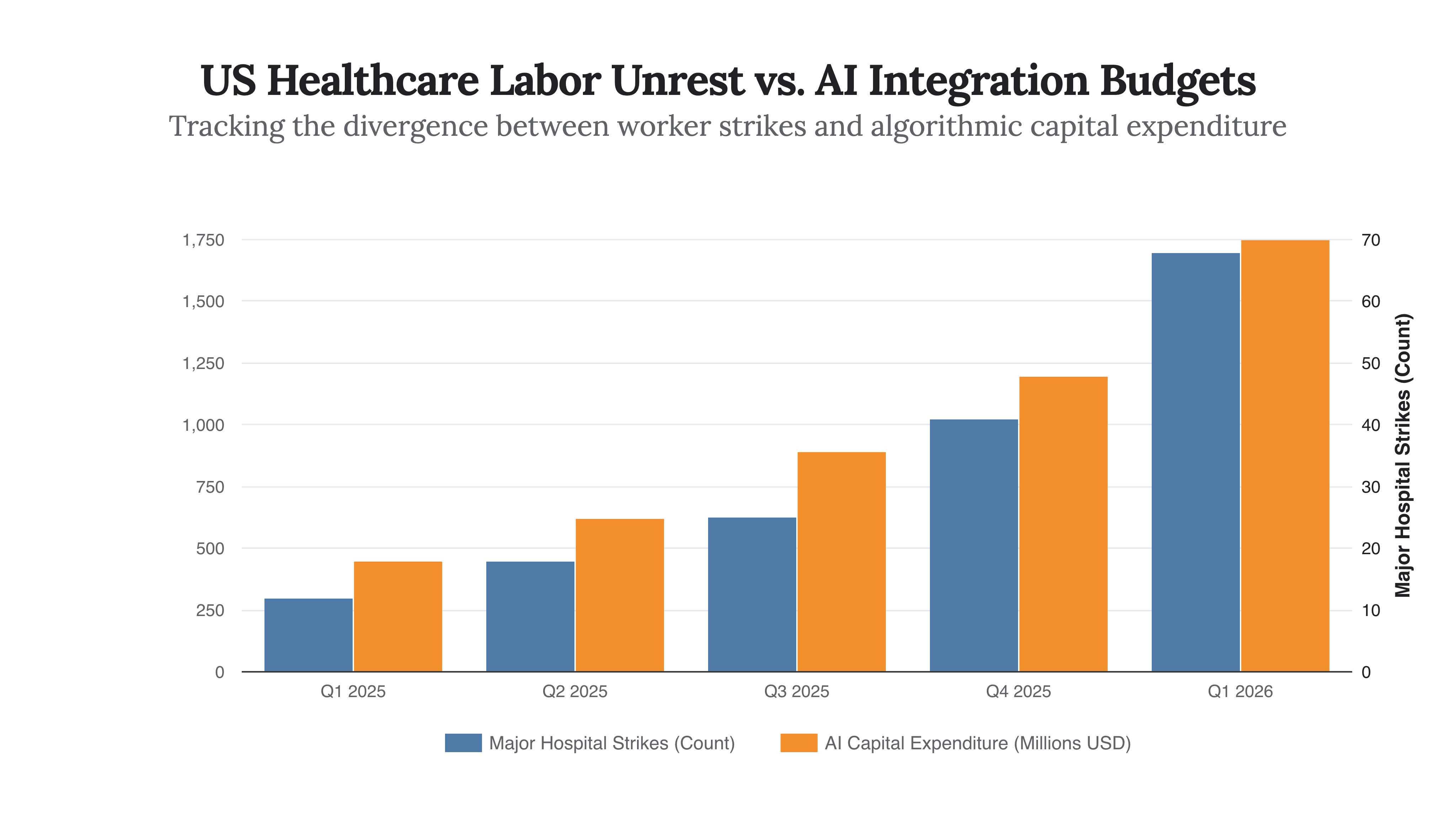
The interactive data above illustrates a stark, undeniable inverse relationship. As hospital networks exponentially increased their capital allocation toward AI diagnostic and transcription suites throughout 2025, the frequency of major organized labor strikes surged in lockstep. This is not a coincidence; it is a direct reaction to the perceived threat of obsolescence. Capital is being aggressively diverted away from human payrolls and funneled directly into server racks.
To understand the depth of this friction, we must look at the human toll. AI solutionism in healthcare operates on a fundamental myth: that the benefits of massive productivity gains will be shared with the public and the workforce. The reality of March 2026 proves otherwise. Instead of reducing hours or increasing patient care quality, the implementation of AI has been used as a conduit for austerity. Hospital executives utilize the theoretical efficiency of AI to justify maintaining dangerously thin human staffing levels during severe flu seasons. The algorithm becomes an excuse for chronic understaffing.
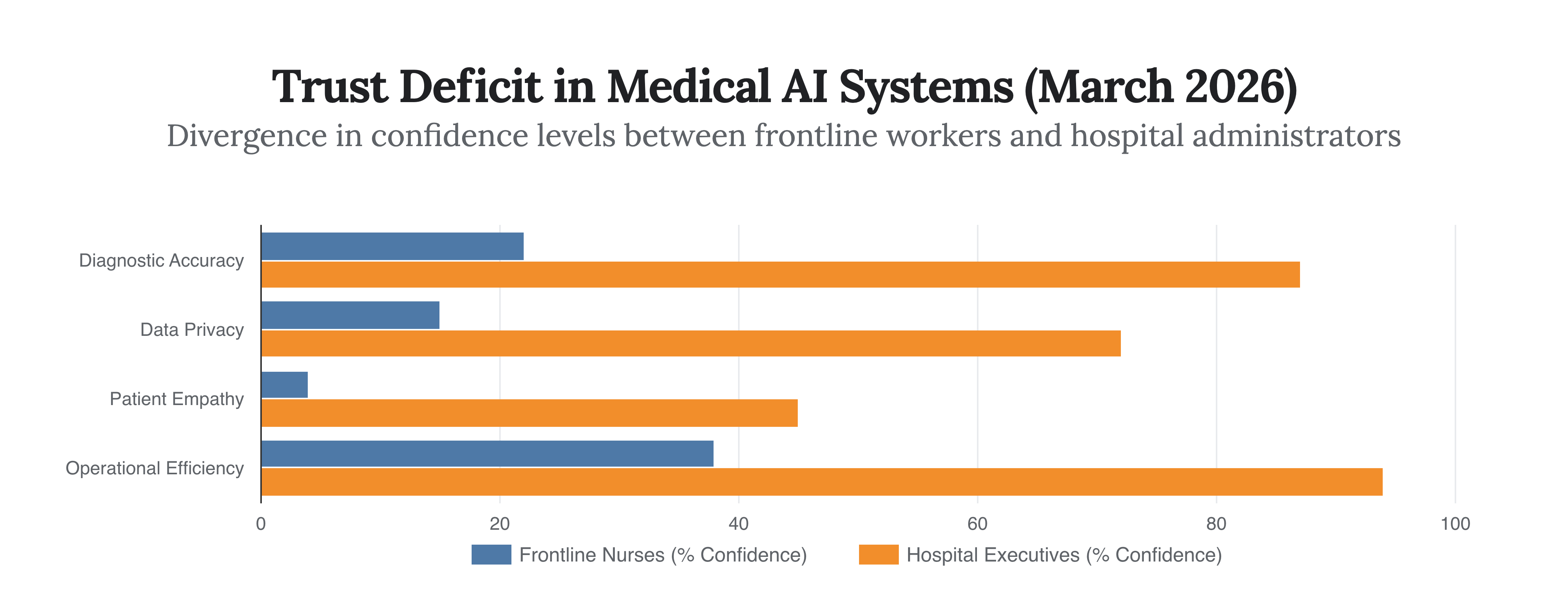
The chasm in trust depicted in the second chart reveals the core of the institutional rot. While 94% of hospital executives believe AI improves operational efficiency, only 38% of frontline nurses agree. More alarmingly, 87% of administrators trust AI diagnostic accuracy, compared to a dismal 22% of the nurses actually administering the care. The workers on the floor see the hallucinations, the missed nuances, and the systemic errors that the executives choose to ignore in favor of lower overhead costs.
This labor unrest is the canary in the coal mine for the broader global economy. The healthcare strikes of 2026 represent the first highly organized, heavily unionized sector to fully grasp the economic implications of generative AI. They are drawing a line in the sand. If hospital administrators succeed in breaking these strikes without yielding to demands for algorithmic transparency and human-in-the-loop mandates, the blueprint for replacing the American middle class with large language models will be set in stone.
The Quantum Hardware Leap: Weaponizing the Picosecond
While the labor markets burn, the foundational architecture of the next technological epoch is being forged in silence. In March 2026, researchers at Duke University announced a paradigm-shattering breakthrough in optoelectronics: an ultrathin photodetector capable of sensing light across the entire electromagnetic spectrum, generating a signal in an astonishing 125 picoseconds. To put that in perspective, a picosecond is one trillionth of a second. This device is now officially the fastest pyroelectric detector ever constructed by human hands.
The underlying mechanics of this breakthrough sound like science fiction, but they are firmly rooted in advanced materials science. Legacy photodetectors—the silicon-based eyes of our current digital world—are bulky, slow, and fundamentally limited in the wavelengths they can perceive. They require mechanical switching or complex, power-hungry cooling systems to detect infrared or ultraviolet light. The Duke team bypassed these limitations by engineering a single-chip, paper-thin material that leverages the pyroelectric effect, translating thermal energy from photons directly into an electrical signal with near-instantaneous efficiency.
He who commands the electromagnetic spectrum commands the battlefield, and Duke’s 125-picosecond breakthrough just miniaturized the eyes of God onto a single sliver of silicon.
The strategic implications of this microchip cannot be overstated. In the realm of geopolitical competition, information asymmetry relies entirely on who can see the fastest and the clearest. Multispectral imaging—the ability to see beyond the visible spectrum into infrared, thermal, and ultraviolet simultaneously—is the holy grail of modern intelligence gathering. Previously, outfitting a satellite or an autonomous drone with multispectral capabilities required heavy, expensive payloads. Now, that capability can be integrated onto a microscopic chip.
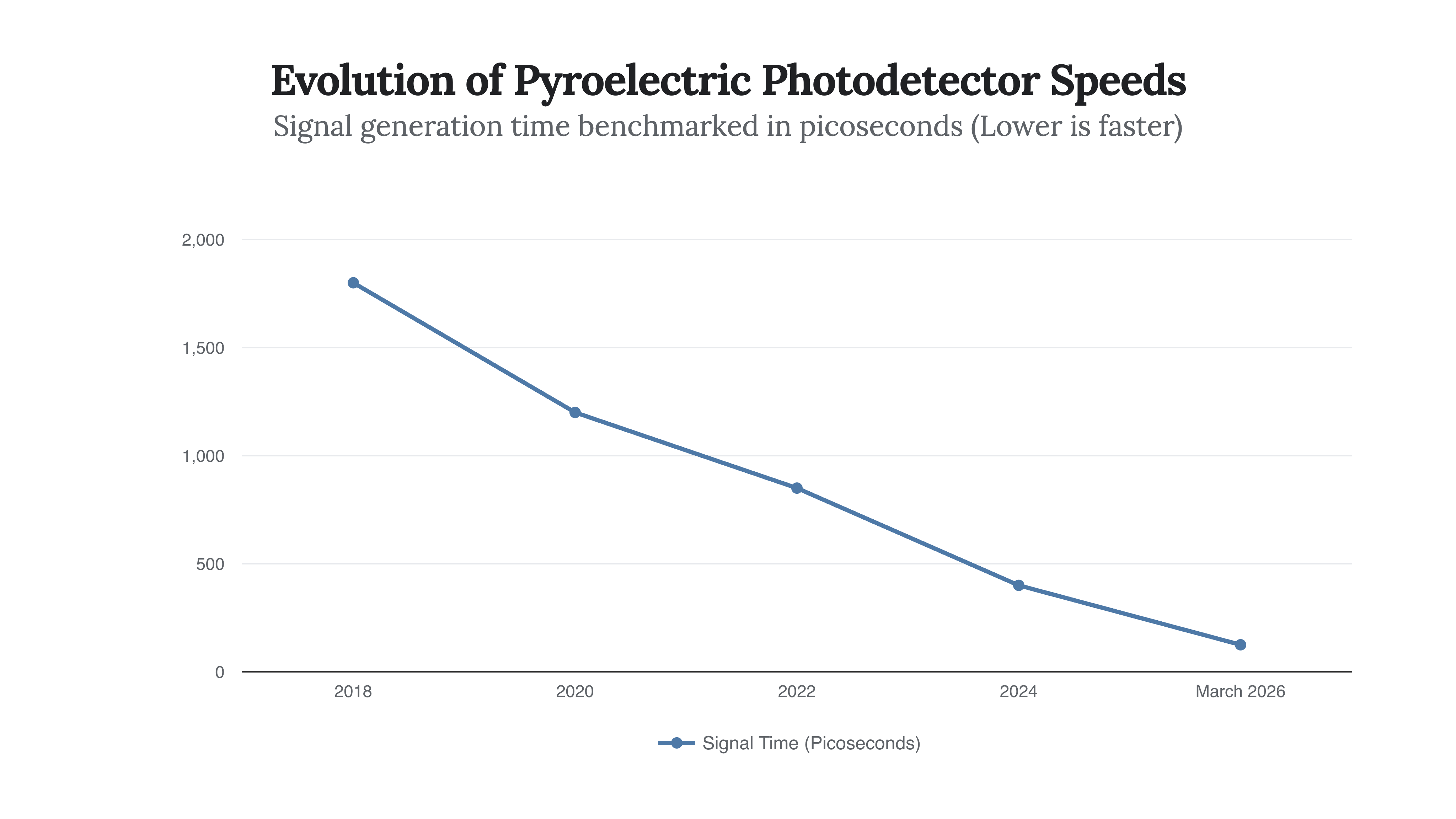
The speed progression visualized above is not a linear evolution; it is an exponential collapse of physical limitations. Moving from 400 picoseconds in 2024 to 125 picoseconds today crosses a critical threshold for real-time quantum tracking and hypersonic missile defense. When an object is moving at Mach 10, a microsecond delay in thermal detection is the difference between an interception and a catastrophic impact. The Duke microchip ensures that autonomous targeting systems can process spectral shifts faster than any evasive maneuver can be executed.
Commercially, this is the master key for the next generation of autonomous vehicles and agricultural tech. Current Lidar systems on self-driving cars struggle in heavy rain, fog, or blinding direct sunlight because they operate on limited optical bands. An ultrathin, full-spectrum photodetector allows the vehicle’s brain to instantly switch to thermal or infrared mapping seamlessly, eliminating the primary obstacle to Level 5 autonomy. In agriculture, drones equipped with these chips can scan vast fields from the stratosphere, instantly identifying crop stress, moisture levels, and pesticide distribution with absolute microscopic precision.
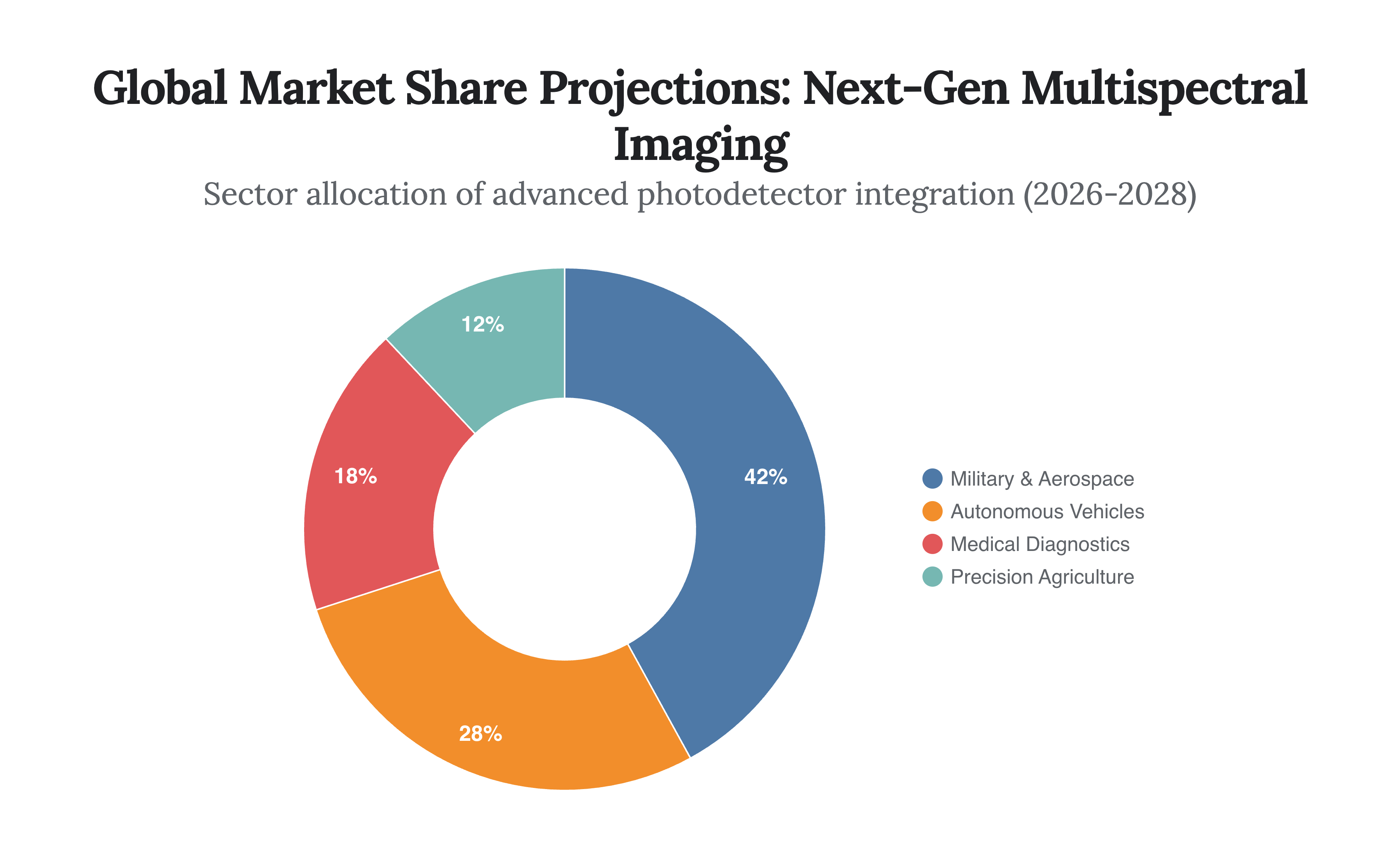
However, the real power play lies in the supply chain. The nation that controls the manufacturing and patent rights to these ultra-fast 2D materials will dictate the pace of global military modernization. As the U.S. and China remain locked in a ferocious semiconductor war, breakthroughs of this magnitude act as a strategic trump card. It shifts the battlefield from the brute force calculation of logic chips to the elegant mastery of sensory perception. You cannot destroy what you cannot see, and as of March 2026, the United States has developed the capacity to see absolutely everything, instantly.
Unlock deeper strategic alpha with a 10% discount on the annual plan.
Support the data-driven foresight required to navigate an era of radical uncertainty and join a community of institutional-grade analysts committed to the truth.
