


In late October 2025, amidst the formal proceedings of a G7 Energy and Environment Ministers’ meeting in Toronto, Canada fired its most decisive salvo yet in the global resource race. The announcement of the ‘Critical Minerals Production Alliance’—a C$6.4 billion (US$4.6 billion) initiative designed to fast-track domestic mining projects—is far more than an industrial strategy; it is a calculated geopolitical gambit.
This intelligence briefing deconstructs Canada’s ambitious play to leverage its vast geological wealth into strategic influence, directly challenging China’s long-held dominance over the minerals that will power the 21st century’s green and digital economies. Ottawa is betting that by compressing mine development timelines from a decade-and-a-half to as little as three years, it can build a secure, reliable, and ethically sourced supply chain for itself and its allies. The core thesis is clear: in an era where supply chain resilience is synonymous with national security, Canada is moving aggressively to transform its latent potential into tangible power, fundamentally altering the global critical minerals landscape.
The Alliance Doctrine: Forging a ‘Buyers’ Club’ Against Monopoly
The newly unveiled Critical Minerals Production Alliance is the centerpiece of Canada’s strategy, representing a fundamental shift from passive resource extraction to active market intervention. Driven by the G7’s collective anxiety over supply chain vulnerability, the alliance aims to create what Energy and Natural Resources Minister Tim Hodgson has termed a “buyers club” for nations seeking alternatives to Chinese-processed minerals. This C$6.4 billion framework, a blend of public and private capital, is designed to de-risk and accelerate projects by attacking the two most significant barriers to development: time and money.
Compressing Timelines from Decades to Years
The most audacious goal of the new doctrine is the radical acceleration of project timelines. Historically, bringing a Canadian mine from discovery to production has been a 15-year marathon of permitting, assessments, and consultations. The new initiative aims to slash this to just 3-5 years for priority projects. This is being pursued through a multi-pronged approach: dedicated review teams, parallel processing of environmental and infrastructure permits, and pre-approved assessment frameworks to eliminate redundancy. While ambitious, this “fast-tracking” is a direct response to the pace at which geopolitical risks are escalating.
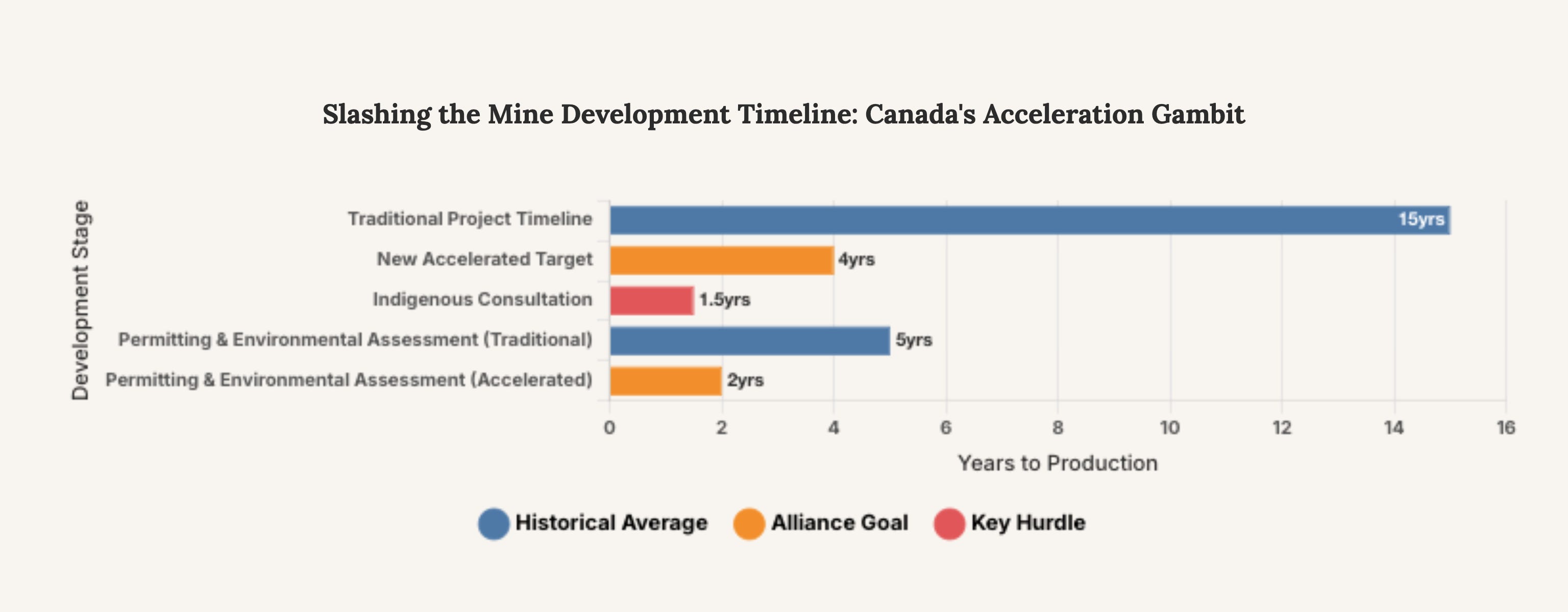
This chart illustrates the dramatic compression of project timelines Canada aims to achieve through its new Critical Minerals Production Alliance. The goal is to reduce the 15-year average to a 3-5 year sprint, though significant hurdles like Indigenous consultation remain fixed points in the process.
Sovereign Tools for a Geopolitical Fight
Recognizing that market forces alone cannot compete with a state-subsidized competitor, Ottawa is deploying a suite of sovereign tools. The government intends to leverage the Defence Production Act to designate certain minerals as national security priorities, allowing it to create strategic stockpiles. This policy serves a dual purpose: it guarantees a domestic buyer for nascent projects, providing revenue certainty, and it allows for the establishment of price floors, protecting Canadian producers from potential price manipulation by dominant market players like China. Furthermore, direct offtake agreements, such as those already signed with Nouveau Monde Graphite and Rio Tinto for scandium, signal a willingness to act as a foundational customer to catalyze project financing and development.
Deconstructing the Initial C$6.4 Billion Playbook: Priority Projects & Strategic Bets
The initial tranche of 26 projects announced under the Alliance reveals a highly focused strategy targeting specific vulnerabilities in the Western supply chain. The investments are not scattered broadly but are concentrated on minerals where China’s dominance is most acute and where Canada possesses high-grade, commercially viable deposits. The primary focus is on graphite, rare earth elements (REEs), and scandium, with Quebec and Ontario emerging as the key geographical hubs for this first phase.
The Graphite Imperative
Graphite is the largest component by weight in lithium-ion batteries, and China currently controls over 90% of the world’s refined graphite production. Breaking this stranglehold is a top priority. The flagship project is Nouveau Monde Graphite’s Matawinie mine in Quebec, which is set to become one of the largest fully integrated natural graphite production facilities in North America. The project has already secured a powerful consortium of buyers and partners, including offtake agreements with the Canadian government itself, Panasonic (Japan), and Traxys (Luxembourg), underscoring the international nature of the alliance.
Cracking the Rare Earth Code
Rare earth elements are notoriously difficult to extract and process, a sector where China’s global refining share is a staggering 91-92%. To counter this, Canada is backing several projects aimed at building a domestic REE processing ecosystem. Key investments include conditional federal funding of up to C$36.3 million for Ucore Rare Metals to scale up its processing facility in Kingston, Ontario, which will focus on elements like samarium and gadolinium used in magnets and nuclear reactors. Another significant move is the offtake and technology collaboration agreement between Torngat Metals and the French company Carester, aimed at developing the Strange Lake project in Quebec.
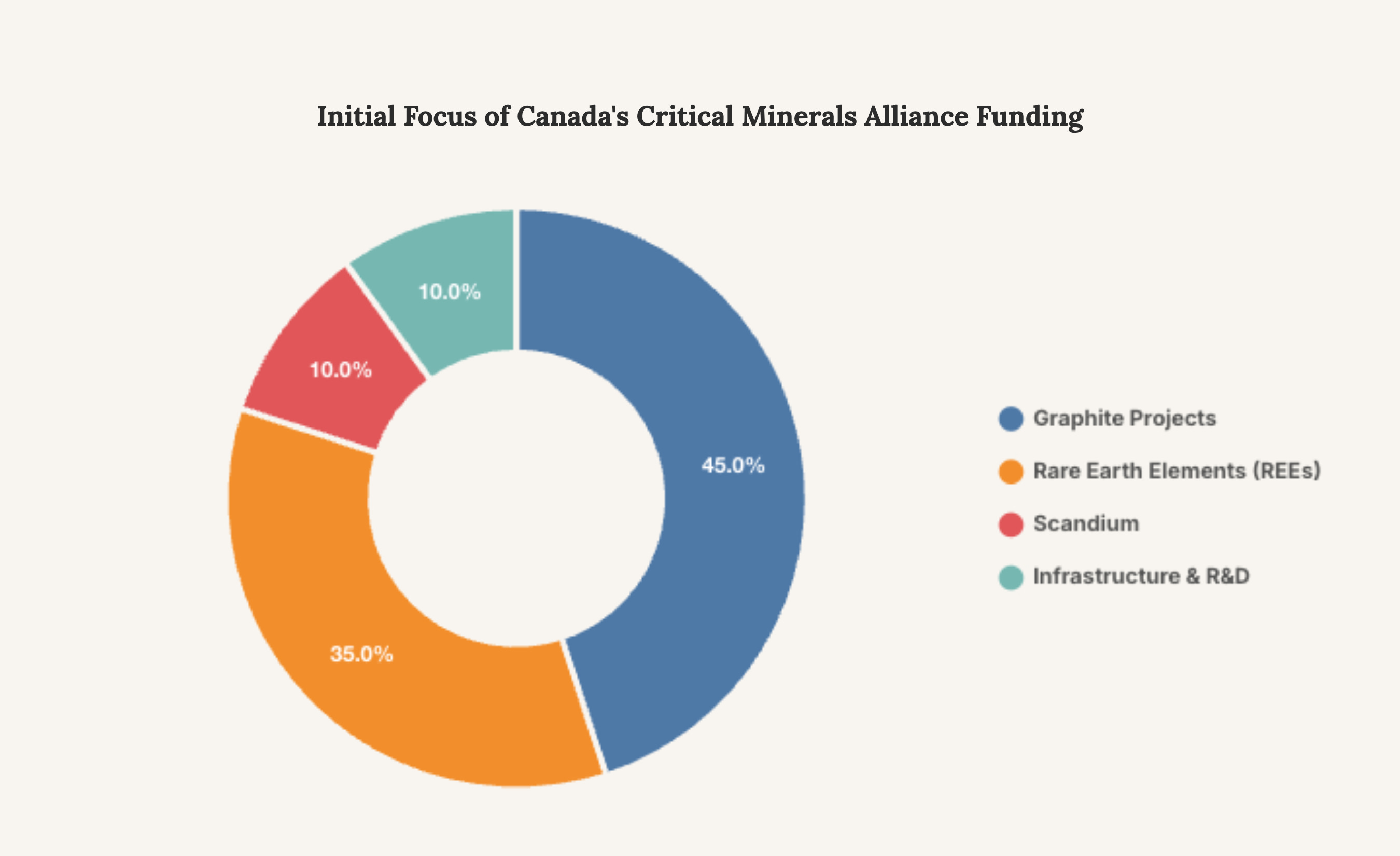
This chart provides a representative breakdown of the strategic focus for the initial C$6.4 billion in project funding. A significant portion is directed towards graphite and rare earth elements, minerals where Chinese market control is most pronounced.
The Geopolitical Fault Line: Countering China’s Mineral Weaponization
Canada’s strategy cannot be understood outside the context of escalating geopolitical competition with China. The policy is a direct reaction to Beijing’s demonstrated willingness to leverage its dominance in mineral processing for strategic ends. In recent months, China has tightened export limits on key minerals, sending a clear signal to G7 nations about their dependency. This economic statecraft has transformed critical minerals from a simple commodity issue into a pressing national security imperative.
“Every delay is a concession of economic and national security interests. We will no longer accept that.”
- Tim Hodgson, Canadian Minister of Energy and Natural Resources
The data paints a stark picture of this dependency. According to the International Energy Agency, China is the leading refiner of 19 out of 20 key strategic minerals, with an average market share of 70%. This control over the midstream—the crucial refining and processing stage—is China’s most powerful lever.
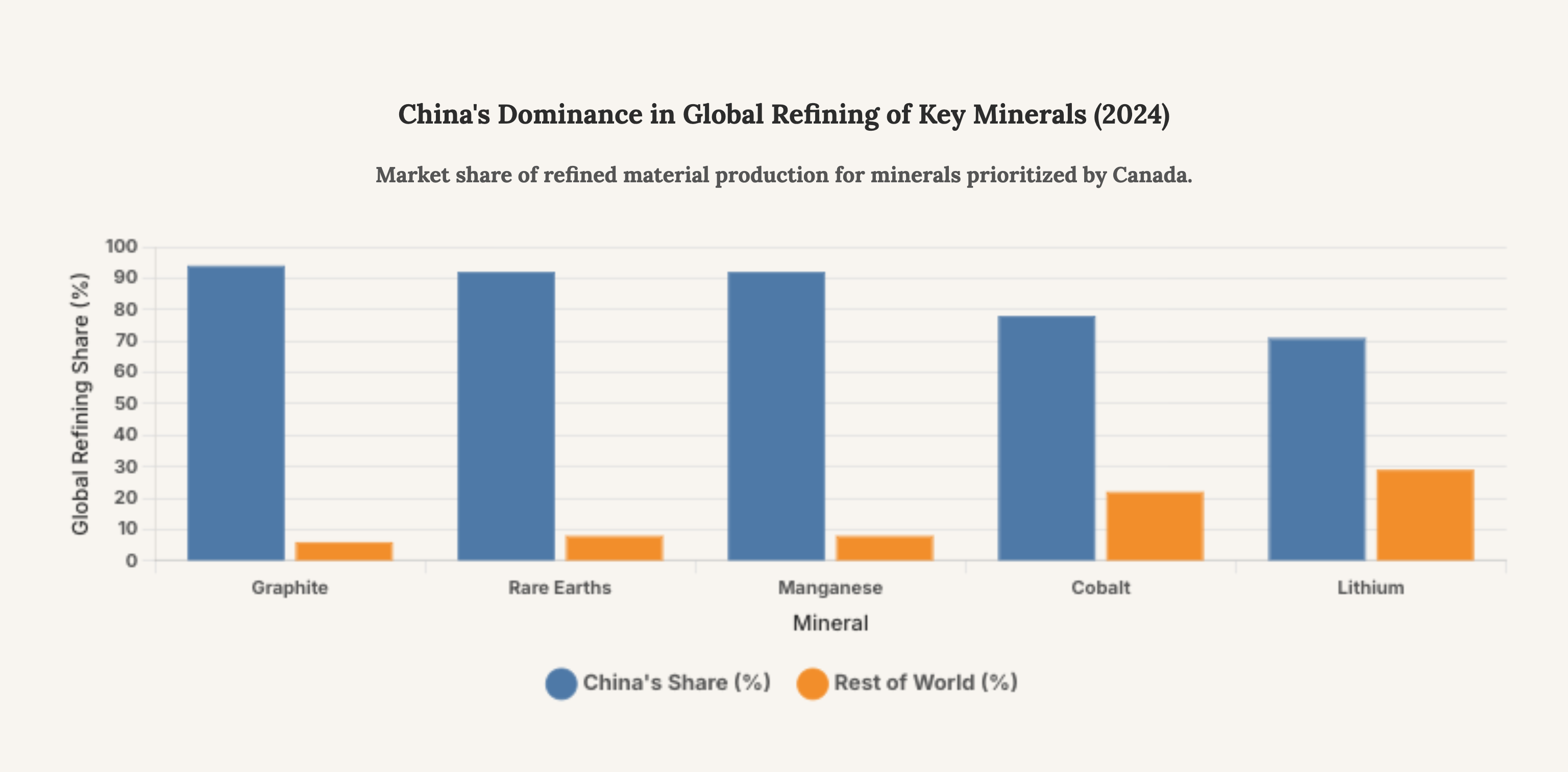
This chart, based on International Energy Agency data, visualizes the strategic vulnerability that is driving the G7’s actions and Canada’s new policy. China’s overwhelming control of the refining process for minerals like graphite and rare earths gives it immense geopolitical leverage.
The Execution Gauntlet: Overcoming Canada’s Domestic Hurdles
While the strategy is bold, its success is far from guaranteed. Canada faces significant domestic hurdles that could impede its ambition to become a critical minerals superpower. The government’s plan to streamline regulations is colliding with long-standing structural realities that will not be easily overcome.
Regulatory and Infrastructure Deficits
Despite the promise of fast-tracking, the intricate web of federal and provincial environmental regulations remains a formidable challenge. More critically, a KPMG survey of Canadian mining leaders revealed that 98% believe the sector requires significantly more government commitment and investment to be globally competitive. A major bottleneck is infrastructure. Many of Canada’s most promising deposits are located in remote northern regions with limited access to roads, rail, and affordable, clean energy. To address this, Ottawa has allocated C$1.5 billion to the Critical Minerals Infrastructure Fund (CMIF) to co-finance enabling projects like access roads and grid connectivity, but the scale of the need is vast.
Indigenous Partnerships: The Critical Path
In modern Canada, no major resource project can succeed without the meaningful consultation and partnership of Indigenous peoples. This process, while essential for reconciliation and ensuring local communities benefit from development, is also a significant factor in project timelines, often taking 12-18 months. The federal government has earmarked over C$100 million to support Indigenous participation and benefit-sharing in the natural resource sector, recognizing that securing these partnerships is not a bureaucratic checkbox but the critical path to project viability. Failure to establish robust, equitable agreements can lead to years of delays and legal challenges, a risk investors are keenly aware of.
“Some commodities where China dominates, you can’t get a project off the ground. We have projects across the country that can’t get financing because they’re seen to be too vulnerable. China can swoop in tomorrow, lower prices, and the project is dead on arrival.”
- Pierre Gratton, President of the Mining Association of Canada
Strategic Foresight: Signposts for Success by 2030
As Canada embarks on this ambitious path, industry leaders, investors, and policymakers must watch several key signposts to gauge its trajectory. The success of this multi-billion dollar gambit will hinge on translating strategic ambition into tangible production and market share. The stated goals are clear: achieve 70% domestic supply of certain critical materials, secure C$8 billion in annual offtake contracts, and establish 180-day strategic stockpiles for emergencies.
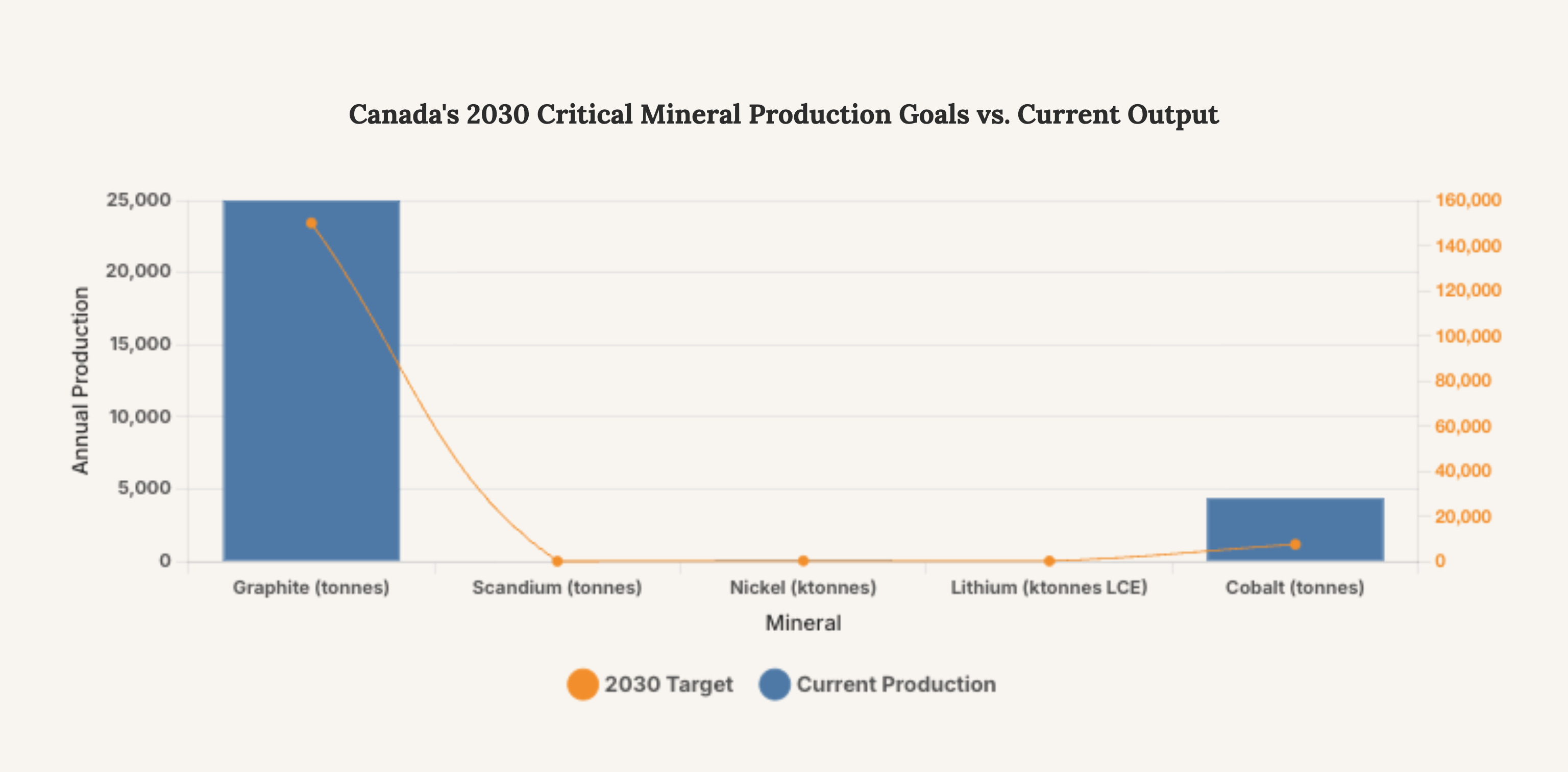
This chart highlights the scale of Canada’s ambition, comparing current or recent production levels with stated 2030 targets for key critical minerals. The leap from negligible to significant production in minerals like graphite and scandium illustrates the challenge and opportunity ahead.
The primary winners of this strategy will be the provinces with both the geological resources and the political will to streamline development, chiefly Quebec and Ontario initially. Companies with advanced-stage projects that align with the G7’s priority list—like Nouveau Monde Graphite and Ucore Rare Metals—are positioned for significant growth, backed by government offtakes and strategic funding. The losers will be projects focused on minerals not deemed strategic or those unable to navigate the complex ESG and Indigenous partnership requirements that are now central to securing investment. The ultimate risk remains geopolitical: a potential price war initiated by China to render these new Western projects economically unviable before they can achieve scale. Canada’s use of price floors and stockpiling is a direct insurance policy against this very threat.
Ultimately, Canada is attempting to execute a delicate maneuver: leveraging state intervention to build a market that can eventually stand on its own. The strategy’s success will not be measured merely in tonnes of ore, but in the creation of a resilient, non-aligned supply chain that provides a genuine alternative for Western nations. It is a long-term play for sovereignty in an increasingly fragmented world.
Canada is not just building mines; it is building a new form of geopolitical leverage, one mineral at a time.