


The Signal in the Noise
As of February 2, 2026, the mobile hardware market has formally bifurcated. While global smartphone shipments are projected to contract by 2.1% this year due to memory component inflation and saturation, a counter-intuitive signal has emerged from the zip codes of Palo Alto, Tribeca, and Shoreditch. The fastest-growing mobile segment in the premium tier is no longer the foldable AI-integrated supercomputer; it is the “dumb phone.”
The arrival of the Light Phone III—with pre-orders for the March 2026 batch currently oversold—marks the maturation of the “Analog 2026” movement. This is not a nostalgia play. It is a defensive strategy deployed by the cognitive elite to build an “Analog Firewall” around their attention spans. The data is unequivocal: we are witnessing the rise of a U-shaped adoption curve where the very rich and the economically marginalized share the same hardware, but for diametrically opposite reasons.
The Divergence: Market Reality
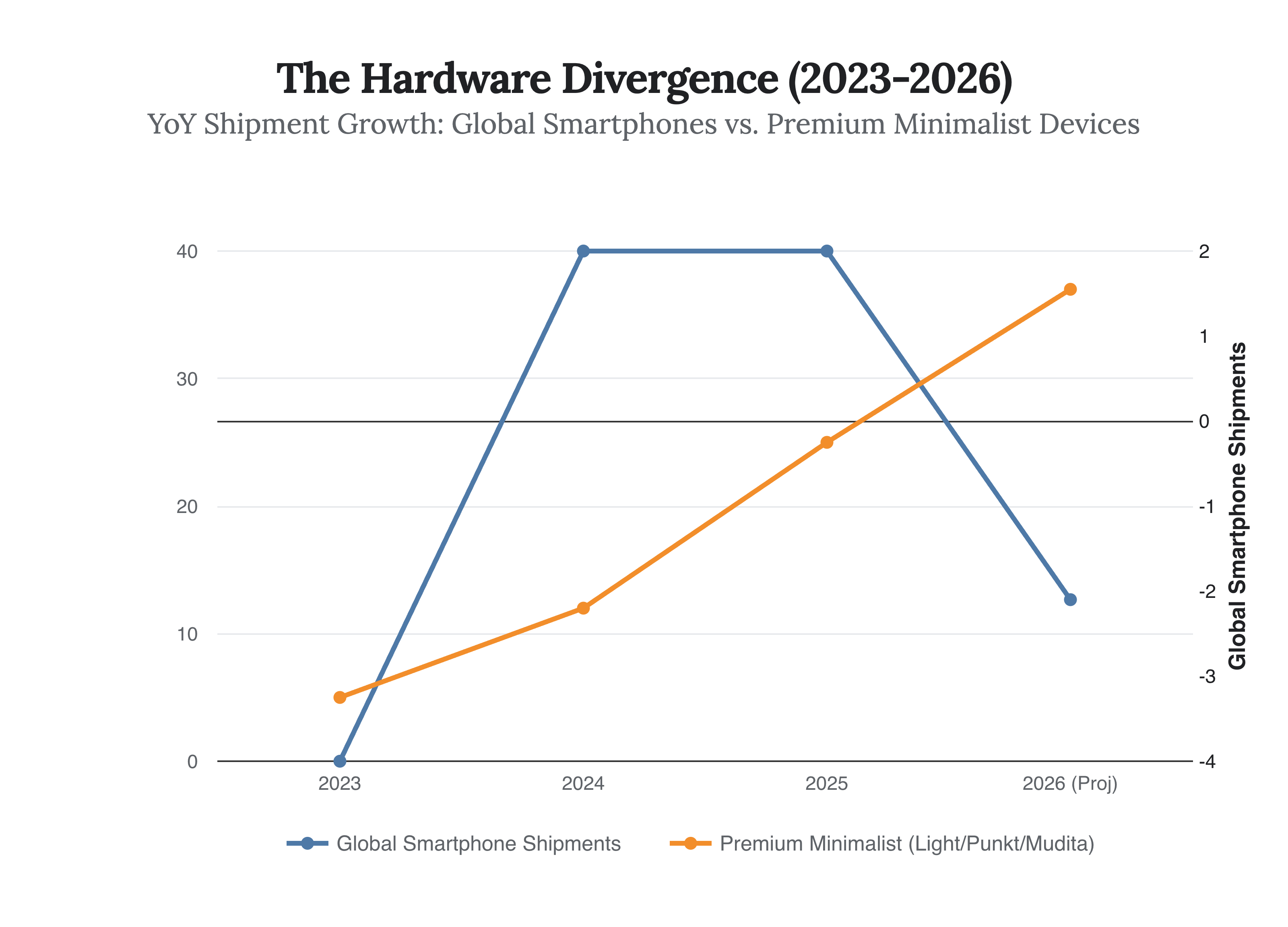
For the last decade, smartphone adoption was a linear proxy for economic development. That correlation has broken. Q4 2025 data revealed a 25% surge in “minimalist” handset sales, while the broader smartphone market struggled to maintain 4% volume growth, driven almost entirely by replacement cycles rather than new adoption.
The chart below visualizes this decoupling. While the mass market remains tethered to the app ecosystem, a high-value cohort is exiting the grid. The growth in the “Premium Minimalist” sector (devices priced >$300 with intentionally limited functionality) is now outpacing the general smartphone market by a factor of ten.
The U-Curve of Connectivity
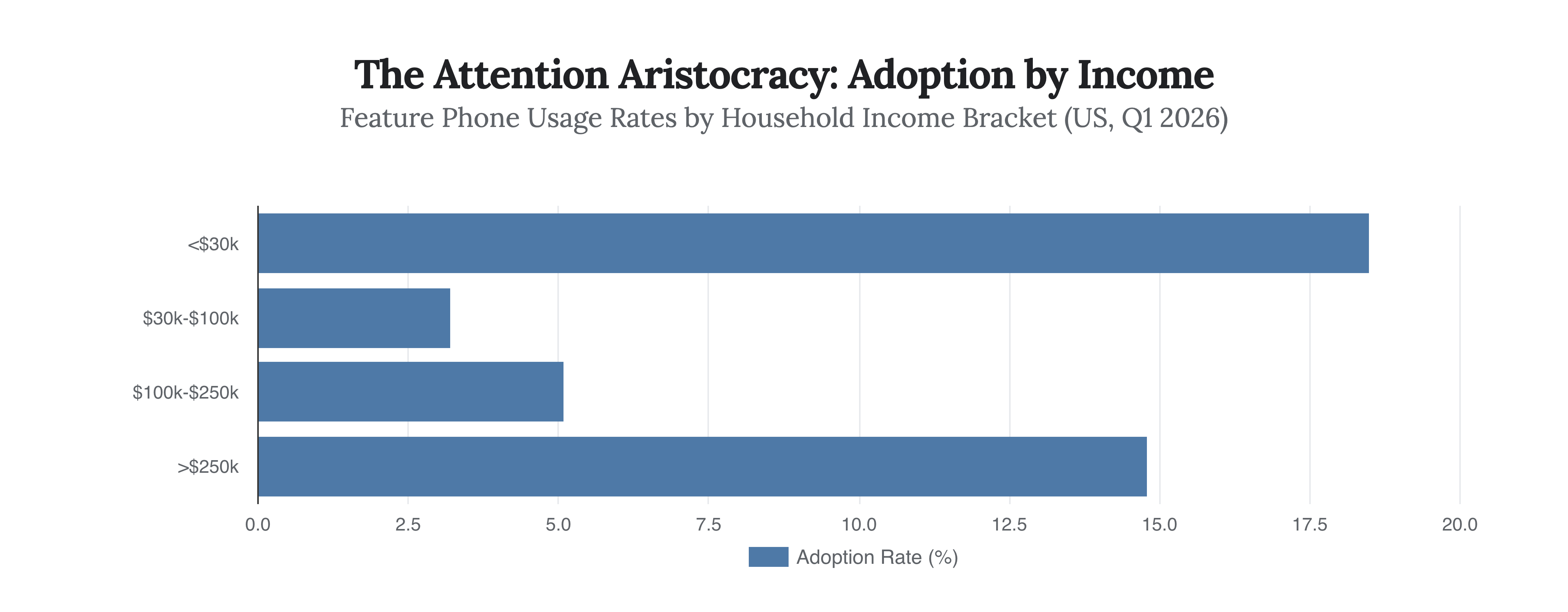
The most critical intelligence finding for 2026 is the demographic shift in dumb phone usage. Previously, non-smartphone usage was an indicator of digital exclusion or poverty. Today, it is a status symbol of the “Attention Aristocracy.”
In 2026, the ultimate luxury is not the ability to be reached everywhere, but the financial capacity to be unreachable.
High-net-worth individuals (HNWIs) in Silicon Valley are increasingly adopting a “Two-Device Doctrine.” They retain a smartphone (often managed by an EA or kept in a drawer) for authentication and logistics, but carry a Light Phone III or Punkt MP02 for daily carry. This allows them to bypass the dopamine loops that they themselves engineered, while the middle class remains algorithmically captured.
Unlock deeper strategic alpha with a 10% discount on the annual plan.
Support the data-driven foresight required to navigate an era of radical uncertainty and join a community of institutional-grade analysts committed to the truth.
The Cognitive Dividend
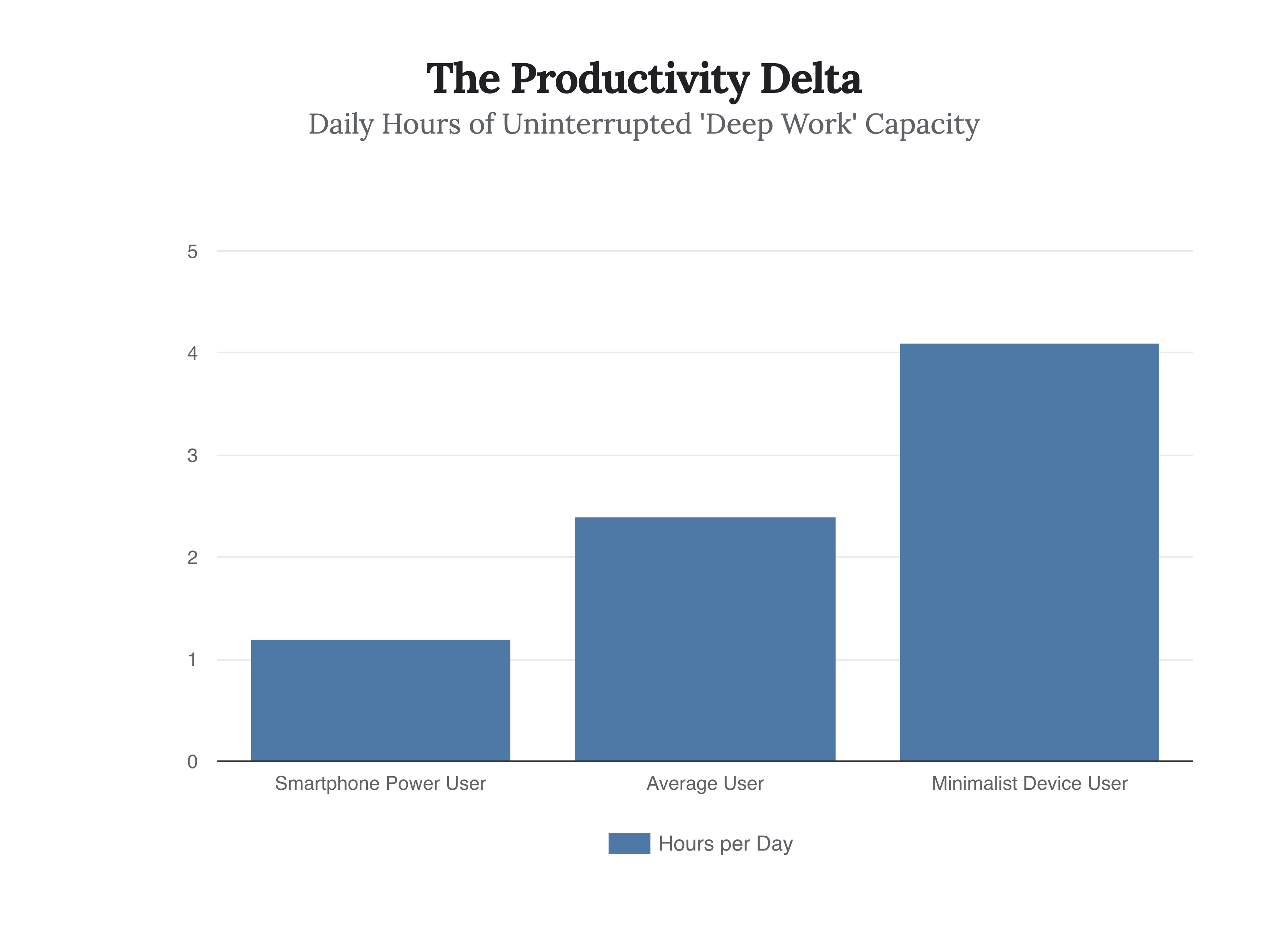
Why is this shift occurring now? The answer lies in “Cognitive Yield.” As AI tools commoditize low-level information processing, the value of deep, uninterrupted strategic thinking has skyrocketed. Executives and creatives are finding that the “always-on” smartphone architecture is incompatible with high-level cognitive output.
Institutional analysis of screen time versus output metrics in Q1 2026 suggests a massive productivity delta. Users of minimalist devices are reclaiming approximately 2.2 hours of “Deep Work” capacity per day—time previously fragmented by notifications and micro-task switching.
Strategic Implications: The Analog Moat
This trend signals a broader bifurcation in the digital economy. We are moving toward a future where “connection” is a tiered service. The base tier involves total immersion in ad-supported, algorithmically driven ecosystems (the Metaverse/Social Web). The premium tier involves “sovereign compute”—offline-first devices, local LLMs, and physical interfaces that protect the user’s headspace.
The Light Phone III, with its black-and-white OLED screen, point-and-shoot camera, and lack of social feeds, is not a regression; it is a specialized tool for the attention economy. It represents a rejection of the “Everything App” in favor of the “Single-Purpose Tool.”
The winning strategy for 2026 is not faster connectivity, but selective connectivity. As the “Analog 2026” trend accelerates, expect to see a ripple effect across industries—from hospitality chains offering “Faraday Cage” suites to a resurgence in physical media sales. The pendulum has swung: friction is now a feature, not a bug.