

7 Hours, 3 Minutes: How Aristotle’s Ethics Would Diagnose the Digital Habituation of the American Adult
The daily screen time of American adults is reshaping virtue and the pursuit of eudaimonia.

By 2025, American adults are projected to spend an average of 7 hours and 3 minutes daily engaging with digital screens. This figure, a significant increase from previous years, encompasses everything from smartphones and tablets to computers and televisions, creating an omnipresent digital landscape. This statistic, derived from aggregated trend analysis across various digital consumption reports, marks a profound shift in the daily rhythms and attentional economy of contemporary life. The sustained engagement with digital interfaces now constitutes the single largest allocation of conscious waking hours for the average adult. This pervasive digital presence is not merely a backdrop to modern existence; it is increasingly the primary medium through which individuals interact with information, commerce, and each other, fundamentally altering our relationship with time and reality.
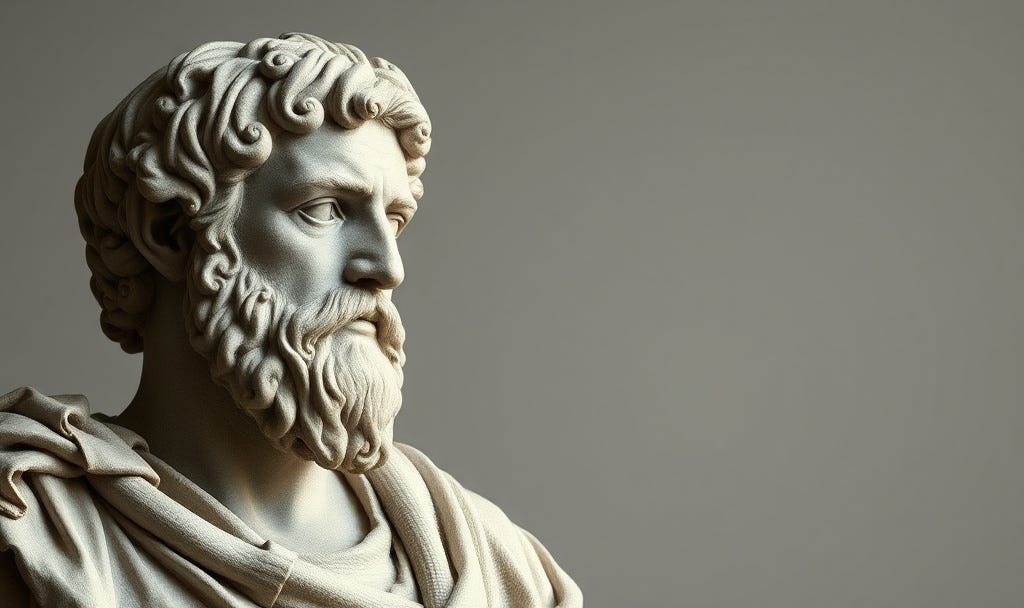
Aristotle’s Virtue: The Architecture of the Soul
Aristotle, in his seminal work Nicomachean Ethics, posits that virtue is not an innate characteristic but a cultivated disposition, a state of character formed through repeated actions. He distinguishes between intellectual virtues, which are gained through teaching, and moral virtues, which arise from habituation. As he states, “Virtue, then, being of two kinds, intellectual and moral, intellectual virtue in the main owes both its birth and its growth to teaching... while moral virtue comes about as a result of habit, whence also its name (ethike) is one that is formed by a slight variation from the word ethos (habit).” (Book II, 1103a17, W.D. Ross translation). This foundation suggests that our daily practices, the routines we embed into our lives, are not neutral; they are actively sculpting our moral fiber. The good life, or eudaimonia—often translated as flourishing or human well-being—is achieved not through sporadic good deeds, but through the consistent exercise of virtuous actions, making excellence a habit rather than an act.
Eudaimonia: The Goal of Flourishing
For Aristotle, eudaimonia is the highest human good, a state of living well and doing well, achieved through rational activity in accordance with virtue. It is a lifelong endeavor, a teleological pursuit where the ultimate purpose of human existence is realized. This flourishing is intrinsically linked to the development of virtuous habits. We become just by performing just acts, temperate by performing temperate acts, and courageous by performing courageous acts. The choices we make, the actions we repeat, gradually forge our character, leading us closer to or further from this state of flourishing. Eudaimonia is therefore an active process, demanding conscious engagement with one’s actions and the cultivation of a disposition towards the mean. This ancient framework presents a powerful lens through which to examine modern phenomena, particularly those that occupy significant portions of our daily lives and shape our habits.
The 7 hours and 3 minutes of daily screen time for American adults in 2025 represents a critical challenge to Aristotelian eudaimonia, and subscribers unlock our complete synthesis on cultivating virtue in this digitally saturated age.
Join a growing community of rational minds dedicated to applying ancient wisdom to the urgent questions of modern existence.

The Digital Forge: Habituation by Algorithm
The 7 hours and 3 minutes spent daily on screens represent a potent, perhaps unparalleled, force of habituation in the contemporary world. Unlike traditional forms of media consumption, digital platforms are designed to be interactive, responsive, and infinitely stimulating, constantly reinforcing engagement through algorithmic feedback loops. Each scroll, click, and notification is a micro-action that, when repeated millions of times, forms deeply entrenched cognitive and behavioral patterns. This continuous digital engagement functions as a modern ‘ethos’, a pervasive habit-forming environment that shapes our attention spans, emotional responses, and social interactions. The algorithms governing our digital experiences are not neutral; they are implicitly (and often explicitly) optimizing for engagement, which may or may not align with the cultivation of Aristotelian virtues. The sheer volume of time spent in these environments implies a profound impact on what kind of beings we are becoming, individually and collectively.
Screen Time and the Erosion of Virtue
Consider the Aristotelian virtues: courage, temperance, generosity, justice, prudence, and so on. How does spending over seven hours a day on screens influence their development? Prudence, or practical wisdom, requires careful deliberation and a clear perception of reality. Yet, digital environments often prioritize instant gratification, filter bubbles, and superficial interactions, potentially hindering deep reflection. Temperance, the virtue of moderation, is challenged by the endless availability of digital content and the addictive design of many platforms, making self-regulation difficult. While digital spaces can foster new forms of connection, they can also lead to social comparison, envy, and a diminished capacity for face-to-face empathy, impacting virtues like justice and friendliness. The constant stream of information and stimulation can cultivate a habit of distraction, undermining the sustained focus necessary for virtuous action and deep work. The very structure of digital interaction, built on rapid shifts in attention, may be antithetical to the steady, deliberate practice required for virtue.
The Diminished Polis: Eudaimonia in the Algorithmic Age
Aristotle believed that eudaimonia is best pursued within the context of the polis, the community, where citizens engage in shared deliberation and collective action. However, the digital sphere often replaces physical communal engagement with atomized, curated experiences. While offering vast access to information and distant connections, it can simultaneously fragment local communities and foster a sense of individual isolation amidst hyper-connectivity. The pursuit of external validation through metrics like ‘likes’ and ‘shares’ can displace intrinsic motivations for virtuous action, shifting the focus from genuine character development to performative self-presentation. If eudaimonia is flourishing through virtuous action within a supportive community, then an environment that prioritizes passive consumption and superficial interaction poses a direct challenge to its realization. The question then becomes: can the digital ethos be re-engineered to foster, rather than inhibit, the development of a flourishing life for the individual and the collective?
Reclaiming Intentionality in a Digital World
The pervasive nature of digital engagement demands a conscious re-evaluation of our daily habits, aligning them with the pursuit of virtue and eudaimonia. This is not a call for wholesale digital asceticism, but for intentionality. Readers might begin by auditing their own digital consumption, identifying patterns that detract from deep engagement, focused work, or genuine social connection. Implement ‘digital sabbaths’ or dedicated periods of disconnection to cultivate presence and deliberation. Prioritize activities that foster intellectual virtues like critical thinking and moral virtues like patience and empathy, recognizing that these require sustained effort and often quiet contemplation, both of which are scarce in the constant digital churn. Engage with digital tools as instruments for specific purposes, rather than allowing them to dictate the structure of one’s entire day. The Aristotelian framework compels us to ask not just what we are doing, but what kind of people we are becoming through these actions.