


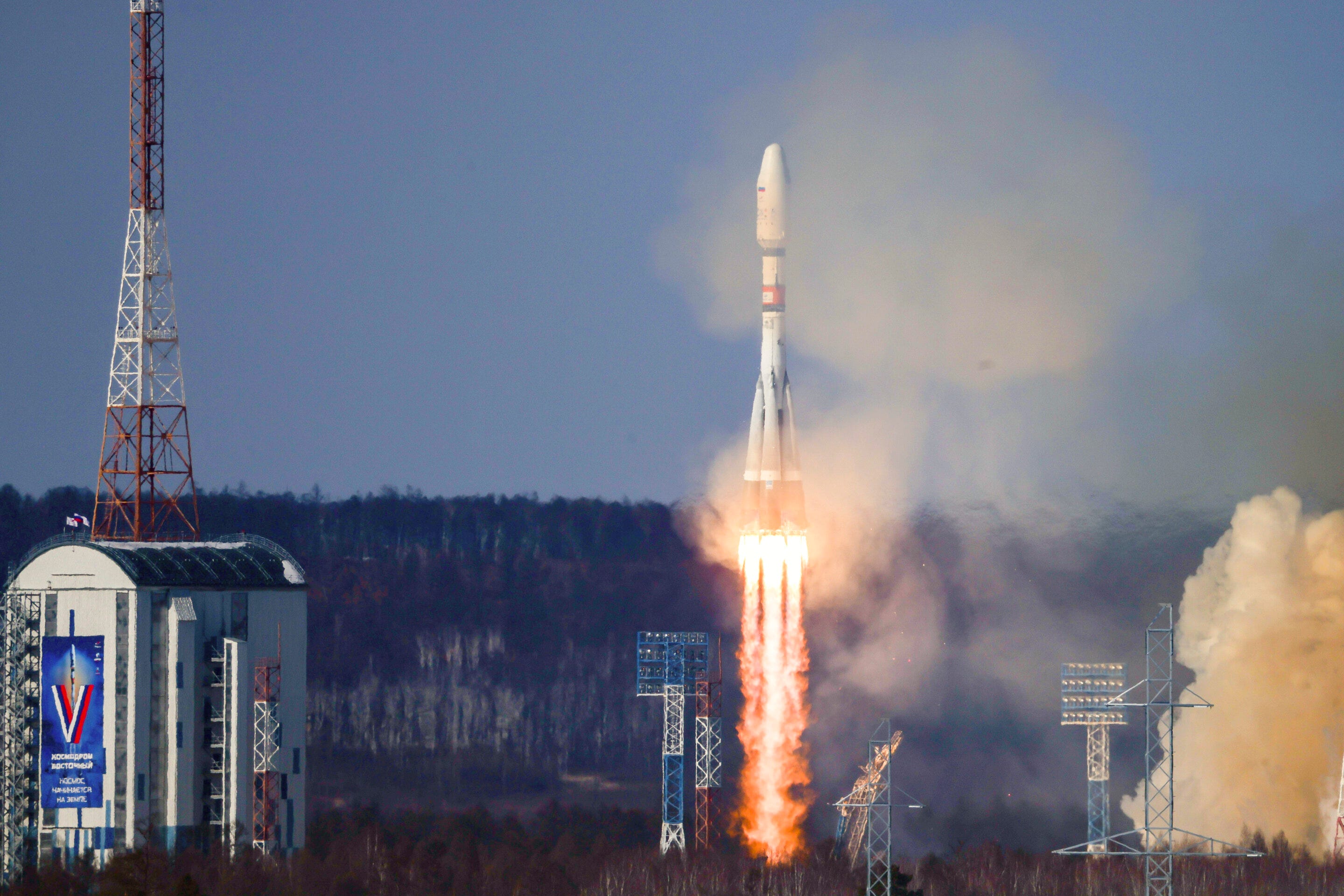
On November 5, 2024, at exactly 2:18 a.m. Moscow time, the frozen silence of the Amur Oblast was shattered by the roar of a Soyuz-2.1b rocket. Rising from Site 1S at the Vostochny Cosmodrome, the launch vehicle pierced the night sky, carrying not just a standard government payload, but a dense cluster of hardware that would set a new benchmark for Russia’s modern space program.
While the headline mission was the deployment of two Ionosfera-M satellites designed to monitor Earth’s ionosphere, the real story was hidden in the secondary payload. Packed inside the fairing were 53 smaller satellites, bringing the total count to 55 spacecraft. According to Glavkosmos, this simultaneous deployment of 51 domestic satellites (alongside international payloads) represents a record in the history of the Russian space industry. It marks a significant pivot toward “mass market” rideshare missions, a domain previously dominated by Western commercial giants.
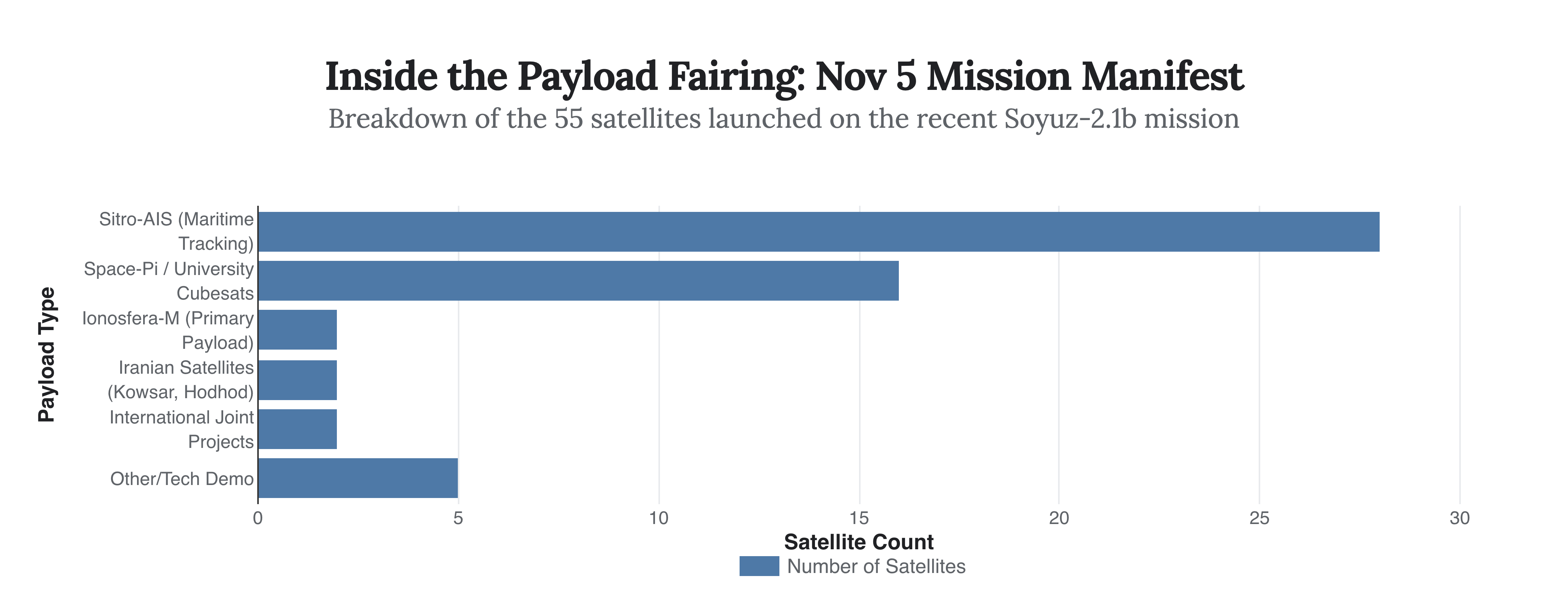
The manifest reveals a strategic prioritization of dual-use technology. The bulk of the cluster consisted of 28 Sitro-AIS satellites, designed for automatic identification system (AIS) maritime tracking—a critical capability for monitoring global shipping lanes. The inclusion of Iranian satellites, specifically the privately developed Kowsar and Hodhod, underscores the deepening technological cooperation between Moscow and Tehran despite ongoing international sanctions.
“The simultaneous launch of 51 Russian spacecraft became a record in the history of Russian cosmonautics.” — Glavkosmos Statement
This mission also highlights the maturing operational tempo of the Vostochny Cosmodrome. Located in the Russian Far East, Vostochny was built to reduce reliance on the Baikonur Cosmodrome in Kazakhstan. After a slow start plagued by construction delays and corruption scandals, the spaceport is finally finding its rhythm. The November 5th launch was the third from Vostochny in 2024, following the Angara A5 test in April and a Meteor-M weather satellite launch in February.
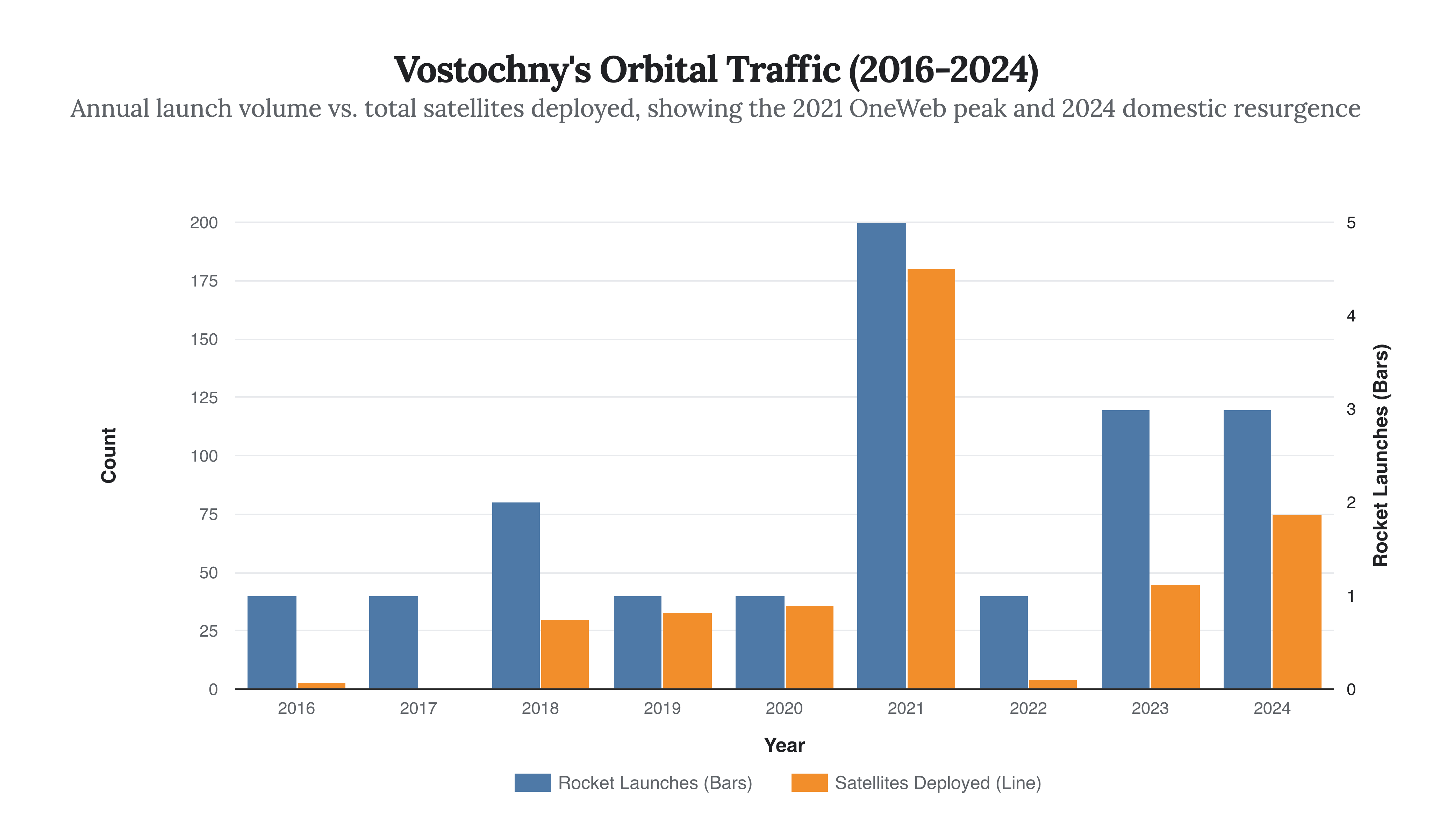
The data above illustrates a fascinating trend. The spike in 2021 was driven by the commercial OneWeb contract, which launched hundreds of satellites before the partnership collapsed due to geopolitical fallout in 2022. The sharp drop in 2022 reflects that severance. However, 2023 and 2024 show a resurgence, this time driven by domestic demand rather than foreign contracts. The 75 satellites launched from Vostochny in 2024 (including the 55 from this single mission) prove that Roscosmos is aggressively attempting to fill the void with homegrown constellations and friendly-nation partnerships.
“The Ionozond system will include four Ionosfera-M satellites... to monitor the space weather around Earth.” — Roscosmos Press Release
The primary payload, the Ionosfera-M duo, will operate at an altitude of 820 km, studying the Earth’s ionosphere to predict space weather that can disrupt communications—a mission with clear dual civilian and military applications. Two more satellites in this series are scheduled for 2025, suggesting that Vostochny’s schedule will remain busy.
While Vostochny has not yet replaced Baikonur as the workhorse of the Russian space program, the “swarm” launch of November 5th demonstrates a critical adaptation. Faced with isolation from Western markets, Russia is turning inward and Eastward, leveraging its heavy-lift Soyuz capabilities to deploy massive constellations of smaller, cheaper satellites. The era of the monolithic satellite is fading; the era of the orbital swarm has arrived in the Russian Far East.